


First Step Towards BNR: 108 Years Ago the First Constituent Charter Was Proclaimed
The proclamation of the BNR took place on March 9, 1918, and its independence on March 25, 1918.

On February 21, 1918, the First Constituent (i.e., Statutory) Charter of the BNR was proclaimed in Minsk.
First, a little historical context.
On February 18, 1918, after the failure of negotiations in Brest, the Germans began an offensive to the east, and on the night of February 19, the Bolsheviks fled from Minsk to Smolensk. From the underground emerged the Executive Committee of the Rada of the All-Belarusian Congress, and from prison – activists of the Central Belarusian Military Council.
The first German units entered Minsk on February 21; four days later the city was completely under their control.
Under these circumstances, the Executive Committee of the Rada of the All-Belarusian Congress appealed to the peoples of Belarus with the First Constituent Charter on February 21: "Our native land has found itself in a new difficult situation... We are facing the possibility that our country may be occupied by German troops."
The authors of the document noted that power in Belarus should be formed according to the will of the peoples inhabiting the land. This was to be achieved through democratic elections to the All-Belarusian Constituent Sejm.
The Charter was signed by Jazep Varonka, chairman of the People's Secretariat of Belarus, created a day earlier – a temporary executive body of people's power.
The secretariat also included Paluta Badunova, Tomaš Hryb, Kastuś Jezavitaŭ, Vasil Zacharka, Piotra Kračeŭski, Arkadź Smolič.
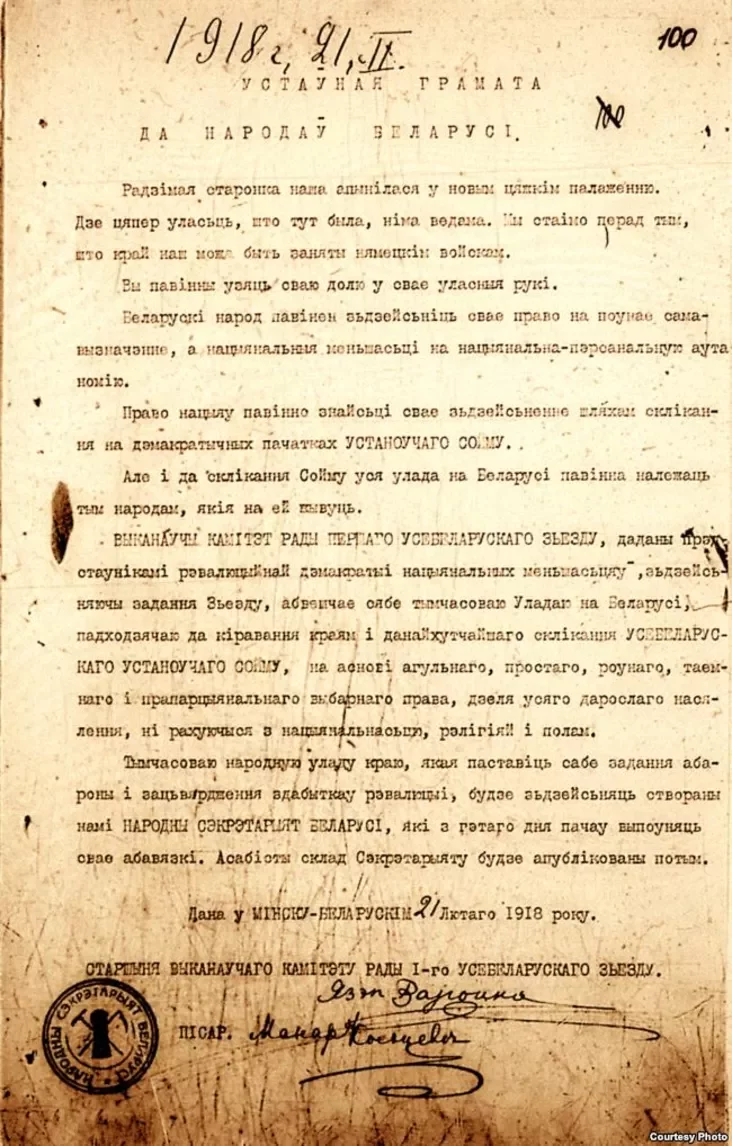
The text of the charter was posted all over Minsk. For the first time, it did not mention the need to remain part of Russia, but the question of the BNR was not yet touched upon.
The Germans did not recognize the creation of Belarusian authorities and occupied the seat of the People's Secretariat, expelled the government from there, removed the white-red-white flag from the building, confiscated financial resources, and never returned them. However, by the end of February, the activity of the People's Secretariat was allowed within the framework of Belarusian national representation.
In early March, the international situation changed again.
On March 3, the Germans and Bolsheviks concluded a treaty, leaving the western and north-western parts of Belarus to the Germans, the Bolsheviks were to receive central and eastern Belarus, and the Ukrainian People's Republic claimed the southern lands. The Germans also promised the Bolsheviks not to recognize any states in the occupied territories that declared their independence after March 3, 1918.
Under such circumstances, on March 9, the People's Secretariat published the Second Constituent Charter, proclaiming the Belarusian People's Republic within the boundaries of the settlement of the Belarusian people.
The Rada of the All-Belarusian Congress temporarily assumed legislative power in the BNR. Rights and freedoms of citizens and peoples of Belarus were proclaimed: freedom of speech, press, assembly, strikes; freedom of conscience, equality of all languages. Private land ownership was abolished, and an 8-hour working day was established.
On March 18, the Rada of the All-Belarusian Congress was renamed the Rada of the BNR.
On March 25, in German-occupied Minsk, the Third Constituent Charter was proclaimed, symbolically declaring the independence of the BNR, severing "all ties with Russia," and protesting against the terms of the Brest-Litovsk Peace Treaty.
The Germans dispersed the Rada of the BNR, but from the end of March allowed it to operate within the framework of national representation and to oversee national education, culture, and social life.
In parallel, Belarusian forces among the Bolsheviks became more active, and preparations for the proclamation of the BSSR began.
-
An antique book from a Belarusian parish is being sold for 700 euros at a Polish auction. How can such exhibits be exported abroad?
-
The book "Belarusians in Latvia (1918—1945)" has been published
-
The famous portrait of Kahanets turned out to be a Soviet fake, but the only photo of archaeologist Tatur was found. Photo mysteries of the Belarusian Museum in Vilnius solved.














Sputnik journalist addresses Lukashenka: her son entered the Higher School of Economics in Moscow, but a criminal case was opened against him back home









Comments
немцы былі розныя, Беларускай стратэгіі ў іх не было, былі агульныя напрамкі, Палякаў яны таксама разагналі , гісторыя БНР гераічная і складаная, акупацыя Беларусі Масквой і Польшчай не гарантаванае. Мы мелі, і маем сусветнае права на нашым баку, Чатырнаццаць пунктаў Вільсана напрыклад. Імперыялістычныя Маскавіты Бальшавікі і Палякі нажаль перамаглі ў 20х перарабіўшы БНФ ў свае калоніі. Алеж не на доўга ў 1991 мы адрадзілі БНР
___
" Беларусі павінна фармавацца згодна з воляй народаў, якія насяляюць край. Гэта мусіла ажыццявіцца шляхам дэмакратычных выбараў ва Усебеларускі ўстаноўчы сойм."