


Sviatlana Kurs: I am an absolute pessimist, but life keeps throwing happy endings my way
On the occasion of the release of the novel "Why do you go, wolf?" in Lithuanian and the arrival of writer Eva Veznavets (Sviatlana Kurs) at the Vilnius Book Fair, the Lithuanian publication 15min.lt spoke with her about Belarus, Lithuania, connection with readers in emigration, longing for home, and the happy ending, which, according to the writer, is already around the corner.

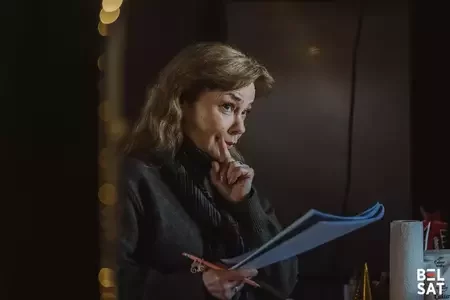
Sviatlana Kurs (Eva Veznavets). Photo: KANAPLEV+LEIDIK
— The first edition of your novel in Belarusian was published in 2020 in Vilnius. This is very interesting and even unexpected. Tell us how it happened.
— My novel was published by the Belarusian publishing house "Pflaumbaum," initiated by Nobel laureate Sviatlana Alexievich. If I remember correctly, "Why do you go, wolf?" was the first book from this publishing house. The novel has now had four print runs. For all this, I am endlessly grateful to the publisher, a true book-bearer of our times, Raman Tsimberau. He cared for the publication of Belarusian books and also delivered foreign books by various means to Belarus, which is ruled by a pro-Russian regime. This was his sacred mission. Unfortunately, a few weeks ago, he suddenly died at the age of 44. This is a huge loss for Belarusian book publishing and culture in general.
The need to create such a publishing house outside Belarus arose as a reaction to the constantly deteriorating political situation in the country. The regime's grip tightened, especially after the falsified presidential elections of 2020 and the subsequent protests of civil society, which were brutally and mercilessly suppressed. Therefore, establishing a publishing house in Vilnius was a quite natural and logical decision.
Personally, this is also very important to me. I endlessly love Vilnius — it's a magical city. And from a historical Belarusian perspective, Vilnius is inseparable from our culture. It was here in 1906 that the first Belarusian newspaper "Nasha Dolya" began to be published, and here the figures of Belarusian independence, brothers Ivan and Anton Lutskievich, were actively involved, etc.
The phonetics of the Lithuanian language are extremely close to me — it reminds me of something long forgotten and very dear. Given these and many other historical and personal connections, I am happy that my novel in Belarusian was published precisely in Vilnius. And also, that it is now published in Lithuanian. I felt a sentiment for the Lithuanian language and culture.
On Thursday, February 26, in Vilnius, within the framework of the Vilnius Book Fair, the largest in the Baltic countries, there will be a meeting with writer Sviatlana Kurs (Eva Veznavets) and a presentation of the Lithuanian translation of her book "Why do you go, wolf?".
The event starts: 16:00 Vilnius time. Venue: LITEXPO, Laisvės pr. 5, Vilnius. Admission to the book fair is paid (12 euros).
In addition to the author, literary critic Virginija Kulvinskaitė-Cibarauskė and Jurgita Jasponytė-Burakienė, the translator of "Why do you go, wolf?" into Lithuanian, will take part in the event.
There will be simultaneous translation.
Also in the program — an autograph session, which will start at 17:00 at the "Pflaumbaum" publishing house stand — 5.A10.
— Do your books reach Belarus?
— Belarusian books and culture are under enormous pressure from the regime. However, my books are not banned; they can even be purchased in state bookstores. This is why I feel quite contradictory emotions: I hate this government with all my soul, and at the same time, I feel gratitude that my books are not touched and can find their readers. On the other hand, because of this, I feel ashamed before other writers included in the lists of "extremists," "terrorists," and "foreign agents" — their books are banned in Belarus. My novels are available, although no one talks about them publicly. Well, thank God for that.
True, there was also a certain curiosity. A Russian-speaking Belarusian "writer" wrote a novel whose plot is exactly the same as my "Why do you go, wolf?", but the idea is completely different. Here, a woman returns to her native Belarus after emigration, refuses to have an abortion, and begins to work for the benefit of the entire country under the red and green flag. This novel is written in Russian, it lacks any Belarusian realities, and, as someone whispered to me, no one wanted to translate it into Belarusian. Then the book was translated with the help of a translation program. I got my hands on a few excerpts of this text — it's complete graphomania and nothing more. Even our police-writer Mikalai Charhinets looks like a titan of thought compared to this "writer."
However, as far as I've heard, this woman is a talented knitter, and her garden is very beautifully arranged... I respect people who can do something with their own hands.
— You have been living in Poland for two decades now. What is the relationship of a writer living in emigration with her readers, when part of the community remains in the homeland, and another is scattered across different corners of the world?
— I haven't lived in Belarus for twenty years, but my departure was not connected with repression. I have been participating in the Belarusian national movement since 1990 and each time deeply experienced our uprisings and the subsequent reprisals by the authorities. In 2006, I was invited to Warsaw to work for European Radio, which then broadcast programs for Belarus. I went for two weeks, and stayed for twenty years.
The last time I was in Belarus was in November 2019, so it's been seven years since I saw my parents. This is endlessly painful for me. But it's also a big problem for me as a writer, because to create something, you need to experience Belarusian realities: to see how people live, what they think, what they feel. I would like to see those new people who were born and grew up in the country during the time I haven't lived there. I don't have this, and I miss it very much.
But I don't have problems with readers. Although they can't "like" my posts on social media, they often come to Warsaw, where I gladly meet them. When I fell ill, I received many heartfelt wishes from all over Belarus. For example, I recently received a jar of sauerkraut from one reader, made according to an old Belarusian recipe. It's incredibly delicious. Just like salo (cured pork fat), which I also love very much.
By the way, at the Warsaw market where I shop, there are also Lithuanian traders, so I often buy salo, black bread, and everything else from them. It seems to me that Lithuanian and Belarusian gastronomic tastes are very similar, so, wanting to feel closer to home, I also eat Lithuanian products. Excuse me, I strayed a bit from the topic, dreaming about salo (laughs). When I'm in Vilnius, I'll definitely buy some.
Well, returning to my readers, they often come to Warsaw from Belarus with my books, and I sign them, we walk the streets and talk. This always moves me tremendously.
— This, by the way, is also one of the themes of your novel. The main character, Ryna, returns to her native village after eight years of emigration to bury her grandmother. You finished writing the novel in 2018, and two years later, huge changes occurred in Belarus: falsified elections, a wave of protests, and repression. After this, between 300,000 and 600,000 Belarusians left Belarus and cannot return today. Do you agree that in this sense, your novel is a kind of myth of return?
— Yes, Ryna returns, but many Belarusians today cannot return to their country, because repression, imprisonment, abuse, intimidation, etc., would await them there. It is difficult for others to believe the conditions in which Belarusians live today on their native land. Practically, it is a Nazi concentration camp, only in Belarus people are not shot and burned alive. However, in daily life, Belarusians suffer torture by hunger, cold, they are raped, driven to death, humiliated, and denied medical treatment. For example, the situation of cancer patients is simply horrific.
I myself cannot return to Belarus because at one time I participated in various civic initiatives whose participants are now declared "extremists." I haven't checked if my name is on those lists, but it is likely that criminal liability also hangs over my head... I cannot return also because I have cancer. So if I returned, I would probably be tortured in prison.
So for now, the return of prodigal sons and daughters to Belarus is indeed a myth and a legend. Many of us dream of how we would return and arrange life in our homeland so that Belarus becomes a normal European state. I am convinced that most Belarusians are ready for this. The only trouble is with the Russian stooge in Belarus and, of course, local fools, aggressors, sadists — there are enough of them everywhere. Especially at this time, an unusually large number of such characters have proliferated.

Cover of the Lithuanian-language edition of the book "Why do you go, wolf?"
— Does the action of the novel take place in your native Lyuban district? Does this mean that, at least in part, this work is autobiographical?
— Yes, this is my native land, I know it better than other parts of Belarus. How autobiographical is this novel? Well, maybe about 20-40%. Honestly, I don't have enough imagination to create and invent everything. I have ADHD (attention deficit hyperactivity disorder), so I cannot understand what other people feel, fully empathize with their experiences. Therefore, when writing, I mostly rely on my own experience and feelings. Precisely for this reason, I cannot become a great writer, creating about other people: from poor Yorick to King Lear. To write something, I must feel it on my own skin. But how much can one write about oneself — in youth, it might be interesting, but eventually, it gets boring, and you start repeating yourself.
So what's left for me? To copy from others. That's why, in addition to my humble biography, the novel contains many other sources — these are archives, Belarusian, Ukrainian, and Polish press from various times, my ethnographic trips, memories, and experiences of Belarusian grandmothers. I can very accurately say where this or that episode, experience, or historical fact came from in the novel.
— In one interview, you said that you did not invent anything in this work. And this is very unexpected, because the text itself — both because of its ancient language and because of the plot and various details — resembles magical realism or a fairy tale. Here there is a healing spring, moving stones, magical herbs, spells are active, wolves constantly appear, etc. It seems that people here simply live in a mythological world.
— Yes, such is this reality. In childhood, village whisperers saved me from death. At that time, I had something similar to childhood epilepsy — I would fall on my back, roll my eyes, and lie like dead in some lethargic sleep. When doctors refused to treat me, local grandmothers took over. And I survived. I remember all these miracles from childhood perfectly, although I cannot explain them in any way. But it really happened, I did not invent them.
Therefore, I look at this world with great respect and do not want to impose anything on anyone. By the way, I recently found out that the younger brother of my publisher from Austria was cured in the same way many years ago. It turned out that in the Alps there were also once whisperers, healers, just like in our "wild" Belarus or "wild" Poland. I have no doubt that "wild" Lithuania is also full of such miracles.
The same goes for moving stones, healing springs, impassable swamps — they truly exist. And this is a common experience for all humankind — it is enough to open and read fairy tales from different countries of the world. Wherever you point your finger on the map — except perhaps Antarctica — those folk traditions, legends, and experiences are quite similar everywhere.
People seek answers to the question of who they are, what is the meaning of this life. And sometimes, striving to alleviate this existence, they use magic, natural wonders. This is a universal story. I am an agnostic who believes in a mystical world. It's just not given to us to see and comprehend it here, on this earth. And, frankly, it's none of our business. When we die — then we'll find out.
— Your novel can be called a historical epic — through the life of old Darofeya, more than a century of Belarusian history is told: two wars, nine changes of power. Can it be said that this is, first and foremost, a novel about memory and an attempt to restore the history of people, and along with it, the entire country, which was censored and altered by various authorities?
— For two centuries, the history of Belarus was not only censored but destroyed. Even in Soviet school, we were taught that Belarusians didn't exist at all, and in these marshy places lived some degenerates with tangled hair. And then in 1917, good Bolshevik-Russians came here and made normal people out of us. So for a whole century, we were told nothing about our heroes or our victims.
This small book is not only a "swamp fairy tale," as I defined its genre, but also a summary of the strange and horrific 20th century. It is a concise and laconic account of Belarusian history: it is enough to read the summary formula, and the whole narrative should come alive in one's mind. This is my way of restoring collective memories, told by previous generations of village grandmothers.
Therefore, this novel, as you rightly noted, is first and foremost about memory. It is truly horrific to lose memory, because then it's as if you never lived at all. You don't remember your ancestors, your childhood, or how the sun shone through the window of your native home. That is why people are so afraid of dementia, afraid of losing their memory. This is already spoken of in ancient myths, in which gods punish people not only by taking away their reason but also their memories.
— But at the same time, it is also a novel about the resilience of people, the ability to survive in extremely dramatic, tragic conditions.
— In Belarus, there's a saying, "you won't go into the ground alive." It's about people's ability to survive even in the hardest times. I recently heard a Polish song that has the line, "new children will be born to us." I wondered, why are these children "new"? And then I understood: the old children were burned alive during the war. God, I couldn't even think about new children if I had lost the previous ones. Because if that happened, I would be a dead person inside.
However, even after the most horrific stories, after wars, terror, murders, new children were born to people. When my grandfather returned home and saw that his entire family, all his children except one daughter, were killed, he married a second time, and he had four more children. What is this? Pride? Dignity? No, it seems to me, it's something from the depths, from much older times. And much stronger. It's from nature itself, in which cruelty and renewal coexist.
Look, grass grows on a daily human path: even though it's constantly trampled, it still grows back. What's the point of this, because it will be trampled again? However, in this seemingly meaningless regrowth lies the essence of life itself, its strength and resilience.
— In your novel, wolves appear many times. What do they symbolize?
— They say that the wolf is a Belarusian totem. They are considered loyal and endlessly hardy animals. Wolves have always evoked dual feelings in people — fear and admiration simultaneously. Because when wolves are hungry, they can attack domestic animals, and later even people.
In various regions of Belarus, there are legends about man-eating wolves who killed people after World War II. Even military units were sent to hunt them down — such stories I heard from people who lived during those times. However, wolves are respected and kept at a safe distance not only by Belarusians. Stories about these impressive animals exist in the fairy tales of many peoples around the world.
Ultimately, the wolf symbolizes boundless freedom and the impulse towards it. Because a tamed wolf is no longer a wolf. This understanding, this symbolism, it seems to me, is common to all people. For the title of the novel, I used the Belarusian proverb "Why do you go, wolf?". And the wolf answers: "I will take all that is yours." In this sense, it also symbolizes death.
While we are calmly here, going about our daily business, we don't even notice that a wolf is already lurking outside the window. And he was always there. Here we can again return to human stoicism — to live knowing that sooner or later it will end... Isn't that a miracle?
— Are there any parallels between the wolf and the authorities?
— Absolutely. Authority also comes and takes everything — the Belarusian people have felt this more than once. You, Lithuanians, are also well familiar with this experience. Frankly, authority is even worse than wolves: because you can hide from a wolf, but even the most distant swamps do not save you from authority. Authority, once it comes, will not only take everything, it will strip a person of seven skins.
— The renowned Lithuanian psychologist Danutė Gailienė wrote a book "What They Did to Us". In it, she speaks about the traumas left in society by decades of occupations, exiles, repressions, murders, and violence. According to the psychologist, one consequence of historical traumas is various forms of self-destruction, especially through alcohol. Is this why so many people drink and die from alcohol in your novel?
— Traumas that we do not acknowledge, do not name, stay with us, accumulate and pile up. A Jewish psychologist once claimed that the trauma of the Holocaust can only disappear in the fourth generation. Before that, it only grows, passing from generation to generation. Of course, Jews cope with their trauma, they learn to live. Especially important here is that they have their own state. Now they are no longer victims, but defenders of their state, their land, their people. Of course, everything connected with Gaza is already another trauma for them.
Belarusian historical traumas have not gone anywhere for more than two hundred years — they haunt us and accumulate from the very first occupation. I myself remember well the trauma I received in the early nineties: we gained freedom, and three and a half years later, we were shoved back into the same den. Some people cannot bear this and turn to drink. The problem of alcoholism in Belarus is gigantic. Unfortunately, the degradation that the "Russian world" brought to Belarus continues today.
You know, when I came to Poland two decades ago, the generation that lived in the occupied country also drank a lot. Artists, intellectuals drank. They even said that only fools don't drink. But now times have changed. Younger generations don't have this trauma, so they don't drink out of despair or because they cannot realize themselves. True, they have other temptations, say, marijuana, but these are already slightly different matters, a different culture and way of life.
You, Lithuanians, have freed yourselves from this — I am extremely happy for your people. Well, we, Belarusians, have not been so lucky in this regard.
— To a significant extent, the history of Belarus in your novel is described as a tragedy. But can this "swamp fairy tale" have a happy ending? Do you believe that evil, as it should in a fairy tale, will be defeated?
— It does end happily. Frankly, I am an absolute pessimist, but life keeps throwing happy endings my way. And now, although I don't believe it myself yet, analyzing various information that reaches me, I intuitively feel that changes are brewing in our region, a brighter time is approaching.
I believe that these, in the words of historian Timothy Snyder, "bloodlands" will rise from the ashes after a century of siege, and growth and prosperity await us. We have waited so many years for foreign boots to stop trampling us...
I believe that with time we will again look each other in the eye and discover the joy of true neighborhood. I don't know if I myself will have the happiness to see this with my own eyes, but I have no doubt that many in this European region will live to see a bright time.






















Comments