


Polish diplomat told how he brought cartoons on discs for Kolya and who Makei was for the Lukashenka family
«Lukashenka understands that he cannot approach the rostrum and address the people, holding a child in his arms. So he turns back. Behind him stand the prime minister, ministers, the head of the KGB, the chief of the General Staff. And he leads this child, takes him by the hand, and places Kolya's hand into Makei's hand.»
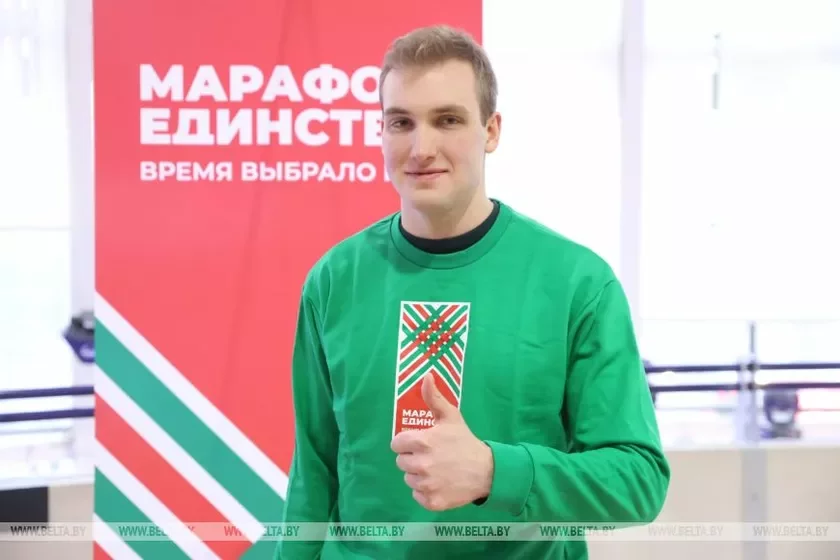
Kolya Lukashenka. Photo: BelTA
Former Chargé d'affaires of Poland in Belarus Witold Jurasz, in an interview with the YouTube channel Kulisy Spraw, recalled several interesting episodes related to Lukashenka's youngest son.
Witold Jurasz began working at the Polish Embassy in Belarus in 2010 as the head of the political department. From April of that year to February 2011, he led the mission as Chargé d'affaires ad interim. After leaving diplomatic service, Jurasz moved into journalism.
"Uncle" Makei
In the interview, Jurasz mentions that before his departure to Minsk, he was told that Vladimir Makei's political career was over, but his own observations indicated otherwise. According to him, Makei, who held the position of Head of the Presidential Administration, was the second most powerful person in the state.
«This was a rather rare moment, because Lukashenka's political talent then (because today I believe he has lost the talents he once had) consisted in the fact that there was never a number two in the regime. He always made sure there was no potential successor. But that moment was an exception. There was such a person — Vladimir Makei.»
To explain why he had such an impression, the former diplomat recalled one episode:
«A wreath-laying ceremony is taking place near the monument on the occasion of the liberation of Minsk. Lukashenka walks to the rostrum to give a speech. Next to him stands Kolya, his son, who was then five or six years old.
And he walks with him. Then [Lukashenka] realizes that he cannot approach the rostrum and address the people, holding a child in his arms. So he turns back. Behind him stand the prime minister, ministers, the head of the KGB, the chief of the General Staff. And he leads this child, takes him by the hand, and places Kolya's hand into Makei's hand.»
According to Jurasz, upon seeing this, he no longer listened to Lukashenka's speech. His attention was focused on Kolya's behavior.
«He stood nearby, crept under his jacket, pulled at him. Makei bent down, stroked his head. It looked as if he was quietly saying: «Quiet, quiet, not now, because dad is speaking.»
And I understood that this child perceived Makei as an uncle. He felt safe with him.
And I then wrote in a note — no, Makei is not on the verge of dismissal. It is not possible for a dictator to entrust a four- or five-year-old child to a person who is already leaving the system and with whom this child feels free. And he is such a close uncle to him.»
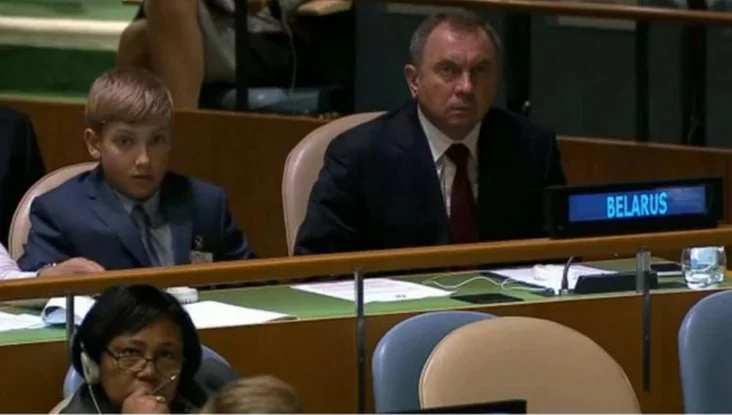
Kolya Lukashenka with Vladimir Makei at a session of the UN General Assembly.
Cartoons for Kolya
The mentioned episode, according to Jurasz, also showed how important a place the youngest son occupies in Lukashenka's life.
«I realized that for Lukashenka, this child is a very special person. Dictators can be cruel, but almost always there are one or two people they treat very tenderly. It could be a woman or a child,» he said.
That's why the diplomat decided to use this peculiarity. During a trip to Poland, he bought popular animated series «Rex» and «Maya the Bee» on DVD and, during one of the official ceremonies, handed them over to Lukashenka's head of security as a gift for Kolya.
After some time, the head of security approached the diplomat and asked him to come along.
«It was surprising for Lukashenka — that someone brought films on DVD for Kolya. And this became an occasion for a conversation.»

Alexander Lukashenka and Kolya celebrating Victory Day. May 9, 2012. Photo: Wikimedia Commons
According to Jurasz, in informal communication, Lukashenka could appear quite direct.
«While Putin always appears cold, Lukashenka is more like an «uncle». He pours coffee himself, asks if you've eaten well, or if you need anything. He might even tell you that you need to lose weight,» shares the former diplomat.
According to Jurasz, such directness is a typical trait of authoritarian leaders, who can combine political harshness with personal warmth in a narrow circle.
























Comments
А тое што яны ,,у́спамінаюць,, ня мае ніякай вартасьці