


These "smart" cars are true mobile platforms for total surveillance. Potentially, they could become tools for sabotage.

Chinese car Voyah Free. Photo: "Nasha Niva"
According to data from the Belarusian Automobile Association, "BelGee" accounts for about 50-55% of new car sales by official dealers. Another up to 25% accounts for Chinese brand cars directly imported from China.
As experts note, Chinese electric vehicles and hybrids are becoming increasingly technologically advanced, often surpassing global manufacturers. Buyers of the latest models gain access to features that are only just being implemented in the West: seamless voice assistants, automated parking systems, and personalized control panels.
In fact, such a car transforms into a mobile hub for a digital ecosystem, synchronized with a phone and cloud services, and regularly updated remotely.
However, it is precisely this total "connectivity" that creates the main danger. As the Rzeczpospolita publication writes, citing analysts' opinions, cars that constantly monitor the environment, collect personal data, and allow remote control interception have become a real threat today.
Analysts warn that such vehicles effectively turn into Beijing's spies. This creates a direct threat that strategically important data — for example, about the routes of military equipment movement or the location of critical infrastructure objects — will fall into the hands of Chinese special services in real-time.
The technologies equipping modern Chinese cars make them not just a means of transportation, but complex multi-sensor platforms. Cameras and laser scanners are capable of creating three-dimensional maps of the terrain with centimeter accuracy, microphones can eavesdrop on conversations in the cabin, and biometric systems can analyze faces, voices, and fingerprints.
As experts note, a modern intelligent car is essentially a collection of several hundred mini-computers that also drive. Such cars download from gigabytes to terabytes of data daily, and China possesses colossal capabilities for processing them.
Hidden Control
In addition to espionage, experts paint even darker scenarios. The ability to remotely control ignition systems and steering mechanisms allows for large-scale sabotage. In the event of a conflict, the manufacturer could, with a single click, block thousands of cars at key city points, paralyzing transport hubs and hindering evacuation or troop redeployment.
A particular concern is the legal aspect: according to Chinese law, any company is obliged to transfer data collected abroad to the government.
This directly concerns Belarus, where not only Chinese Geely cars are mass-assembled, but also cars under their own brand Belgee. Experts warn: even if a car is considered manufactured domestically, its "digital brains" remain Chinese, meaning they are technically controlled by Beijing.
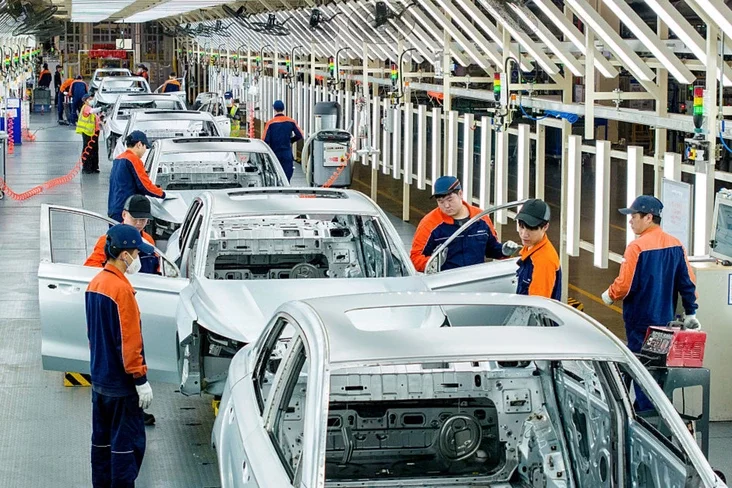
Chinese car assembly line. Photo: Tan Yunfeng / VCG via Getty Images
This primarily refers to so-called CIM (cellular modules) — chips responsible for connecting the car to the internet. It is through this "gateway" that system updates and data transmission occur. According to experts, during times of tension or war, malicious programs could be remotely implanted into CIM modules to stop vehicles directly on roads or disable critical infrastructure.
The story of American John Deere tractors, stolen by Russian military personnel from Ukraine, proves that this is not science fiction. The manufacturer simply remotely disabled access to these machines via similar CIM modules, turning the equipment into useless scrap metal.
Today, China holds 69% of the global market for these modules. Such a total monopoly creates a strategic dependence that analysts consider even more dangerous than reliance on rare earth metals.
But there are other vulnerabilities. For example, autopilot and intelligent cruise control functions operate based on LiDAR sensors. In this segment, Beijing's dominance is even more pronounced – China accounts for almost 80% of global sales of these devices.
It turns out that the "eyes" and "ears" of a modern car, as well as its means of communication with the outside world, are entirely dependent on one country.
Defense Strategy
To protect against these threats, experts suggest adopting China's own experience. Beijing has long restricted the movement of Western cars (e.g., Tesla) near government and military facilities.
Experts insist that mandatory storage of domestic drivers' data exclusively on servers located within the country should be introduced, and a so-called "flight mode" for the car — a button that allows the driver to completely disable all sensors and data transmission — should be implemented.
Additionally, advanced anonymization needs to be implemented: passers-by's faces and license plates of other cars should be automatically blurred before data is sent to the cloud. Manufacturers are also to be required to undergo additional security certification.
Finally, one more risk should be remembered, which buyers of the cheap Chinese "miracle" often ignore. In the event of a large-scale geopolitical conflict, China could face severe sanctions.
This means that spare parts supplies and software updates would be stopped instantly, turning high-tech machines into immobile scrap metal. The attractive price and rich features of Chinese cars today could turn into serious problems tomorrow — both for the owner and for the state.


































Comments