


Europe paralyzed by snow, while powerful cyclone "Ulli" approaches Belarus. Drifts up to 40 cm and frosts down to -25°C expected
The beginning of 2026 in Europe was marked by a real weather cataclysm. While Europeans struggle with snow-covered palm trees and transport collapse, meteorologists warn Belarusians: something similar to the famous "Xavier" is heading our way.

Winter in Paris. Photo from social networks
What's happening in Europe?
Abnormal cold and snowfalls covered even those regions where winters are usually mild.
In the Italian resort of Rimini, locals observe a surreal scene — palm trees under snow.
A "yellow" alert level has been declared on the Spanish island of Mallorca and other Balearic Islands.

Snow-covered Basilica Sant'Apollinare Nuovo in Ravenna, Italy. Photo from social networks

Snow-covered beach in Italy. Photo from social networks
But Central and Western Europe suffered the most. In France, a high threat level has been introduced in 38 departments. Paris airports Orly and Charles de Gaulle were forced to cancel hundreds of flights due to icy runways. Traffic jams with a total length of up to 1000 km (around Paris — up to 600 km) formed on the country's roads. Unfortunately, there were casualties: at least five people died in accidents related to the bad weather.
In the Netherlands, rail traffic is partially paralyzed — this is the longest snowfall in the last 4 years. Schiphol Airport (Amsterdam) cancelled over 700 flights, people were forced to spend the night directly in the terminals. In the UK, hundreds of schools are closed, and Eurostar train services are disrupted.
What has already reached Belarus?
Belarus is currently in the "warm-up" phase. On January 6 and 7, a southern cyclone brought snow mainly to the south and center of the country.
By the morning of January 7, the highest snowdrifts were recorded in Naroch and Pleshchenitsy — 28 cm. In Minsk, the snow cover reached 21 cm. However, the main challenge is yet to come.
"Ulli" follows in the footsteps of "Xavier"
Meteorologists are closely monitoring a new active southern cyclone that formed over southern Italy. German meteorologists named it "Ulli", and Italians — "Francis".
Its danger lies in the fact that it formed at the junction of very contrasting air masses: arctic cold blows behind it, and it is saturated with Mediterranean moisture. This combination generates very powerful vortices — just like the legendary cyclone "Xavier".
"Ulli" is expected to reach the borders of Belarus on the evening of January 8.
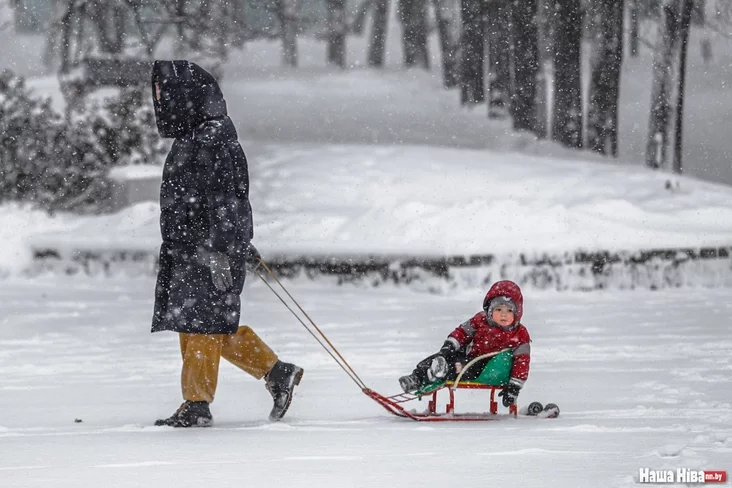
Illustrative photo. Photo: "Nasha Niva"
What to expect on January 8-9?
Forecasts for Belarus have worsened. The cyclone's trajectory will pass closer to our borders than previously expected.
-
Heavy snowfalls: On January 8 and 9, the bad weather zone will cover not only the south and southeast, but also the center of the country.
-
Record precipitation: Up to 30 mm of precipitation may fall in the south within 24 hours, and a total of up to 45 mm. This is almost one and a half monthly norms of snow in a couple of days.
-
Snowdrift growth: In the south and southeast (Gomel, Brest regions), snow will increase by 20‑30 cm, in the center — by 10‑15 cm. In some places, the height of snowdrifts may exceed 40 cm.
-
Wind and snowdrifts: Gusty winds of 15‑22 m/s, strong blizzards and snowdrifts on the roads are expected.
-
Freezing rain: Black ice is possible in the southeast of the Gomel region.
In Minsk, the peak of bad weather is expected on the night of January 9 and in the morning: heavy snow, blizzard, wind up to 18 m/s.
Belarusian meteorologists confirmed the danger: according to updated data from Belhydromet, on January 8‑9, wind gusts may reach 24 m/s (more than previously predicted).
Due to difficult conditions, rescuers strongly recommend Belarusians to refrain from traveling if possible and stay in a safe place.
After the snow — severe frosts
The snowfall will be followed by a sharp drop in temperature. According to ECMWF model forecasts, a blocking anticyclone will establish itself in Europe, preventing warm air from the Atlantic. This will bring a true continental winter.
Starting from the second half of the week, temperatures will begin to drop. By the 20s of January, nighttime temperatures in Belarus could fall to -20..-25°C.






































Comments