


"He made Latvia Latvia," wrote the country's president, Edgars Rinkēvičs.
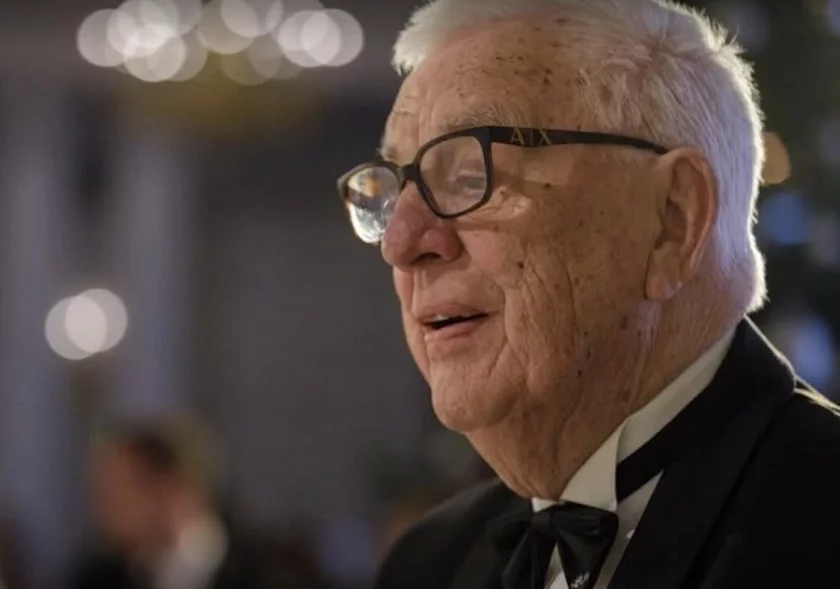
The famous Latvian composer celebrates his anniversary today; he is 90 years old.
"Raimonds Pauls is more than just a composer for Latvia. Raimonds Pauls is a miracle. Because everything works out for him. The Maestro possesses an amazing ability to reach every listener in the most unusual way — and always surprise us. The Maestro makes Latvia Latvia, because his music taught the whole country to feel: to rejoice and be proud, to be angry, to feel awe and sincere sorrow," President Edgars Rinkēvičs wrote in his congratulatory message.
"Raimonds Pauls created not just a soundtrack to our lives. It seems his music has always been and will always be — like the sunrise in the east and the sunset in the west," he added.
Raimonds Pauls was born on January 12, 1936, in Riga into a German-Latvian family. His father was a glassblower and a pearl embroiderer. His father was an amateur musician.
Little Raimonds played the piano already in childhood. He graduated from the Latvian Conservatory, and parallel to his studies, he worked as a pianist in variety orchestras of trade union clubs for road workers and medical professionals, and as a concertmaster in the philharmonic. He played in restaurants, having studied jazz classics and modern songs. He wrote his first music for the Puppet Theater.
From 1978 to 1982, he was the conductor of the Latvian Radio and Television Orchestra of Light and Jazz Music. He was the first musician to perform in the "Musical Pause" segment of the TV game "What? Where? When?" in January 1979. From 1982 to 1988, he was the chief editor of music programs for Latvian Radio.
Author of numerous hits for Laima Vaikule, Alla Pugacheva, Valery Leontiev, Aija Kukule, Ojārs Grīnbergs, Nora Bumbiere, Edita Piekha. Songs were often first written in Latvian, such as Alla Pugacheva's famous "A Million Scarlet Roses" which was originally Dāvāja Māriņa by Aija Kukule, or "Yellow Leaves" — Lapa zarā (Last Leaf) performed by Margarita Vilcāne and Ojārs Grīnbergs.
During Soviet times, Pauls was not a member of the Communist Party of Latvia; he was elected a deputy of the Supreme Soviet of the Latvian SSR of the 11th convocation (1985–1990). Later, he became a People's Deputy of the USSR (1989–1991) from the Popular Front of Latvia. From 1989–1993, he served as the Minister of Culture of Latvia.



















Comments