


Where Belarusian was spoken a century ago, Polish now prevails. What remains of Belarusian dialects in Lithuania
A century ago, Belarusian dialects tightly encircled Vilnius. Today, this once powerful linguistic massif has turned into an archipelago of isolated villages, where locals call their language "simple" and consider themselves Poles. Belarusian dialects in modern Lithuania are gradually fading away. The Vilnius surroundings currently remain their most stable stronghold.

Franciscan monastery in Norviliškės — the Lithuanian-Belarusian border runs just a hundred meters beyond the forest. In the Dieveniškės salient, everything has changed: once, Soviet authorities transferred this territory to Lithuania because it was a Lithuanian linguistic enclave, but now a "skansen" has formed here, where Belarusian dialect is best preserved. Photo: Wikimedia Commons
A large-scale study by Polish linguist Mirosław Jankowiak from the Institute of Slavic Studies of the Czech Academy of Sciences was published in the fresh issue of the scientific journal Acta Albaruthenica for 2025.
The author analyzed the works of predecessors over the past 120 years and added the results of his own field expeditions, which lasted from 2008 to 2025. The collected material allows tracing how the borders of our language changed in the northwest.
Ambitions of the BNR
The works of Yaukhim Karski are traditionally considered the starting point for defining the historical boundaries of the Belarusian ethnos. During his 1903 expedition, he recorded the area of dominance of Belarusian dialects.

Map of Belarusian dialects, compiled by academician Yaukhim Karski. Photo: Wikimedia Commons
The line went from Dzvinsk (Daugavpils) and Ezerosas (formerly Novoaleksandrovsk) through Švenčionys, encompassing Širvintos and Kernavė. Settlements such as Vilnius, Nemenčinė, and Maišiagala remained within the Belarusian-speaking area. Further south, the border bypassed Trakai, went through Vievis and Mezhyrichchia, descending to Druskininkai and Suwałki.
These same data were later confirmed by the Moscow Dialectological Commission in 1915.
It was Karski's scientific authority and the research of Mitrafan Doŭnar-Zapolski that became the foundation for the creation of the famous map of the Belarusian National Republic of 1918.
It was drawn in Berlin before the Paris Peace Conference and claimed all lands where Belarusian was spoken, including not only the Vilnius Region, but also Suwałki and Białystok.
Interwar Paradoxes
After the First World War and the Polish-Lithuanian conflict, the region was divided. In the Vilnius Region, which became part of interwar Poland, intensive Polonization processes took place.
Polish researcher Halina Turska, studying the local language in the late 1930s, concluded that southeastern Lithuania was historically Baltic, then partially Belarusianized, and later began to switch to Polish.

Linguistic situation in the Vilnius Region in the early XX century according to the research of Aloyzas Vidugiris. A complex zone of contact between Belarusian (pink), Lithuanian (green), and Polish (yellow) dialects is recorded. Photo: Wikimedia Commons
State administration, school, and church did their work: the Catholic population, even speaking Belarusian, began to identify themselves as Poles.
A completely different situation developed on the other side of the border, in the interwar Lithuanian Republic (centered in Kaunas). According to the Russian census of 1897, more than seventy thousand Belarusians lived in these lands, mainly in villages near Trakai.
But already the Lithuanian census of 1923 showed a catastrophic, sixteen-fold decrease in the number of Belarusians in Lithuania. Belarusians there turned into small linguistic islands, scattered even in areas far from the modern border — near Šiauliai, Telšiai, and Raseiniai.
Soviet Maps and the Phenomenon of "Simple Language"
In the post-war period, interest in the region resumed thanks to work on the multi-volume "Dictionary of Belarusian Dialects of Northwestern Belarus and Its Borderlands".
In the 1960s-70s, Soviet linguists recorded Belarusian speech in dozens of villages in the Trakai, Varėna, Šalčininkai, Vilnius, and Ignalina districts of the Lithuanian SSR.
Researchers confirmed that to the east of the Buivydžiai — Rudamina — Rūdiškės line, the Belarusian language remained the predominant means of communication for the older generation.

Belarusian Song Festival in Šalčininkai. Photo: Facebook community of the Belarusian Cultural Center "Ranitsa".
The baton was taken over by Professor Valery Chekman of Vilnius University, who researched the region's multilingualism until the early 2000s.
Already then, scientists encountered an interesting sociolinguistic phenomenon: local residents called their language not Belarusian, but "simple" or "local," while identifying themselves as Poles.
The sphere of use of this language was constantly narrowing, giving way to official Polish (which remained the language of the church and local intelligentsia), as well as Russian and Lithuanian.
Reality of the XXI Century
In modern linguistics, optimistic assessments are sometimes found. For example, Belarusian researcher from Vilnius Lilia Plyhauka stated ten years ago that Belarusian dialects are concentrated in a continuous massif along the border and firmly serve as a means of communication alongside the Polish language.
However, one hundred thirty hours of audio recordings made by Mirosław Jankowiak over the past sixteen years paint a much more dramatic picture: Belarusian is systematically being displaced.
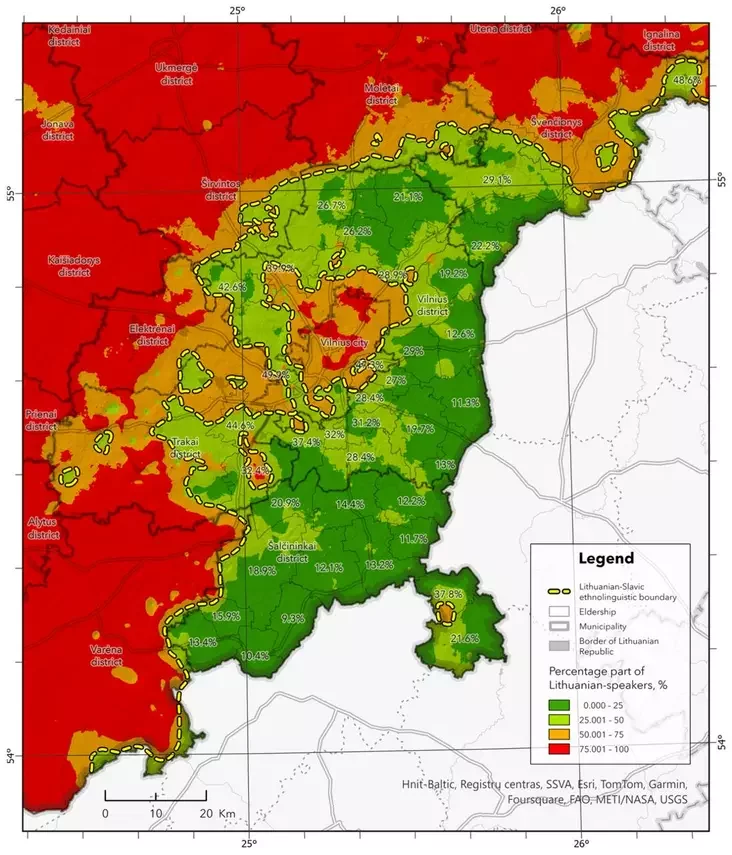
Ethnolinguistic situation in the region according to the 2021 census. Green and light green colors indicate territories where the number of Lithuanian speakers is 0-25% and 25-50% respectively. Orange and red — 50-75% and 75-100% respectively. Photo: Center for Geolinguistics of the Institute of the Lithuanian Language
The geography of this fading is uneven. In the Varėna district, the Belarusian language is pressed against the very border: forests separated Slavic settlements from Baltic ones. The dialect can still be heard here in the villages of Kotra, Rudnia, Raki, or Paramok, but it is used exclusively by the oldest generation, which signifies its rapid disappearance.

Territories where Mirosław Jankowiak conducted research in 2008-2025.
In the section from Kalesninkai to Šalčininkai, previously described as confidently bilingual, finding a Belarusian-speaking interlocutor today is a great stroke of luck. The Polish language has definitively triumphed here.
The researcher managed to record remnants of the dialect only in Daugiadances, Gerviškės, and Kaniūkai.
The so-called Dieveniškės salient remains a peculiar linguistic open-air museum — a territory that deeply cuts into Belarus. Historically, it was Baltic, but after the war, it experienced an influx of Slavic population. There, the Belarusian language is still recorded in Dailydės, Milkunai, Krakunai, and Norviliškės.

Villages like Šumskas near Vilnius remain a stable stronghold of Belarusian dialects in Lithuania. Photo: Wikimedia Commons
The Vilnius district remains the most stable stronghold of Belarusian dialects, especially the villages to the east and southeast of the capital: Lavariškės, Šumskas, Mastiščiai, Sloboda. This is the only area where Belarusian dialect can still be recorded in almost every settlement.
At the same time, in the north, in the Švenčionys and Ignalina districts, rapid assimilation in favor of the Lithuanian language is taking place.
For example, in the Slavic triangle of Rimšė — Gaidės — Vidzy, as late as 2014, out of twenty-three surveyed villages, Belarusian dialect was found in only three. All generations there have switched to Polish or Russian, and the old Belarusian islands around Kaunas are permanently lost.
«Nasha Niva» — the bastion of Belarus













Comments