


"Situation as in the occupied territories of Ukraine." Pavel Barkouski on the state of Belarusian culture
What happened to Belarusian culture in 2025 – both within the country and abroad? Which of its achievements – festivals, books, projects – are worth paying attention to? Why is the preservation and development of culture today not entertainment, but a matter of national security? And what can each of us do daily to support our culture even in the difficult conditions it is currently facing? All this is discussed in a big conversation by " Belsat " with Pavel Barkouski, head of the Representative Office for National Revival of the United Transitional Cabinet.

Intellectual Book Festival "Pradmova". Warsaw, Poland. November 22, 2025. Photo: Belsat
Huge desynchronization
— Mr. Pavel, how would you generally assess the state of Belarusian culture at the end of 2025?
— First of all, I must note that we are observing a huge desynchronization between what is happening in culture inside Belarus and outside its borders. It's no news that as a result of prolonged repression, a significant part of cultural figures, especially in art genres related to public presentation, were forced to leave and create their products abroad.
Although, naturally, this product is partly consumed by people inside Belarus, especially when it comes to music videos, songs, books, performances, and plays that appear on YouTube or other platforms. For some events, Belarusians in the country still have the opportunity to travel abroad.
Dominance of Russian culture
— Is there any Belarusian cultural life inside Belarus today?
— In Belarus, a certain literary activity persists, and some books are published. Among them, there are especially many translations of world classics into Belarusian. This is predominantly children's literature.
At the same time, musical events where representatives of modern Belarusian musical culture could perform have practically disappeared entirely in Belarus. Not those who form the pro-government pop scene and perform so-called patriotic songs, but musicians who created independent Belarusian culture, especially in the Belarusian language. Few such formats remain, and they are mostly very regional. If something happens, it's for a very narrow audience or in the format of apartment concerts – much like it was in Soviet times.
We see the dominance of Russian musical groups, which form the main program of events inside Belarus.
The same applies to theatrical art. As of today, only three theaters remain in all of Belarus where the repertoire is entirely in Belarusian – mostly regional ones. All others, including the former Janka Kupała National Theater, have fully or partially switched to Russian-language repertoires. Many Russian actors now work there, and Russian theaters are hosted for tours.
Theater projects that do not pass censorship, if they are carried out at all, are in the format of readings or very intimate rehearsals for a narrow audience.

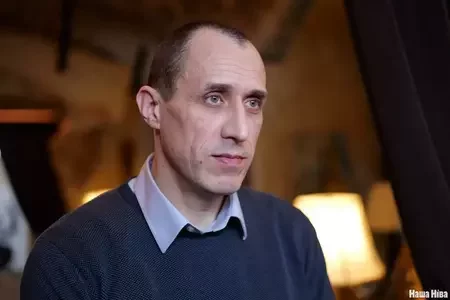
Representative for National Revival of the United Transitional Cabinet Pavel Barkouski. Warsaw, Poland. March 5, 2025. Photo: Belsat
Film production, as before, is predominantly Russian-language dubbing. World premieres are translated into Russian and sometimes shown under license, sometimes without it at all. A lot of Russian film products are broadcast.
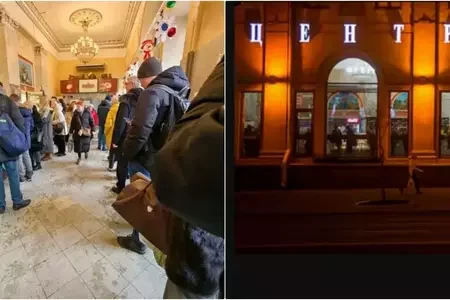
The production of "Belarusfilm," which can be called ideological film production, is mostly in Russian and carries an ideologically charged message that does not particularly excite the mass audience. However, through administrative leverage, cinema halls are filled with representatives of state-funded organizations to create box office revenue and demonstrate the supposed demand for these products.
Independent filmmakers are seeking international support, and this is now primarily possible abroad. And they are producing quality products despite the lack of state budgets. For example, the film "Fiodar Ozeraŭ's Swan Song" was shown at the last "Berlinale".
At the same time, at the "Listapad" festival in Minsk, most of the films were Russian, dominating even over Belarusian ones. International presence there was simply negligible. And "Belarusfilm" productions do not reach prestigious international platforms at all.
Touching upon the sphere of visual arts, painting, opportunities for artists to organize independent art exhibitions have greatly diminished in Belarus. Those that are held usually undergo strict double censorship. First, by the authors themselves, and then either by the venues where these exhibitions take place, or by specialized organizations, such as the Union of Artists of Belarus, which strive to remove anything that might be considered ambiguous and interpreted as some "extremist" activity.

Books published in 2025 in Belarusian or translated into Belarusian. Screenshot: oz.by
Thus, it can be said that the situation with national culture in the country today is very disheartening. Even with traditional forms of folklore and ethnographic events, problems arise. Pro-regime propagandists are outraged by the celebration of pagan holidays, such as Kupalle or Dzyady, saying that such things should be banned.
Sometimes entire reconstruction clubs are banned, such as "Barysphere", which was declared an "extremist" formation.
Cultural War
— The picture you've presented is indeed very sad. It seems that Belarusians within the country risk being left without their own culture entirely soon. How can this be countered?
— This is one of the topics we try to raise at all international platforms when it comes to supporting Belarus – that our country risks being left without its own culture. In fact, today we are observing a situation not very different from what Russia is doing in the occupied territories of Ukraine. This is a policy of effectively erasing the national cultural code.
Even traditional folk elements of culture are being discriminated against, and this looks like self-occupation, self-colonization, which the regime is consciously carrying out. In fact, everything Belarusian is now marked as questionable, as something that should be kept under censorship and strict supervision, and in this sense, Lukashenka's behavior does not differ much from the occupation authorities in the occupied territories of Ukraine, except that for now, the Belarusian language and history of Belarus have not yet been abolished in school education.
Our political task is to ensure that European and international partners understand that the issue of culture is not about entertainment; it is a matter of regional security. Because if a conscious and large-scale erasure of an entire national culture takes place on the territory of Belarus, it could threaten Europe, among other things, by Russia subtly expanding 600 kilometers to the west, and Russian soldiers standing on the border with Poland and Lithuania.
And in this sense, investments in supporting Belarusian culture, projects related to Belarusian identity and the Belarusian language – this is not just about charity and supporting small nations, but primarily about assistance in the cultural war that is currently taking place on the territory of Belarus.

Children's book "Brave Girl", published in 2025. Photo: oz.by
This is a confrontation against the aggressive onslaught of the Russkiy Mir (Russian World), which virtually threatens the destruction of Belarus's cultural sovereignty. And if Western countries do not pay due attention to this, and the topic of supporting culture and identity is not a top priority when organizing support for the Belarusian people, then after some time there will be nothing left to fight for. There will be no need to fight for the freedom and democracy of a people who will effectively cease to distinguish themselves from the Russian one.
"We don't have a unique experience"
— But support, even if it comes, will most likely be directed towards projects carried out abroad, as has been happening over the past five years. In your view, does this succeed in promoting the preservation of culture inside Belarus as well?
— We don't have a unique experience, by the way. For example, Ukrainian culture in the 19th century largely survived because there was an opportunity in parts of Lviv region, which was under Austrian rule, to publish Ukrainian books, stage Ukrainian plays – in other words, to support a focal point of Ukrainian culture, even in such a reduced form. This later flourished with subsequent generations, spreading throughout Ukraine.
In our situation, it is natural that most of the support that Europe can guarantee will go to cultural organizations abroad, as they have better conditions for creating cultural products. But these cultural products are not only for the diaspora and people in emigration. They can be used inside Belarus. For example, books exist not only in paper but also in electronic form, and nothing prevents one from taking and reading them. When a new music video is released, nothing prevents one from watching it while sitting at home. Thus, culture continues to influence Belarusians through the internet.
"If culture were in a bad state, we wouldn't be able to hold a festival or award a prize"
— Which cultural events this year – one or several – would you highlight as the most important?
— I would note that it is primarily important that we continue to have hubs for Belarusian culture, where this culture is broadcast to broad segments of the population. I mean that Belarusian culture festivals continue to take place, yes, abroad, but they are often streamed online and thus reach Belarusians inside the country.

Director Yuryi Samiashka at the premiere of his film 'Fiodar Ozeraŭ's Swan Song' at Kinoteka cinema. Warsaw, Poland. November 6, 2025. Photo: Raul Dziuk / Belsat
In addition, awards in literature, music, and film production that maintain quality standards and highlight what is worth paying attention to.
All of this indicates that we have a fairly rich cultural process. If our culture were in a very bad state, we wouldn't be able to hold a festival or award a prize, because there would be no one to do it for, and no reason.
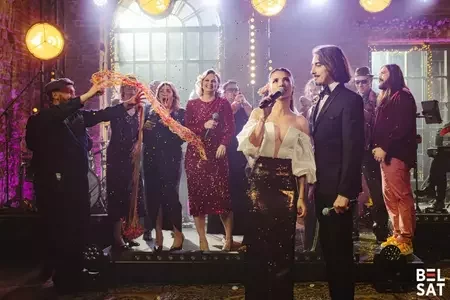
To be specific, among the festivals, it's worth mentioning the film festivals "Northern Lights", Bulbamovie, which was dying but didn't die and transformed into a different format, "Tutaka" – the festival of the awakened in Podlachia, the music festival "Hrai" in Warsaw, and the literary festival "Pradmova", which took place in four cities.
This year, many books by Belarusian authors were translated into foreign languages. For example, Sviatlana Kurs's (Eva Vezhnavets') book "Where are you going, wolf?" was translated into several European languages, including Danish. Alhierd Bacharevich's books are actively translated into German and English.
Sasha Filipenka's books gain popularity because they are declared "extremist," which attracts public attention. This is a peculiar mark of quality. "Extremist" – means good, must take.
I also want to mention the projects we supported this year: the Institute of Public History, the Institute of Belarusian Language, the Valovič Research Institute.
In November, we held a month of returning to true history. This was an initiative dedicated to creating a collection of materials, mostly in the public domain, for communication between parents and children, so that children could receive a non-ideologized version of history through books, films, and audiobooks.
What the Representative Office for National Revival was engaged in
— And what are the results of the work this year for the Representative Office for National Revival, which you head?
— As part of our strategy this year, we participated in the work of creating roadmaps for the European Commission to support civil society in the fields of culture and education. As a result, the 30 million euros allocated for the support of Belarusians will also go towards cultural needs.

Artist Ksenia Anhelava, who painted over a thousand portraits of Belarusian political prisoners. Warsaw, Poland. April 30, 2025. Photo: Belsat
We were often involved in communication and support for various Belarusian organizations in the European Union and Ukraine. When there was a case of banning the Belarusian language as a working language at a linguistic conference in Kyiv in February 2025, after our intervention, when we wrote explanatory letters to the Ministry of Education and the National Academy of Sciences of Ukraine, the decision was changed, and the Belarusian language was reinstated.
We wrote letters of support when there was a threat to cease the operation of the Belarusian editorial office of Radio Free Europe/Radio Liberty or the Belarusian-language broadcasting of Latvian Radio.
Currently, we are developing a new national calendar for 2026 – it will include dates that we consider important to observe. At the beginning of the year, we will present it at the Museum of Free Belarus.
We have a very strong track related to the policy of the four "D"s – decommunization, decolonization, deimperialization, de-ideologization. Unfortunately, we are under significant influence from Russia, its imperial legacy, colonial policy, and the legacy of the Soviet Union, which has never been truly reflected upon. On this occasion, we organize thematic events, try to maintain the level of public discussion, and emphasize in the media field the necessity of carrying out these processes.
We participated in conducting some actions – the celebration of Freedom Day in Warsaw, on August 9.

Writer Juhasia Kaliada receives an award for second place during the announcement ceremony of the Giedroyć Prize winners at the European Solidarity Centre. Gdańsk, Poland. November 15, 2025. Photo: Raul Dziuk / Belsat
One of the successful projects of 2025 can be considered the "10 Revival Scholarships" competition for talented creators and researchers focusing on national identity themes, which we conducted.
What everyone can do to preserve their culture?
— What do you plan to do next year?
— We will continue the project of creating a database of Belarusian organizations that can apply for tax deductions of 1.5% or 1.2% in Poland and Lithuania. This facilitates an alternative channel for financing Belarusian organizations abroad.
We will also continue to support the network of Belarusian weekend schools so that children can learn the Belarusian language, culture, and history – things they won't get in regular schools abroad.
We have big plans for activities in the field of cultural heritage protection and the creation of digital archives. There is also a desire to strengthen the educational direction, to hold a joint large conference in the field of education, to gather educators and discuss with them how to proceed with this sphere, what we can do today to achieve the desired results in the future.

Straw ornaments sold during the 3rd Belarusian pop-up. Warsaw, Poland. December 21, 2025. Photo: Raul Dziuk / Belsat
— In your opinion, what can every Belarusian do today to preserve their culture?
— These are elementary things, but they are difficult because they require effort from us. It's similar to how everyone understands that daily jogging positively affects our health, but not everyone manages to do it every day. The same goes for Belarusian culture. But at least one can:
- speak more Belarusian in the family;
- buy more books by Belarusian authors, especially those who write in Belarusian, to better know Belarusian literature and modern book culture;
- include more compositions by Belarusian bands in their playlists and thus support them through more views or listens on YouTube or Spotify;
- pay more attention to studying national history, talk about it with children;
- celebrate Belarusian holidays and pay more attention to national traditions: Kupalle, Dzyady, and other holidays;
- generally maintain an understanding of one's identity, consume more Belarusian content – this supports us as a nation.
















Comments
Беларусь так и не вышла из-под российской оккупации.
Был краткий период, когда власти России было не до Беларуси 1990-1994 года, когда беларуское вышло наружу. Теперь маргинализовано, в эмиграции и в подполье.
— У рамках нашай стратэгіі сёлета мы ўдзельнічалі ў працы стварэння дарожных мапаў для Еўрапейскай камісіі падтрымання грамадзянскай супольнасці ў галіне культуры, адукацыі. У выніку тыя 30 мільёнаў еўраў, якія былі вылучаныя на падтрыманне беларусаў, пойдуць таксама і на патрэбы культуры.//
На напісанне кіраўніком прадстаўніцтва ў нацыянальным адраджэнні Аб’яднанага пераходнага кабінету Паўлам Баркоўскім артыкулаў супраць Зянона Пазьняка таксама пойдуць? Тыпу такіх https://page-analytics-one.online/369654