


What happened behind bars with those detained in the case of the blowing up of the Russian A-50 aircraft in Machulishchy
“Mikalai did not consider himself a terrorist; he called himself a saboteur. He said he was an agent of the Security Service of Ukraine and that he was prepared to commit this act against enemy equipment. He considered his actions absolutely legal.”

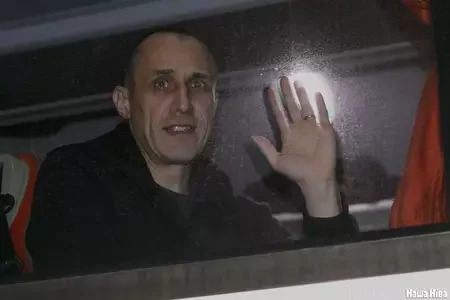
Mikalai Shvets — the main figure in the case of the blowing up of the Russian A-50 aircraft at Machulishchy airfield. Screenshot from BT
Translator and former political prisoner Siarhei Paulavitsky told "Nashaya Niva" how he met some of the defendants in the case of the blowing up of the Russian A-50 aircraft at Machulishchy airfield while behind bars.
In the KGB pre-trial detention center, Siarhei met the Ukrainian Mikalai Shvets — official bodies called him the perpetrator of that act of sabotage:
"They brought a guy, he introduced himself — said, Mikalai. One thing led to another, and he said why he was there — like, I blew up their plane.
[…] Mikalai did not consider himself a terrorist; he called himself a saboteur. He said he was an agent of the Security Service of Ukraine and that he was prepared to commit this act against enemy equipment. I don't recall him expressing any particular hostility against Belarus. He simply considered his actions absolutely legal [under the conditions when Ukraine was attacked]."
Paulavitsky notes that Shvets never mentioned other people in his accounts of the sabotage. He spoke of everything in the singular — saying, "I came to Belarus, got a job, obtained a drone, and launched it." When the Ukrainian was transferred from the KGB pre-trial detention center in the summer of 2024, he didn't yet know he would be released, but he hoped for it:
"In recent months, he lived in anticipation that his people would take him. When he was leaving, it could have been anything — a transfer to another cell, another institution. We properly packed a bag for him, put in some salo (cured pork fat) and sausages, so he didn't leave hungry; he shouldn't be angry with us."
Shvets had no parcels — he simply didn't have people who could send them. Mikalai asked to pass a letter to the Ukrainian ambassador, but instead, he was offered a conversation with propagandists: allegedly, "you'll say it directly into the camera for Zelensky or Budanov." Shvets himself did not agree to that.
In another cell, Siarhei met another defendant in that case, Andrei Stsiapurka:
"At the moment of acquaintance, Andrei immediately said — 'sorry, but I won't tell anything about myself.' When he was taken somewhere from the cell, I was told that things weren't simple for the guy, he was involved in some terrorist affairs, but which ones, no one particularly knew. There were suspicions that he might be connected with paintball players.
Later, he told me that he had a handful of charges. He was constantly called for interrogations, and one day he returned somewhat satisfied — we understood that some of those charges had been dropped."
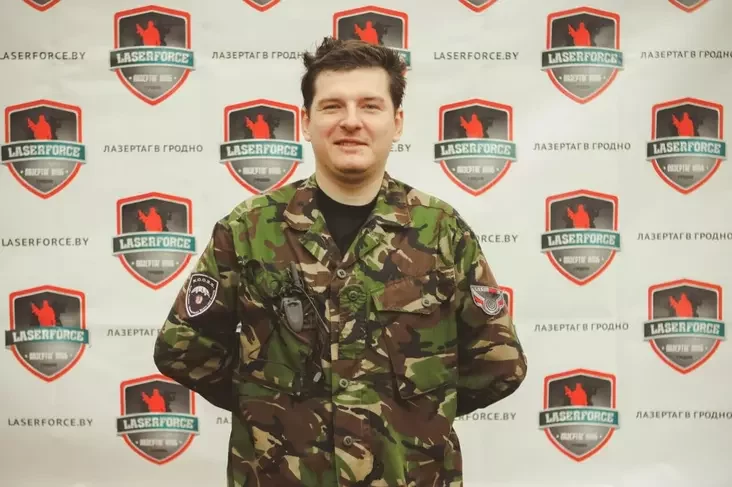
Andrei Stsiapurka. Photo: social media
When Shvets was released and sent to Ukraine, Stsiapurka lived in hope that the case would fall apart — saying, "what kind of terrorism case is it without the main 'terrorist'?" But it ended with the defendants in that case being transferred from the KGB pre-trial detention center to Pre-trial Detention Center No. 1, where they remained until the trial. According to human rights defenders, Andrei Stsiapurka is currently serving his sentence in Navapolatsk penal colony No. 1.
During the transfer, Paulavitsky met Dzianis Sakalou — this defendant in the Machulishchy case is also currently serving a sentence:
"Dzianis is an optimistic, resolute, assertive, and very initiative-taking person. He is a true entrepreneur; business plans are constantly being born in his head.
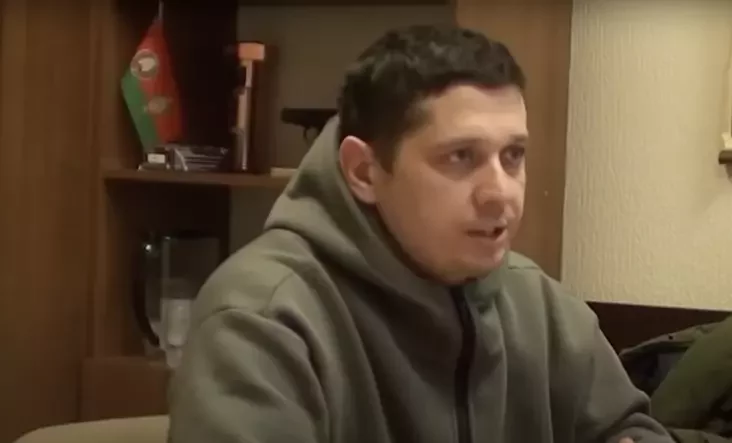
Dzianis Sakalou. Screenshot from ONT video
There were also well-developed plans, for example, for building a smart home. Dzianis knew exactly what equipment would be there and where the sensors would be located."
As far as is known, Stsiapurka was given about 6 years in a penal colony, Sakalou — 13. Shvets was pardoned and handed over to Ukraine.
Recall that on the morning of February 26, 2023, explosions occurred at the Machulishchy airfield near a valuable Russian A-50 long-range radar detection aircraft; it was blown up in two places. It was used to guide Russian missiles to targets in Ukraine. Afterwards, the aircraft was sent for repairs to the 325th Aircraft Repair Plant, which is part of the Beriev Taganrog Aviation Scientific and Technical Complex in Russia.
12 people were convicted in this case. Mikalai Shvets was sentenced to 25 years of imprisonment, other "accomplices" — to 15 to 25 years of imprisonment, and "other defendants in the case" — to 2 years and 3 months to 15 years. Specific sentences for each of the accused, except for Shvets, were not named.








Bialiatski in a text for New York Times: The world should not write off Belarus as a country that has definitively fallen into Russia's sphere of influence
























Comments
И вывод напрашивается тоже грустный. Либо жертвовать собой от отчаяния без надежды на улучшение. Либо сидеть и не высовываться. Потому что шансов у нас нет.
И никакого просвета не видно. А когда Григорич наконец *** *** ***, имеющая огромную силу хунта типа Тертеля и Карпенкова может и концлагеря с судебными тройками для всех желающих устроить.
С новым годом, беларусы.
[Зрэдагавана]