


"When you are alone with yourself, you want to cry, remembering everything." Iryna Shchasnaya on life at liberty and volunteering in Ukraine
In May 2024, political prisoner Iryna Shchasnaya, editor of the Telegram channel "My Country Belarus," was released. She had initially left Belarus, then returned and was detained. The woman served her full sentence on charges of "preparing to participate in mass riots"—the court sentenced her to 4 years in a penal colony. Belsat met with Iryna in Kyiv, where she volunteers at a "point of invincibility" opened by Belarusians, and talked about life at liberty and how her imprisonment affected her life.

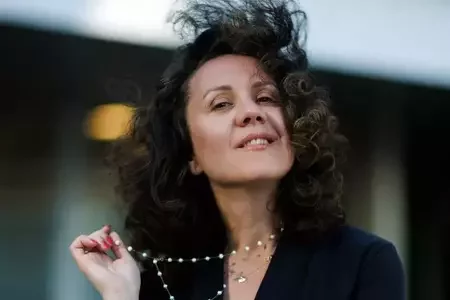
Iryna Shchasnaya. Photo provided by the interviewee
"When ordinary people see what we do, they stop seeing us as aggressors."
— Why did you come to Ukraine? Aren't you afraid to stay in a place where something can fly in or explode at any moment?
— I always wanted to return here. Well, and now I've come because the Belarusian "point of invincibility" has started operating here. Ukrainians are wonderful people, and I'm very, very sorry that Russia created such conditions where everyone is without light, heat, or water.
And even a small contribution—if I warm up 3-5-10 people with at least a cup of tea and some sandwich, that will be my personal act. It will probably be morally easier for me this way.
As for the constantly flying missiles, UAVs, unconfirmed "Oreshniks" — well, if I'm in places without shelter, I take a philosophical approach: whatever will be, will be. If there's a shelter, in principle, I go down, but I often don't stay there long – it gets boring. It's interesting to observe people's reactions. Just now, when there was an "Oreshnik" threat, there was a sufficient number of Kyivans in the shelter, and people weren't panicking; they weren't tense, they didn't retreat into their own worries or fears. They joked, discussed the news. I see that this collective cohesion, supported by positivity, helps them get through all these difficult moments.
— How do your relatives, family, react to this risk?
— Naturally, I think relatives and friends who don't live in Ukraine are worried. People generally live with a stereotype that something flies here every minute, that we live in trenches, that we cross the road—and mortars are firing at us. (laughs) Or that we're just covered in icy stalactites! I understand their worries, their fears, so I always try to explain that it's not like that at all. That Kyiv lives a normal life—with a caveat for certain conditions brought by this Russian aggression. But people haven't broken; they continue to live.
— Did you yourself have such a stereotypical perception?
— I don't have an internal fear that I'll arrive and immediately be attacked by some drone. I understood what was happening; I follow the news, I communicate with people who live here. Of course, the first time I heard air defense working against drones, it was unpleasant. But curiosity got the better of me, and I went to the balcony to watch how it was happening. They say everyone does that the first time. (laughs)
Missiles, ballistic missiles—that's very scary. It's not just a whistle—it's a growing roar, walls swaying, windows rattling. The feeling that this missile is about to hit the house and simply press you into the ground.
The first time I experienced a ballistic missile attack, there was no shelter in the building. All that was left was to go down to the first floor and sit between two walls. Then, I remember, one day a ballistic missile flew in at 6 or 7 in the morning, and I had gone to bed quite late and decided not to get up: sleep was more important. Well, so those missiles flew by.
When we moved in for the second time, at the end of January, the days were filled with tents, the "point of invincibility," and organizational matters.
This is a constant upgrade, attracting the public—because this is a Belarusian point, we really want ordinary Ukrainians, Kyivans, not to see us as enemies, as, unfortunately, sometimes happens after February 24, 2022.
And in principle, I think we are succeeding. Every day there was a lot of gratitude, warm words. There are very warm Belarusian-Ukrainian ties here. A police officer once said that his father was from the Mogilev region.
And when ordinary people, even without Belarusian relatives, see what we do—they stop seeing us as aggressors. Ukrainians continue to see us as friends.
But overall, I think this is a great effort to restore good relations between our two nations in the future.
"I will never forget that I caused immense pain to my family."
— How have these past year and a half of freedom been for you?
— They are very difficult. For some reason, it's hard for me to adapt in Poland, although I know that this country does a lot for us.
I arrived in Bialystok, which was completely unfamiliar to me. I knew three people there, including my husband and child. I didn't know what to do, where to go; it was very hard to make new acquaintances. Gradually, I started traveling to Warsaw, where I had friends I'd known since 2020, people with whom we became close from the pre-trial detention center or the penal colony. But Bialystok is a kind of loneliness. It's thoughts about what happened in my life. About having left Belarus.
Perhaps I only found some inner lightness here, in Ukraine. Maybe because I already lived here, I understand Ukrainian perfectly, I know that they will understand me perfectly in Belarusian. And I know that if I say something in Russian in a store, they definitely won't hang me on a pole, as propaganda claims. And the people, whom I always liked and still like. There's some approximate feeling of home.
— Has any imprint of those 4 years in the penal colony remained?
— Yes. These PTSD symptoms haven't passed yet. I am a very restless person. It's very easy to agitate me with something that other people don't react to at all. The only thing is, here in Ukraine, I've completely stopped being afraid of people in uniform. Although even before 2020, even in Kyiv, I shied away from them, and after my time in the penal colony, for a couple of days in Minsk, when I saw OMON (special police units) patrolling the streets, the police—it was simply a nightmare for me. I thought it would never pass.
I reacted terribly to military uniforms: people in them, internal troops working in IK-4 and beyond, caused me a lot of harm. Here, all of that has simply disappeared. Police, the National Guard constantly come to us—absolutely normal people. Our volunteers, Ukrainian military personnel—wonderful people—come. I don't feel any threat. Being in Ukraine has completely nullified this uniform phobia.
— What are the manifestations of the consequences of this horror you've experienced?
— These are endless memories, thoughts about those who remained there, it's completely disturbed sleep—and even here, I dream that I'm supposed to be released, but they don't let me go and give me an additional term—I wake up in a cold sweat. When you are alone with yourself, you just want to cry, remembering all this and imagining that it hasn't disappeared anywhere in Belarus. It's there, and I can't do anything about it.
— Do you talk about this with your loved ones?
— No. Firstly, some simply don't understand what it's like to be imprisoned. And others get very traumatized if they learn all the details of what happened there. Sometimes, I talk about it with guys who have been through it themselves. I have girls who also served long sentences, and now it's hard for them to learn to be mothers again. I don't want to burden them with my problems, because they are going through the same thing as I am. When it's really painful, I try to replace these feelings with something else.
"Whether my husband and I build our lives separately or together—time will tell."
— In the first month after the penal colony, you said you had changed for the worse. How do you feel about this change in yourself, in your relationship with your family, now?
— It's also about relationships with relatives, with the same family, which are no longer as they were before the arrest.
This is my inner world—if before I was always confident, the life of the party, it was easy for me to communicate with people, now I have a lot of complexes, some kind of internal suppression.
Although, of course, I am learning to both talk and make new acquaintances—and it's even working out, but it took about 6-7 months and often still causes a lot of worries.
I feel a great deal of guilt for having come from Kyiv to Minsk, straight to prison. Some internal delusion that "I want to be where my home is" forced me to return, and I let down my loved ones, condemning them to worries and suffering. I made a huge mistake, and my guilt here is, in general, obvious and unforgivable. I caused immense pain to my family. I will never forget this; I will live with it until the end of my days.
But, naturally, I need to move on, so, probably, I'm trying to isolate myself from the problems that have piled up here.
To understand this life and what I need in principle, because I cannot go to Minsk, which I want more than anything in the world. Kyiv brings me some moral relief. From here, I plan to start a new phase of my life.

Former political prisoner Iryna Shchasnaya. Photo provided by the interviewee
— How much has all this experience, this separation, affected your relationship with your husband? Many couples, no matter how hard they try, change a lot and can't find common ground.
— First of all, I am very grateful to my husband for being there for my child in my absence, and in emigration, alone. When there are no grandparents who were constantly with the grandchild. I know how difficult it was for him, and yet, the child was learning, he had everything.
Relationships? Of course, here it's not just an element—it's a landmark of misunderstanding, because life suddenly pulled us so far apart that reaching the harmony we had before the arrest, if not impossible, is very difficult.
But I will always treat my husband as a good person, because I remember him as kind, responsive. He is a very good father to my child.
I don't know what will happen in the future, but I am grateful for the overall understanding of the situation, that, from my point of view, there are no culprits here. Not me, not my husband are to blame—the regime is to blame, which allowed everything that happened in our lives.
But at the same time, again, it's respect, gratitude, and the understanding that he, as a kindred spirit, will not disappear from my life.
— And love?
— Perhaps it remained within me, but it transformed, changed. I lived with this person for many years of my life, and to lose him or say "Goodbye, I don't want to know you"—well, no, of course not. We don't abandon our loved ones. Yes, it turned out this way, but my husband is family to me.
It's probably hard for him to understand me, to cope with my PTSD, my nervousness, some excessive suspiciousness. Naturally, he had his own worries—he had to survive with a child in emigration. So, I think he also understands everything perfectly. Naturally, we had these conversations in the kitchen, during which we came to understand that, no matter what happens, we are family. We can build our lives separately or together—time will tell, but to disappear from each other forever—that is already impossible.
— Based on your experience, what advice could you give to families on how to interact with a former political prisoner returning to the family?
— I've read a lot of advice from psychologists on this matter.
Simply, if the person who is waiting truly waits, supports, understands who will come to them—a wounded, tormented, mentally unstable person. If they are ready for this, then let them take care of their significant other. If they doubt even a little, it's better to be open immediately and clarify everything. Or there's another, most effective option—to go to a psychologist. Because the situation is truly mega-traumatic for both.
To some extent, I blame myself for neglecting psychological help. When I was released and immediately left, I thought I didn't need it, that I would cope on my own, especially since I already had some antidepressants there.
Then, after some time, about 8 months later, life still forced me to turn to a psychologist again. If I had immediately followed all the recommendations for rehabilitation and adaptation, it would probably have been much easier.

Former political prisoner Iryna Shchasnaya. Photo provided by the interviewee
— What was difficult in your case when you returned home?
— Well, I didn't return home—I returned to an unfamiliar environment, a country, to unfamiliar people. That's difficult.
Then—I returned, and my child was already 14 years old. He's no longer the little kitten I remember; I was stuck in 2020. I remember him at 10, when he played outside so I could see him from the window. And now he plays until ten in the evening, and when I call him 10 times, asking where he is—naturally, this starts to annoy a teenager; I remember myself at that age. In principle, I would have reacted exactly the same way. Now I understand that a teenager probably doesn't really like hearing "sunshine, kitten." Before, I couldn't overcome myself; I internally wanted to make up for the years I had lost.
I don't think enough time has passed for us to completely get used to each other. But everything will be fine; we just need to get through this stage. It requires time and moderation in one's emotions. I want to listen to him more and understand his needs to get into a routine that will bring comfort to both of us.
"When someone just says 'Ira'—I startle and straighten up."
— Have you erased that prison experience from your life, or have some habits remained?
— No, I haven't erased those four years at all. When someone simply says "Ira," I startle and straighten up, because it's still ingrained that it's a regime and it must be followed. Now it's important for me to have a food supply. You know how it is in the zone: food runs out, and the package is still far away, or you've been deprived of it altogether, and you only eat what they give you in the mess hall. And that's not always edible.
I started smoking very quickly—everyone says: "Your cigarette lasts half a minute." And that's because in the zone, there's never time to stand and smoke—you have to run, run somewhere.
— Do I understand correctly that getting out of prison is a great happiness, but life doesn't immediately become easy and happy? There are many more problems, just at a new level.
— To rephrase a well-known saying: a girl can leave the penal colony, but the penal colony can't leave the girl. (laughs) Naturally, these are difficulties, the future of social integration, constant self-doubt.
And will people you meet for the first time treat you normally? Because you yourself feel that there's something wrong with you, that there's some kind of imprint.
Again, if it's immigration directly to a country unexpected for you, you need to learn the language. I, for example, would have done this while still in the penal colony, but political prisoners were forbidden to have foreign language learning books. Then I found myself in this new world and realized that I simply didn't have the moral strength to immediately grasp Polish and study it, because I didn't even have the strength to support myself.
Therefore, this communication with the people around you, this internal shame when you want to say something, is also an additional stress. Yes, it's easier to go to a country where it's easy for you, which you already know, but most political prisoners have the same experience as I do.
— Do you feel happy?
— I'll put it this way: I can often feel cheerful when I'm in good company. I've learned to be cheerful—it wasn't always like that after my release. But cheerful and happy are different things. I haven't reached happiness yet. I can't say I'm a happy person, but I would like to become one.
-
Traffic to be stopped on Centralnaya Street in Minsk for eight months
-
"No longer possible to sustain the free format." The Tutaka Festival will charge an entrance fee for the first time
-
Lithuanian traveled to visit relatives in Belarus — he was arrested and given 15 years. They say it's for espionage
Now reading








Tour agency director did not recognize the Belarusian language when congratulating on the Day of Unity of Belarus and Russia. And continues to dig herself in






Comments