


In Kazakhstan, 709 criminal cases were opened against citizens recruited to fight for Russia in a year
They are given 5-6 years in a penal colony.
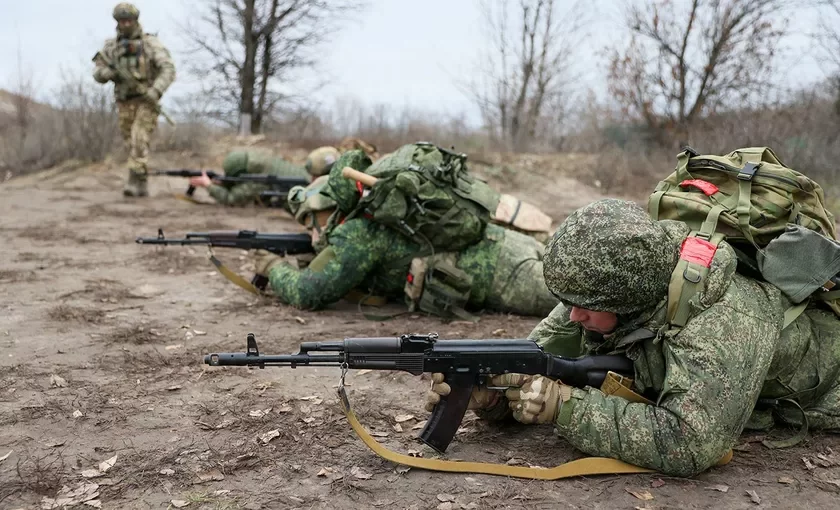
Photo: Alexander Reka / TASS
Kazakhstan's authorities are massively prosecuting participants in the war in Ukraine: in 2025, local law enforcement agencies initiated a record 700 cases against those who were recruited into Russian military formations.
In such cases, it doesn't matter to the courts where the accused served: they hand down identical sentences to both 'Wagner PMC' militants and those who signed a contract with the Russian Ministry of Defense. All of them, from the point of view of the Criminal Code of Kazakhstan, 'committed a criminal intent' to participate in the war.
According to calculations by 'Mediazona' and the Russian service of 'BBC', almost 200 citizens or natives of Kazakhstan have died in the war with Ukraine. Until recently, the country's authorities only warned about criminal liability, and the number of cases was limited to dozens per year. But at the beginning of 2025, after the publication of personal data of possible mercenaries, the situation sharply changed.
'Mediazona' jointly with the project 'Farewell, Arms' studied judicial statistics of Kazakhstan and sentences for specific individuals to find out how Kazakhs end up in the war and how local law enforcement then detains them.
The Criminal Code of Kazakhstan has two articles under which participants in foreign wars can be prosecuted. The first, Article 172 of the Criminal Code of the Republic of Kazakhstan, is relatively lenient — for 'Participation in armed conflicts or military actions on the territory of a foreign state,' up to 9 years of imprisonment can be assigned. Article 170 of the Criminal Code of the Republic of Kazakhstan 'Mercenarism' is more severe; under its third part — if it is proven that the accused killed someone — punishment up to life imprisonment is stipulated. Property of those convicted under the article 'Mercenarism' is also confiscated.
The article 'Participation in armed conflicts' appeared in the country's Criminal Code in 2014, against the backdrop of Russia's annexation of Crimea. Until February 2022, sentences under both articles were rare — no more than fifty cases for both 'Participation' and 'Mercenarism'. In the first years of the war, the situation hardly changed: dozens of cases were filed with the courts annually.
The situation began to change in 2024: law enforcement agencies started opening more cases (17 for 'Mercenarism' and 166 for 'Participation'). And finally, 2025 shows records of criminal prosecution for participation in the Russia-Ukraine war: 709 cases for 'Participation' and 28 for 'Mercenarism'.
Cases also began to appear en masse in courts in 2025: just over a hundred 'participations' and 12 'mercenarism' cases. In total, throughout the war, 149 cases of participation in the war and 30 cases against mercenaries reached court.
Human rights activist Artur Alkhastov, who works with the 'Farewell, Arms' project, provided 'Mediazona' with 17 full texts of sentences for participation in the war. These court decisions allow a look at how the Russian recruitment system is organized and how former Russian army servicemen are detained by Kazakh law enforcement agencies.
15 out of 17 received cases were considered under simplified procedure — this is a situation where the defendant agrees with the charges. Another case was already dismissed in court due to the death of the suspect, and in one case, the defendant was acquitted and sent for compulsory treatment.
In the sentences, five served in 'Wagner PMC,' 11 (including the deceased) — in the Russian Ministry of Defense or related structures ('PMC Redut'). The Kazakhstani sent for treatment did not manage to get recruited at all — he was detained en route.
Service in 'Wagner PMC' itself is not considered grounds for a conviction under the more severe article on mercenarism — all Wagner mercenaries, except one, were tried under the same Article 172 of the Criminal Code as those who signed a contract with the Ministry of Defense.
All known defendants received real sentences. The 'standard' for a sentence under Article 172 of the Criminal Code is 4.5 to 5 years in a penal colony. The sentence for mercenarism (Article 170 of the Criminal Code) is stricter — 6 years and eight months.
In July 2025, the publication 'Vot Tak' found out that sentences for participation in the war are also being handed down in Uzbekistan and Kyrgyzstan. In Kyrgyzstan, journalists found 16 sentences at that time, and in Uzbekistan — 26.



























Comments