


Vibe Programming Will Change the Developer's Role, RLVR, and When the Bubble Bursts. A Belarusian AI Engineer Working in the USA Explained What Awaits Us in 2026
Andrus Khrapavitski hails from Hlybokaye, studied in Polatsk, and now works in the USA — for 6 years in the field of artificial intelligence and big data. "Nasha Niva" asked him to assess what changes will occur next year in the field of artificial intelligence and how this will affect various aspects of life.
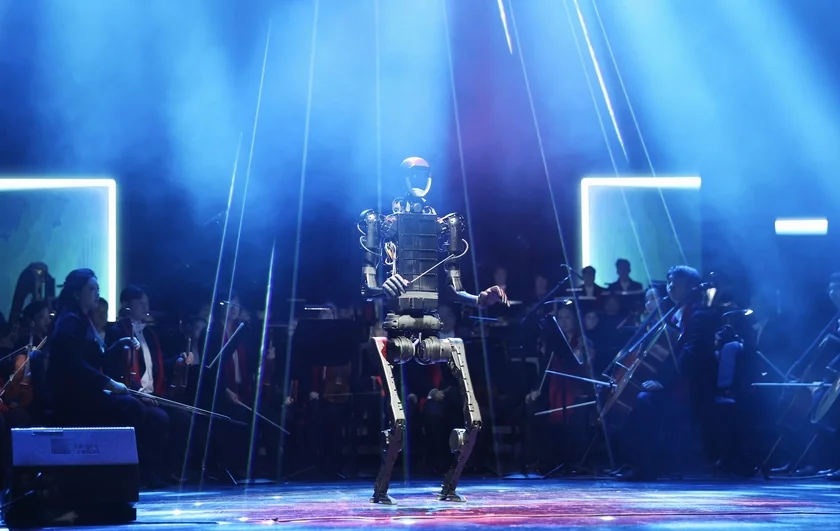
A robot conducts an orchestra in the Chinese city of Ji'anxi, December 28, 2025. Photo by Liu Zhankun/China News Service/VCG via Getty Images
The cover photo for this article shows a robot conducting an orchestra in the Chinese city of Ji'anxi on December 28, 2025. This is part of a new reality. Where is everything heading in the near future?
Continuous Learning
Continuous learning has reappeared on the agenda. By continuous learning, we mean artificial intelligence systems that can continue to learn after deployment, rather than remaining static after a single training session.
In theory, this allows models to adapt to new data, user behavior, and environmental changes. There are several interesting ideas, but none are yet ready for widespread and reliable use. Truly testing promising approaches requires significant budgets, complex infrastructure, and strict control to ensure the model doesn't "learn what it shouldn't."
Closed and Open AI Labs
American AI labs have largely become closed. This means that the most advanced research and models are no longer openly published. The latest techniques for training frontier models — the most powerful and expensive — are significantly less accessible to the public today than a year ago. This is evident, for example, in publications and the industry's main conference — NeurIPS.
Interestingly, against the backdrop of greater closure among American market leaders, Chinese laboratories have now taken up the baton in releasing models with open weights or even entirely open source. Open source means that the software is available to everyone. Open weights mean that the trained model itself can be downloaded and used.
DeepSeek Moment and RLVR
The DeepSeek moment had a significant impact on 2025. It showed that small teams, using smart methods, can achieve results that previously required enormous resources.
Significant progress has emerged in RLVR — reinforcement learning with verified rewards. This is a method where a model receives a "reward" for correct actions, and correctness can be automatically verified.
Currently, this works best in mathematics and programming. In 2026, we will likely see the expansion of this post-training direction into physics, chemistry, and other sciences. Aiding scientific research is one of the main goals, but perhaps new methods of model training will be needed for a real breakthrough.

Andrus Khrapavitski. Photo from social networks
Data and Ownership
Collecting data with verified rewards for business tasks is a complex matter.
Most specialized data is proprietary to companies and protected by them, as it gives them a competitive advantage. It's not so easy to convince business leaders to share such data, for example, with OpenAI or Anthropic.
Medium-Sized Models
Great potential lies in using medium-sized models with open weights and training them within companies.
Such models are powerful enough but significantly cheaper to use. This is becoming increasingly economically viable.
Agents
2026 will undoubtedly remain the year of agents. AI agents are systems that can plan actions, use tools, and perform tasks.
In 2025, programming agents had great success. In 2026, we will see their expansion into other areas.
For many companies, small models that are better at interacting with tools (browsing files, searching for information, executing functions, writing code, etc.) may become the optimal choice.
Using Computation During Inference
Increasing computational resources during inference (the moment when the model provides an answer) has great potential.
That is, instead of trying to achieve the best possible results during model training, it makes a lot of practical sense to work with models that can process a larger context (more words), integrate better with tools, and use resources more intelligently.
At the same time, large companies will continue to scale up infrastructure. In this regard, 2026 could be even hotter than the past year.
Vibe Coding and Testing
Vibe coding is gradually displacing traditional programming.
This is an approach where the developer sets the direction, and AI takes on the main volume of work in writing code or even, more quickly, writes it entirely according to a given plan. This makes testing significantly more important. Companies need to invest in automated tests and quality assurance. The role of the developer itself is also changing. As renowned AI researcher Andrej Karpathy joked, English has become the new programming language.
Accordingly, old technical interview formats are becoming less and less useful.
The Bubble and General Artificial Intelligence
The AI bubble in the stock market truly exists. Perhaps it might even burst in 2026. But even in that case, progress will continue. The market is overheated, certain corrections will happen sooner or later, but a new AI winter is not expected, I think. And it's still too early to expect general artificial intelligence next year.
«Nasha Niva» — the bastion of Belarus
SUPPORT USNow reading








Pinsk—Minsk train stopped near Dzyarzhynsk without heating. After arriving in the capital, passengers were picked up by people from social networks and driven home




























Comments