


Dulina responded to Kalesnikava: The cloak is firmly stuck to Lukashenka. One must treat the disease, not the symptoms
"Everything has gone too far. Therefore, I'm afraid Masha's proposal simply won't work," Natallia Dulina, a former political prisoner and associate professor of Minsk State Linguistic University, who was imprisoned with Kalesnikava in the Gomel women's colony, wrote on her Facebook page in response to Maria Kalesnikava's interview .
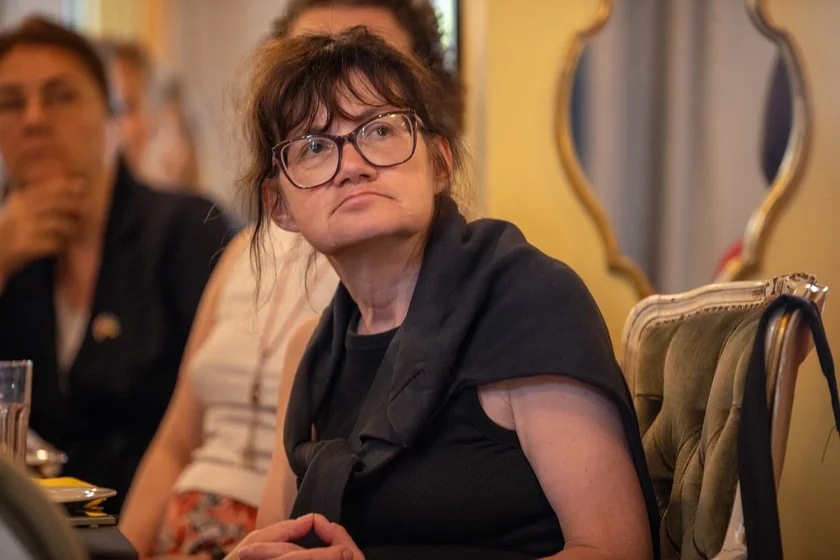
Natallia Dulina after her release. Photo: Press Service of Sviatlana Tsikhanouskaya's Office
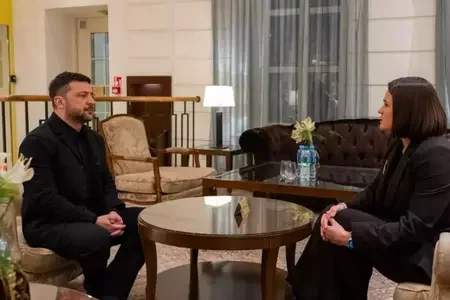
In a big interview with Maryna Zolatava, Maria Kalesnikava called on the European Union to enter into a dialogue with the Belarusian authorities. "If America does this, why can't the EU do it?" — Kalesnikava said. "I'm afraid Masha's proposal simply won't work," Natallia Dulina replied to her. "This cloak is so firmly stuck to Lukashenka that even with all the desire in the world, he won't be able to remove it himself. He won't want to."
Maria Kalesnikava called for a "return to normalcy": "A return to normalcy is not a process that happens quickly or in one day. It's a gradual reduction of pressure on society and business, bringing the country out of isolation. This involves an end to arrests, the suspension of repressive laws, so that people can freely read news, travel, conduct business, and develop civic initiatives, calmly return to the country, and obtain documents abroad. For this, clear and predictable rules are needed — both for people returning and for the work of independent media and civil society," Kalesnikava said.
Maria Kalesnikava believes that Lukashenka's supporters themselves are interested in changes in the country.
"And the situation that has now developed in our country will one day end. And why not start now to create an atmosphere and groundwork for further political transformation to happen less painfully or with the fewest upheavals?" — Kalesnikava said.
"Is such a return to normalcy possible under the current government? Many of these things existed under Lukashenka previously. Is it possible now — that's a difficult question. But Western partners can talk about this, and the authorities within the country can also understand the importance of this process," Kalesnikava says.
Among those who responded to Kalesnikava's interview is Natallia Dulina, a former political prisoner and associate professor of Minsk State Linguistic University, who was imprisoned with Kalesnikava in the Gomel women's colony.
"The first thing I would like to note is the excellent journalistic work of Maryna Zolatava. I am very grateful to you, Maryna, for your professionalism and at the same time the unusual humanity and empathy that this conversation radiates," Dulina wrote on her Facebook page. "I was captivated by your open and very attentive response to Maria Kalesnikava's equally sincere and detailed account. Thanks to this interview, we learned a lot about Masha, although much of what was said, I had already long seen and understood from her actions and from those few and fleeting, but invaluable meetings with Masha in the colony.
I really want to react to some statements that touched my emotions, feelings, and thoughts. I simply cannot help but share this.
And this concerns Masha's attitude towards the possibility of talking to Lukashenka, psychologically (yes, indeed!) influencing him. Masha reminds us that mercy is a manifestation of unusual moral strength. A person who has done a good deed feels, how to put it... well, something like moral relief, feels satisfaction from their noble act, and this makes them strong and invincible in their own eyes.
The problem is that Lukashenka has crossed a line beyond which it is no longer possible to perform good deeds. Whatever he does now, neither for himself nor for others will it erase the deeply ingrained mark of a cruel and ruthless criminal. For him, what's at stake now is not even the loss of power, but the fear of losing his life. Losing basic freedom and security. Everything has gone too far. Therefore, I'm afraid Masha's proposal simply won't work.
The attitude towards the possibility of releasing political prisoners. You see, the situation with these people resembles a leaky boat. If we merely bail out water (people who have fallen victim to repression) without firmly plugging the hole at its bottom, the boat will continue to sink. Therefore, first we need to stop the continuous, unrestrained inflow of water, and then bail out all the remaining water. I understand that such a comparison seems cynical and sacrilegious, because the main thing, as Masha said, is people. But, to speak in medical terms, we are treating symptoms, not the disease. And the longer we try to get rid of symptomatic pain, the more dangerous and deadly this systemic disease becomes.
I return to Masha's ideas about how Lukashenka can be persuaded to release people. There's a parable — lately I've been fascinated by parables — about a dispute between the north wind and the sun over who is stronger. To test this, they decided to hold a competition: who could remove the cloak from a lonely traveler. However much the wind raged, unleashing unbearable cold upon the man, he wrapped himself even tighter in his cloak. But when the Sun appeared and warmed the frozen traveler, he himself removed the cloak, without any coercion — the man no longer needed it.
I also, like Masha, believe that kindness can melt any cold, overcome even the most seemingly intractable evil. But there is, it seems to me, one "but" in this case. This "cloak" has become so entrenched, so firmly stuck to Lukashenka, that even with all the desire in the world, he won't be able to remove it himself. He won't want to.
The wind, of course, will have to repeat its actions again and again to finally tear off this ill-fated shell, permeated with others' suffering. So that it would simply be impossible to hold onto it with any internal forces," Dulina concludes.























Comments
з чым не згодны ? 1) , 2) , 3), etc. я гатовы дзеля грунтоўнай размовы