


Ocean Changed the Face of One of Iceland's Most Famous Beaches in a Few Days
Just at the beginning of the week, the famous cave among basalt columns could be reached on foot. Now, this spot is covered by water and a steep cliff. In just a few days, the Atlantic Ocean significantly altered the contours of one of Iceland's most famous beaches.
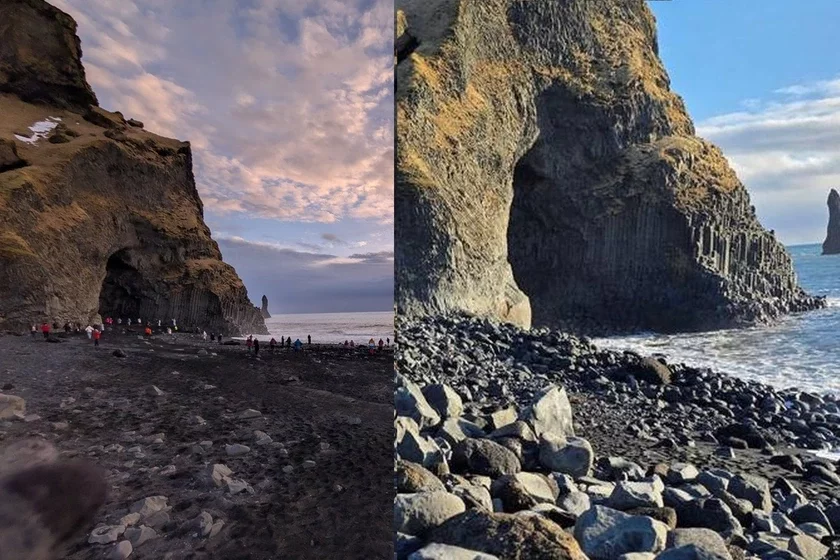
Black sand beach Reynisfjara in December 2025 (left) and February 2026. Photo: _adanneya / X
On the southern coast of the island, in the Mýrdalur valley, lies Reynisfjara — a black volcanic beach, considered one of the country's main natural attractions. It is distinguished by basalt columns, a cave at the foot of the cliffs, and powerful Atlantic waves. Hundreds of thousands of tourists visit annually, and the beach is a mandatory stop on most tour routes in southern Iceland.
Praia de areia preta de Reynisfjara, na Islândia, considerada uma das mais perigosas do mundo
Muitas pessoas já foram mortas por ela, e é proibido virar de costas quando estiver próximo dela. pictwitter.com/0fMl6nMd5a
This is how the beach looked before. Video: accuweather / X
However, in just a few days in February, the appearance of the beach changed dramatically. According to the website icelandmonitor.mbl.is, the coastline was literally reshaped by the sea. Where a wide sandy stretch once lay, there is now deep water. Instead of a relatively level approach to the ocean, a high, steep cliff has formed, and large boulders lie along the surf line. In the sandy area, right under the cliff, massive stones are visible, which the waves powerfully roll along the shore.
According to local guides, powerful currents washed away dozens of meters of sand. While it was recently possible to approach the basalt columns and the cave directly, now the sea reaches the cliffs themselves, and water fills the entrance to the grotto. Observers note that the changes happened extremely quickly — the beach began to look completely different in literally just a couple of days.
Reynisfjara is known not only for its beauty but also for its danger. The Atlantic waves here are particularly powerful and unpredictable. Tragic incidents have occurred in the past when people who approached too close to the water were swept away by sudden waves and carried out into the ocean.
The famous black sand beach, known as Reynisfjara was partially eroded by the ocean during a recent storm in Iceland pic.twitter.com/vzkvOqK5Ys
The new configuration of the shore may increase the risk. Experts note that tourists are attempting to descend from the newly formed cliff to the water's edge. While the weather appears calm, the danger might seem minimal. But if the waves suddenly intensify, it will be difficult for those at the bottom to quickly climb back up the steep slope. In this regard, there are calls to strengthen control at the beach, without waiting for another accident.
Local residents note that the coast of Iceland is always in motion — sand constantly shifts, and the coastline changes. However, the current processes are occurring on a much larger scale than usual. For several weeks in January-February, the country was affected by persistent strong easterly winds. Large volumes of sand were washed away and carried west towards Dyrhólaey cape.
Meteorologists explain this by a combination of a wide area of high pressure in the north of the country and deep cyclones in the south. The southern coast found itself in the collision zone of these systems, which led to intensive erosion.
Iceland's landscape is forever changing. Saw some recent videos of Reynisfjara & it looks so different from what I saw last December.
Weeks of strong easterly winds have nearly eroded the shoreline. Mother Nature always reminds us who is in charge.
4: 2/26. pic.twitter.com/bsyuwU37wb
Despite the large-scale changes, observers do not expect a decrease in tourist interest. For most visitors, this is their first visit, and they perceive the beach as they see it now. However, the events of recent days have served as a vivid illustration of how quickly even the most famous and seemingly familiar landscapes can change on the volcanic coast of the North Atlantic.


























Comments