


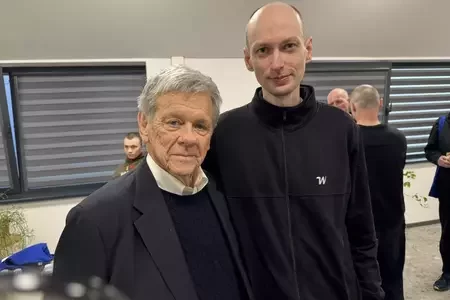
David Swartz served as ambassador to Belarus from 1992-1994.

Swartz died on February 11, but the fact of his death went unnoticed at the time until highlighted by Siarhiej Naumchyk.
David Swartz was born in Chicago in 1942. He was a specialist in Soviet Union and Eastern European affairs, fluent in Russian and Ukrainian.
He worked at the US Embassy in the USSR and was the head of the group for opening the US Consulate General in Kyiv. He served as US Consul General in Zurich; Consul General in Calgary (Canada); and Deputy US Ambassador to Warsaw (1984-1988). From August 1992 to January 1994, he was the US Ambassador to Belarus.
He retired in 1995. In 1996, Swartz founded and led the European Humanities University Foundation. At the request of the State Department, he headed the Organization for Security and Co-operation in Europe Mission in Moldova for two years (2001-2003).
"Sad news came from the United States: David Swartz (1942-2026), the first American ambassador to Belarus, passed away," wrote Siarhiej Naumchyk. —
The US was not the first country to recognize Belarus as an independent state (Poland did so immediately after August 25, 1991, followed by Turkey and Sweden), but as soon as then-President George Bush announced the recognition and establishment of diplomatic relations in December '91, a diplomatic mission arrived in Minsk. They settled into the "Belarus" hotel.
David Swartz, who, along with three colleagues, undertook the organization of the future embassy's work, recalled that the rooms were filled with American military boxes of canned goods — Washington feared that the diplomats would have nothing to eat.
The presentation of credentials to Stanislaŭ Šuškievič, Chairman of the Supreme Soviet, took place more than half a year later — on the first anniversary of Belarus's declaration of independence, August 25, 1992.
David Swartz left memoirs that allow one to see the events and some politicians of that time from a slightly different perspective than we Belarusians do.
"Yes, it was interesting for me to learn that in 1993, Americans (apparently, this was information 'for internal use') assessed the living standard of Belarusians as the best compared to other former USSR republics. We in the Belarusian Popular Front (BNF) complained (and rightly so) about the slowdown of economic reforms, nevertheless, elements of reforms were still present, and they began to bear fruit. In any case, the country was not 'in ruins,' as Lukashenka would later repeat," wrote Siarhiej Naumchyk.















Comments