


Vytautas Landsbergis, or Who isn't afraid to become a leader in a pivotal time
History often chooses its heroes against obvious logic. Vytautas Landsbergis was neither an underground oppositionist nor did he belong to the party nomenclature. A professor-musicologist, a researcher of Čiurlionis, and a chess enthusiast — in theory, national leaders look far from such. However, it was he who was destined to become the architect of the restoration of Lithuanian statehood. A descendant of a distinguished intellectual dynasty, he carried within him the "gene" of pre-war Lithuania, which half a century of Sovietization could not destroy.

Vytautas Landsbergis. January 1990. Photo: Alain Nogues / Sygma / Sygma via Getty Images
Vytautas Landsbergis was born on October 18, 1932, in Kaunas. His background played a decisive role in shaping his personality: he is a representative of two significant intellectual dynasties for Lithuania.
On his mother's side, his grandfather was Jonas Jablonskis — a great linguist who standardized grammar and is considered the "father" of modern Lithuanian literary language. Vytautas himself wrote that thanks to his grandfather, he grew up in an atmosphere where the Lithuanian language was not just a means of communication, but a sanctuary.
His mother, Ona Jablonskytė-Landsbergienė (1894—1957), chose medicine; she was an ophthalmologist. During the years of Nazi occupation, she showed exceptional courage: she hid a Jewish teenage girl from the ghetto, Bella Gurvi, in her home. In 1995, the Yad Vashem memorial posthumously awarded her the title Righteous Among the Nations.
On his father's side, his grandfather, Gabrielius Landsbergis-Žemkalnis, was a well-known playwright and figure of the Lithuanian national revival of the 19th century.

Ona Jablonskytė-Landsbergienė and Vytautas Landsbergis-Žemkalnis. 1940. Source: atmintiesvietos.lt
His father, Vytautas Landsbergis-Žemkalnis (1893—1993), volunteered for the Lithuanian army, participating in battles for Lithuania's independence in 1918—1920. Later, he received an architectural education in Rome, taught, and implemented significant architectural projects in Lithuania.
Vytautas's early years were spent in Kaunas' Žaliakalnis district, in the atmosphere of a "temporary capital" steeped in the spirit of modernism and patriotism. It seemed that the independence won by his father's generation was forever.
However, this peaceful way of life collapsed when Lithuania found itself between the millstones of two totalitarian regimes. Lithuania's fate was predetermined in 1939 by the signing of the Molotov–Ribbentrop Pact between Germany and the USSR. The secret protocol to the treaty divided Eastern Europe, assigning Lithuania (as well as Latvia and Estonia) to the sphere of influence of the Soviet Union.
The implementation of this plan began in the autumn of 1939. Lithuania, whose army numbered only 28,000 men, was forced into Mutual Assistance Pacts and the stationing of Soviet military bases. Resistance to the giant USSR machine after this became impossible. The climax came in June 1940: Moscow issued an ultimatum, demanded the formation of a pro-Soviet government, and introduced the Red Army. The country was occupied.
To legitimize the seizure in the eyes of the West, the occupying authorities carried out a special operation for "voluntary accession to the USSR". After fictitious elections in July 1940, the new parliament proclaimed a Soviet republic, which was incorporated into the USSR in August. The USA and a number of Western countries did not recognize this act, rightly considering it an annexation.
Thus, for the boy Vytautas, peaceful life ended. Instead of school and games, he witnessed regime changes: the first Soviet occupation (1940), the Nazi occupation (1941—1944), and the return of Soviet troops in 1944, which cemented the loss of independence for half a century.

Vytautas Landsbergis-Žemkalnis with his sons Vytautas (left) and Gabrielius. Date unknown. Source: lrt.lt
Between 1939 and 1943, Vytautas's father held the high position of chief engineer and architect of Vilnius. In 1944, he left for Germany, and in 1949 — for Australia. His eldest son, Gabrielius, who was arrested by the Gestapo in 1944 and imprisoned in Germany until 1945, settled with him there. Twelve-year-old Vytautas remained in Lithuania with his mother. From this moment on, the family was divided by the "Iron Curtain".
Youth of Vytautas Landsbergis
Vytautas spent the post-war years in Soviet Lithuania with the dangerous stigma of being the son of a political emigrant. This could have ruined his future, but the authority of his deceased grandfather Jablonskis and the impeccable reputation of his mother, the doctor, helped the family survive and avoid arrest.
Contrary to the stereotype of a refined musician, young Landsbergis was not a typical desk-bound scholar. He grew up as an ardent person. Having received his primary education in Kaunas schools, in 1950 he entered the Lithuanian State Conservatory in Vilnius, studying piano. During his student years, he actively played basketball but later left the court due to the risk of injuring his fingers.
Explaining his path from musician to politician, Landsbergis writes in his autobiography that choosing musicology was a form of escapism for him. According to him, in the Soviet Union, humanities such as history or law were completely subservient to ideology, and it was impossible to honestly engage with them.
Music, and especially the study of M.K. Čiurlionis's work, offered an opportunity to stay away from Soviet lies. Landsbergis recalls that delving into cultural heritage became a way for him to preserve national identity without entering into open conflict with the system.
His main passion, besides music, was chess. Landsbergis played at a high level, twice participated in the finals of Lithuanian championships, and earned the qualification of Candidate Master of Sport. Specialists noted his positional style of play. The ability to calculate moves and take "grandmaster pauses" would later become the basis of his political style.

During one of the chess tournaments. Undated photo. Source: tv3.lt
In 1955, he graduated from the conservatory. His first marriage to pianist Rita Kučinskaitė-Sakalėnė also dates to this period. The couple had a daughter, Jūratė (1955), who would later become a musicologist. That family life did not work out, and the couple soon separated.
The late 1950s marked a time of radical change in Landsbergis's fate. In 1957, his mother, Ona Landsbergienė, died without seeing her husband before her death. Vytautas remained alone in Vilnius and focused on teaching.
In 1959, a sensational event for that time occurred: his father, Vytautas Landsbergis-Žemkalnis, returned from Australia to Soviet Lithuania. The authorities sanctioned this return, wanting to show how people were returning, and at the same time use the experience of the famous architect for the restoration of monuments.
At this moment, Vytautas was already 27 years old.
His father did not return alone but with his second wife, whom he met in emigration. They settled separately but reestablished relations. The intellectual dialogue between father and son continued for the next three decades — the architect lived to be 100 years old and witnessed his son's triumph in 1990.
Soon after his father's return, Vytautas also settled his personal life. In 1960, he married Gražina Ručytė (1930—2020). This union became fateful. Gražina came from a repressed family: in 1949, she was deported to Siberia, where she survived by playing the accordion. She returned to Lithuania only in 1957, enrolled in the conservatory, where she met Vytautas.
Marrying an "exile" for the son of an emigrant was a risky step, but at least the family was cemented by shared values. In this happy marriage, two children were born: daughter Birutė (musicologist) and son Vytautas (director and writer).

Gražina Ručytė-Landsbergienė and Vytautas Landsbergis. Undated photo. Source: lrytas.lt
Career of Vytautas Landsbergis
Up until the age of 56, Landsbergis remained a figure known mainly in academic circles. His career path had a clear ceiling: he fundamentally refused to join the Communist Party, which blocked his path to administrative positions. But by doing so, he did not stain his reputation.
He taught at the M. K. Čiurlionis School of Arts, and from 1978, he became a professor at the Lithuanian Conservatory. The main focus of his scholarly life was the study of the legacy of Mikalojus Konstantinas Čiurlionis. In 1969, Landsbergis defended his dissertation on this topic. Promoting Čiurlionis's work — a symbol of Lithuanian mysticism and independent spirit — became a way for the professor to legally cultivate the national idea under conditions of censorship.

Vytautas Landsbergis. Undated photo. Source: tv3.lt
At the same time, Landsbergis was not a conservative, stuck in the past. In his biography, there is an unexpected fact that connects him with the global avant-garde. His childhood friend was George (Jurgis) Maciunas — the founder of the famous "Fluxus" movement. Despite his friend's emigration, they corresponded. In the 1960s, while behind the "Iron Curtain," Landsbergis tried to implement "Fluxus" ideas in Vilnius, organizing performances and happenings. To Soviet censors, this looked like student hooliganism. Meanwhile, it showed the future politician as a person free from dogmatism.
Path from Conservatory to Tribune (1988—1990)
Vytautas Landsbergis's political ascent began on June 3, 1988, when the Lithuanian Movement for Restructuring ("Sąjūdis") Initiative Group was formed in Vilnius. The 55-year-old conservatory professor, known only as a musicologist and Čiurlionis researcher, joined its ranks, although he was not the most famous among the 35 founders.
On October 22—23, 1988, the Sąjūdis founding congress took place. At it, the central coordinating bodies of the movement — the Seimas and the Seimas Council — were established. Interestingly, at this stage, Landsbergis did not yet appear to be the sole favorite: during the elections to the Council, it was not he, but the philosopher Romualdas Ozolas, who received a record number of votes.
However, when the chairman was elected at the Seimas Council meeting on November 25, 1988, it was Vytautas Landsbergis.
Why was Landsbergis chosen, and not Ozolas? The compromise nature of his figure played a decisive role. Ozolas was a member of the Communist Party, which caused distrust among the radical wing of the movement. Landsbergis, on the other hand, was a non-party professor capable of uniting different currents.

Vytautas Landsbergis speaks at a rally in Vilnius on the occasion of the 50th anniversary of the Molotov–Ribbentrop Pact. August 23, 1989. Photo: Wikimedia Commons
In March 1989, Landsbergis entered the Union level: he was elected People's Deputy of the USSR. Under his leadership, Sąjūdis achieved a triumphant victory, taking 36 out of the 42 seats allotted to Lithuania.
Using the high platform of the Congresses of People's Deputies in Moscow, Landsbergis and his Baltic colleagues began a systematic attack on the legal foundation of the USSR. They initiated a parliamentary inquiry into the legal assessment of the Molotov–Ribbentrop Pact, arguing that Lithuania, Latvia, and Estonia did not join the Union voluntarily, but as a result of a criminal conspiracy between dictators.
Struggle for Lithuania's Independence
In February 1990, Lithuania held its first free elections to the Supreme Council, in which Sąjūdis candidates won an absolute majority.
The culmination was on March 11, 1990. At the first session of the new parliament, Vytautas Landsbergis was elected Chairman of the Supreme Council of the Republic of Lithuania, becoming the de facto head of the reborn state. On the same day, under his chairmanship, the Act of the Re-Establishment of the State of Lithuania was adopted.

Chairman of the Supreme Council of Lithuania Vytautas Landsbergis. April 1990. Photo: Chip HIRES / Gamma-Rapho via Getty Images
Landsbergis emphasized the legal subtlety of this moment: it was not the creation of a new state, but the restoration of what had been stolen in 1940.
"We did not consider this a transfer of power from one system to another, but rather a return to our old system. (…). We couldn't divorce because we were never married. We were raped and dragged into that house. So we're just leaving," he later explained, referring to continuity with the Republic of Lithuania of 1918—1940.
Moscow declared the Act of the Re-Establishment of Independence illegal and moved from threats to actions. The Kremlin imposed a harsh economic blockade, trying to punish the recalcitrant republic. Lithuania's oil and gas supplies were cut off, and Union-subordinate enterprises "unexpectedly" stopped shipping critically important goods — even medicines. However, the calculation that economic difficulties and shortages would force Lithuanians to overthrow Landsbergis's government did not come true — the country withstood the blockade.
Moreover, in December 1990, the republic's parliament adopted a demonstratively independent budget for the following year.

1991. Barricades around the Lithuanian Seimas building. Photo: AP Photo/Liu Heung Shing
"It stipulated that Lithuania receives nothing from the Soviet Union and, accordingly, pays it nothing. Trade relations would arise between states: what you supplied to us before, now sell; what we gave you, we will sell," Vytautas Landsbergis explained the logic of this decision.
The center responded to political audacity with a violent action. On the night of January 12-13, 1991, army units, supported by tanks and KGB "Alpha" special forces, entered Vilnius.
One column of armored vehicles headed towards the Lithuanian parliament, but the assault did not take place. The second column reached its goal — the television tower and the building of Lithuanian Radio and Television in the Karoliniškės microdistrict, around which thousands of unarmed defenders stood in a human chain. Soviet soldiers began the assault. As a result of this massacre, 15 people died, and more than 500 were wounded.

In the building of the Supreme Council of Lithuania during the events of January 1991. Photo: Wikimedia Commons
At this time, Landsbergis was in the parliament building, which was preparing for an inevitable assault.
"We distributed weapons to the guards, but I knew: if they entered, we wouldn't be able to physically fight back. Our victory could only be moral. If we died here, the world would not forgive it," Landsbergis recalled those terrible hours.
According to him, he tried to reach Gorbachev:
"I tried to call Gorbachev, but I was told he was asleep. I reached Yeltsin, and he immediately called Gorbachev. And Yeltsin said: 'Stop these atrocities.'"
It is difficult to say why Gorbachev ultimately did not order the full seizure of power in Lithuania. Perhaps it was part of his characteristic, half-hearted style. Or perhaps the USSR no longer had the strength to subjugate Lithuania, as this threatened to accelerate the "explosion of the empire from within."
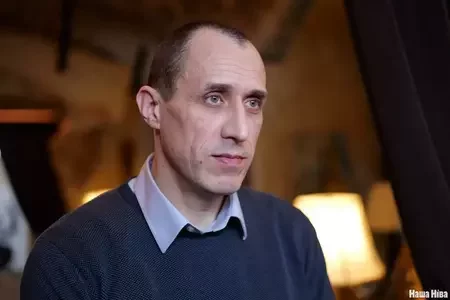
It is memorable that Belarusians actively supported the Lithuanians' struggle for independence. A delegation of deputies of the Supreme Council of Belarus arrived in Vilnius at the most alarming moment. Among the dozens of Belarusians awarded the January 13th Commemorative Medal (Sausio 13‑osios atminimo medalis) for active participation in defending independence was the first chief editor of the revived "Nasha Niva," Siarhei Dubavets.

Belarusian Uladzimir Karmilkin in Vilnius, January 16, 1991. Radio Liberty archive photo
Read also: Lithuania. Belligerent force against the people

Chairman of the Supreme Council of Lithuania Vytautas Landsbergis and Russian President Boris Yeltsin after signing the Agreement on Economic Cooperation. July 29, 1991. Photo: AP Photo / Liu Heung Shing
The final resolution came half a year later. In August 1991, the attempt at a state coup (GKChP, or August Coup) failed in Moscow, depriving the Soviet center of the remnants of its power. On September 7, 1991, Moscow officially recognized the independence of the three Baltic republics. Soon, Landsbergis led the delegation in negotiations with Russia, achieving the final withdrawal of occupation troops.
Political Swings (1992—2000)
After gaining freedom and the decline of revolutionary euphoria, Lithuania faced a harsh economic reality. Sąjūdis's popularity began to fall. Landsbergis clashed with the left wing of the Supreme Council, asserting that they were hindering reforms and sabotaging the exit from Russia's orbit.
In the 1992 parliamentary elections, Landsbergis's party suffered a defeat. The Democratic Labour Party of Lithuania (LDDP), led by former Communist Party leader Algirdas Brazauskas, won. Landsbergis left the post of head of state but did not withdraw from politics.
In 1993, he became one of the founders of a new right-wing force — the center-right party "Homeland Union" (Tėvynės Sąjunga) and was elected its chairman. He occupied the niche of a tough opposition leader, criticizing the government for "creeping Sovietization" and corruption.
The parliamentary comeback occurred four years later. After a convincing victory for the conservatives in the 1996 elections, Landsbergis returned to power, becoming the Speaker of the Seimas of the Republic of Lithuania. He held this position for a full term, from 1996 to 2000.
While serving as Speaker, Landsbergis attempted to return to the highest state office, putting forward his candidacy in the 1997 presidential elections. However, he only took third place, gaining 15.92% of the votes, and did not advance to the second round.

Speaker of the Lithuanian Parliament Vytautas Landsbergis during military exercises. March 1998. Photo: Giedrus Pocius / Sygma / Sygma via Getty Images
Nevertheless, as the head of parliament, he continued to shape the state's ideology, consolidating an irreversible course towards the West. Towards the end of his term, on September 12, 2000, at his initiative, the Seimas adopted a law recognizing the declaration of the Provisional Government of Lithuania of June 23, 1941, as a legal act of the Republic of Lithuania. This decision sparked sharp historical debates but underscored Landsbergis's desire for a complete legal revision of the Soviet period. However, President Valdas Adamkus did not sign this law.
From Vilnius to Brussels (2000—2014)
Despite stepping down as Speaker, Landsbergis did not intend to retire. In the 2000 elections, he was elected to the Seimas for the fourth time. During this period (2000—2004), he actively worked as part of Lithuania's delegations to the Parliamentary Assembly of the Council of Europe (PACE) and the Baltic Assembly.
In 2003, Landsbergis stepped down from party leadership of the "Homeland Union," taking on the role of strategist — Chairman of the Political Committee and a member of the Presidium. This allowed him to focus on Lithuania's integration into Western structures. Even before the country's official accession to the EU, in 2003—2004, Landsbergis was already working in Brussels as an observer delegated by the Lithuanian Seimas.
His full entry onto the European stage occurred on June 13, 2004, when Landsbergis was elected a Member of the European Parliament. In 2009, he was re-elected for a second term, becoming the oldest and one of the most authoritative representatives of the Baltics in Brussels.
He considered his main mission to be explaining the true nature of the Russian regime to Western politicians. In the corridors of the European Parliament, Landsbergis was often called a "hawk" and Russophobe, but the politician persistently repeated: Russia has not changed. Time would tell how right he was.
In 2005, Landsbergis initiated a high-profile campaign to ban Soviet symbols alongside Nazi ones. Landsbergis called on the EU to outlaw the hammer and sickle, red stars, and the USSR anthem. The initiative bore fruit in his homeland: in 2008, Lithuania adopted a law prohibiting the display of Nazi and Soviet symbols at mass events.
When the Russian army entered Georgia in 2008, Landsbergis sharply criticized the European Union for its softness and "appeasement policy," prophetically warning: "Next will be Ukraine or the Baltic countries."
"Europe likes to sleep. It only wakes up when bombs start falling on its cities. We in Lithuania don't sleep because we know who our neighbor is," he told his colleagues.
Patriarch of the Nation
In 2014, at 82, Vytautas Landsbergis decided not to run for the European Parliament again, ceding the way to younger politicians. However, this did not mean retiring. He remained the honorary chairman of the party "Homeland Union – Lithuanian Christian Democrats" (TS-LKD), retaining his influence. His speeches at party congresses still set the ideological vector for Lithuanian conservatives.

Vytautas Landsbergis gives a speech during the I Baltic-Black Sea Forum "Through Dialogue - Towards Trust" in Kyiv, December 1, 2016. Photo: Vladimir Shtanko / Anadolu Agency / Getty Images
The late 2010s brought a new surge of international interest in the professor's personality.

Stanislau Shushkevich and Vytautas Landsbergis, Kyiv, 2016. Photo: Den
In 2019, the documentary film "Mr. Landsbergis" by renowned director Sergei Loznitsa was released. The film won the main prize at the Amsterdam festival, reminding the world of the "quiet musicologist's" role in the collapse of the Soviet empire.
However, public success was overshadowed by a heavy loss. In February 2020, Gražina Ručytė-Landsbergienė passed away. She was 90 years old. Vytautas and Gražina had lived together for 60 years.
Despite his own health problems and hospitalizations, Landsbergis maintained mental clarity, continuing to write books and give interviews.
In 2022, the longest and most painful legal "gestalt" in Landsbergis's career was closed. For decades, his status caused controversy: in 1990—1992, the position of president did not exist in Lithuania, and Landsbergis governed the country as Chairman of the Supreme Council. Political opponents blocked attempts to officially equate him with a president for years.
The matter was settled on June 30, 2022. The Seimas of Lithuania adopted a special Law on the Legal Status of the Chairman of the Supreme Council. Vytautas Landsbergis was officially recognized as the head of state (de facto president) for the period from March 11, 1990, to November 25, 1992.
"I don't need titles. Titles are needed by the state so that it respects itself and its history," the politician himself commented on this decision.
Landsbergis also took an unequivocal stance regarding the war in Ukraine. He calls modern Russia a "cancerous tumor" and an "evil empire 2.0," and considers Putin a threat to the entire civilized world.

Vytautas Landsbergis (left) at Ukrainian President Volodymyr Zelenskyy's speech in Vilnius, January 10, 2024. Ukrainian Presidential Press Office via AP
"Russia is not a country, it's a state of mind. And that state is war with the whole world. Putin will go exactly as far as he is allowed. If you don't stop him in Ukraine, you'll have to stop him in Poland or Lithuania," he stated in an interview.













Comments
[Зрэдагавана]
Гэта вельмі дасведчаны,адукаваны,культурны і разумны дзядзька,ен бадай самы паважаны мной летувіскі дзеяч.
Аднойчы ў Бруселі на плошчы Шумана ў будынку Еўракамісіі пасля "выбараў"2010 я прысутнічаў на даволі масавым схадняке беларускай апазіцыі,там выступалі "дзеячы" ад Рымашэўскага да Калякіна,спадар Ландсбергіс таксама прысутнічаў.Нават быў там такі ціпок- Сяргей Каваленка,ён жа елачны бэтмэн,які павесіў БЧБ на елку ў Віцебску. Карацей кожны ўдзельнік выступіў з прамовай і калі чарга дайшла да Сяргея Каваленкі-пачалася дзіч. Ен чамусці пачаў разганяць,што сучасныя літоўцы гэта жмудзь,што Вільня-беларускі горад,што літоўцы гэта беларусы і гд,карацей кажучы- Шарыкаў...) Атмасфера стала даволі нязручнай,але спадар Ландсбергіс прыгожа і вельмі дыпламатычна ўсе разруліў і нават дапамог Каваленку трохі менш выглядаць быдлагопнікам.
Вось такі адбыўся смешны выпадак з Ландсбергісам. )