


Tomas Venclova: "Lithuania and Belarus were never at enmity. This is a rare case for relations between two nations"
World-renowned Lithuanian poet, intellectual, and dissident Tomas Venclova told in an interview with "Salidarnasts" how he put his relationship with his father above his political views, under what circumstances he managed to escape from Soviet Lithuania, and how he views the shared history of Belarusians and Lithuanians.
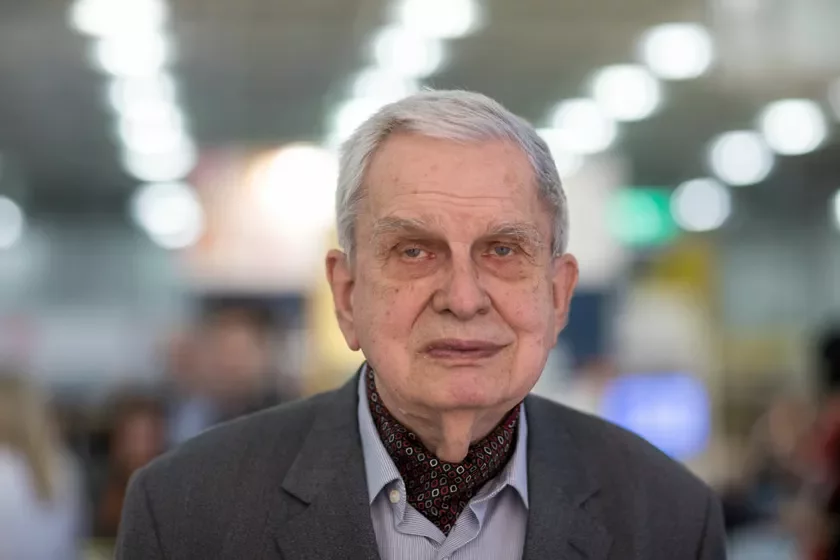
Tomas Venclova. Photo: David Levenson/Getty Images
— Your father Antanas Venclova, who received the title of "People's Writer of the Lithuanian SSR" in 1965, supported the Soviet regime. How did you interact, considering that your views and beliefs were completely different?
— Until I was 19 or 20 years old, I held the same views as my father. But then I discovered a lot of new information, and under the influence of both personal experience and friends, my views changed significantly.
Although my father and I did not hide that we viewed the situation in Lithuania differently, we tried to maintain a filial relationship, to be father and son. And I am very pleased that we succeeded in this.
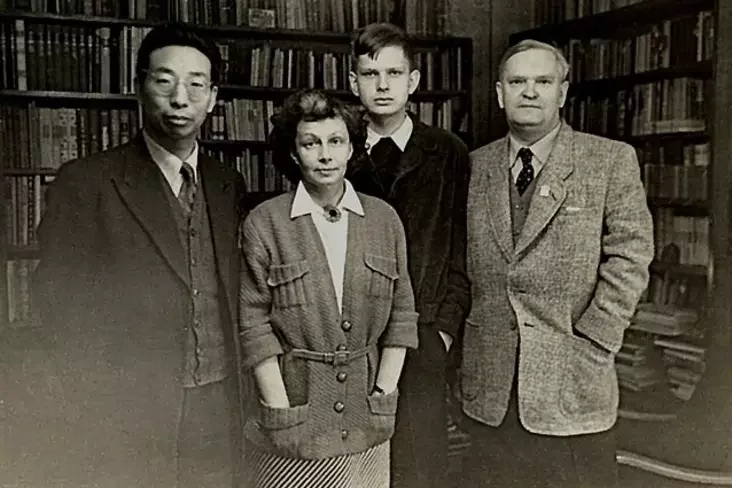
Tomas Venclova with his mother Eliza and father Antanas: in a 1955 photo, they host Chinese writer Ge Baoquan in their home
My father was seriously ill, he had several heart attacks, which made me a little cautious in my actions and statements. If I had openly acted as a dissident during his lifetime, I think my father might have died much earlier (Antanas Venclova passed away in 1971 — 'Salidarnasts').
— Today, in many Belarusian families, children and parents, brothers and sisters do not speak to each other due to polar opposite political views: some support Lukashenka's regime, others cannot reconcile with dictatorship and human rights violations. Do you think it's still worth trying to preserve relationships?
— The situation is different in every family. I am personally glad that my relationship with my father was preserved. And he himself gave me an example, well-known to him, of the relationship between an Italian right-wing figure and his communist son, who, despite everything, remained father and son. My father said: "We have approximately the same situation."
But, of course, I cannot offer general advice. I am only sure of one thing: it's better with less anger and more tolerance.
— Under what circumstances were you able to leave Soviet Lithuania in 1977?
— This story is complicated. In the Lithuanian SSR, because of expressing my views, I lost the opportunity to engage in cultural activities, from whose earnings I lived. They stopped printing me (even translations), stopped inviting me to teach at the university.
And then I wrote an open letter to the Central Committee of the Lithuanian Communist Party, circulating it as samizdat (thus the letter reached the West and received resonance). So I wrote: since they don't let me work in Soviet Lithuania, I believe it's more reasonable for me to go to the USA, where there is a Lithuanian community, where Lithuanian books are published, where I can be useful.
To write such a letter was madness. If only because nobody was simply allowed to leave for the West. True, Jews were allowed to leave — and even then, not easily. But I was not Jewish. If they let people leave after such letters, everyone would have been able to leave, and many would have left.
But my letter gained prominence; in the West, they wrote about it and spoke about it on the radio. And two people came to me who were forming the Lithuanian Helsinki Group (the first open human rights association established in the Lithuanian SSR in 1976 — 'Salidarnasts'). And they said: you are now a well-known person, and we need well-known people — won't you join us?
My answer was: I would join — I have nothing to lose, and I consider human rights activities useful. But if I join the Lithuanian Helsinki Group, it's possible that they might still let me leave the country while you are imprisoned, and then I would look like a deserter.
They said: don't worry, everyone will be imprisoned — including you.
But if they suddenly let you go (which is unlikely), you will become our representative in the West — we need someone like that too.
I joined the Lithuanian Helsinki Group, and we engaged in open dissident activity. At one point, people from the authorities came to me and said: "You're asking to go abroad — so why aren't you leaving?". I replied that I didn't have a passport or a visa. They told me: you'll have a passport and a visa — just go. They gave me two weeks to think about it.
I needed to consult with my family and friends. My family was my mother. Mother said: of course, go, it's better to be there than in prison. Friends also approved: go, you will speak on our behalf.
I left and began representing the Lithuanian Helsinki Group, for which I was deprived of Soviet citizenship. Only then did I ask for political asylum in the USA and received it. And after some time — US citizenship as well.
By the way, only one person from the Lithuanian Helsinki Group was imprisoned: Viktoras Petkus. He was released only in 1988: in free Lithuania, he became a presidential advisor on human rights. Viktoras had not the slightest complaint about my departure and remained my close friend.
— How did you feel initially in the USA?
— I was very lucky to get a university job. I had, as they said in Soviet times, strong connections. Specifically — friends Czesław Miłosz and Joseph Brodsky, who took care of me, although, of course, I also had to put in great effort — to defend my dissertation.
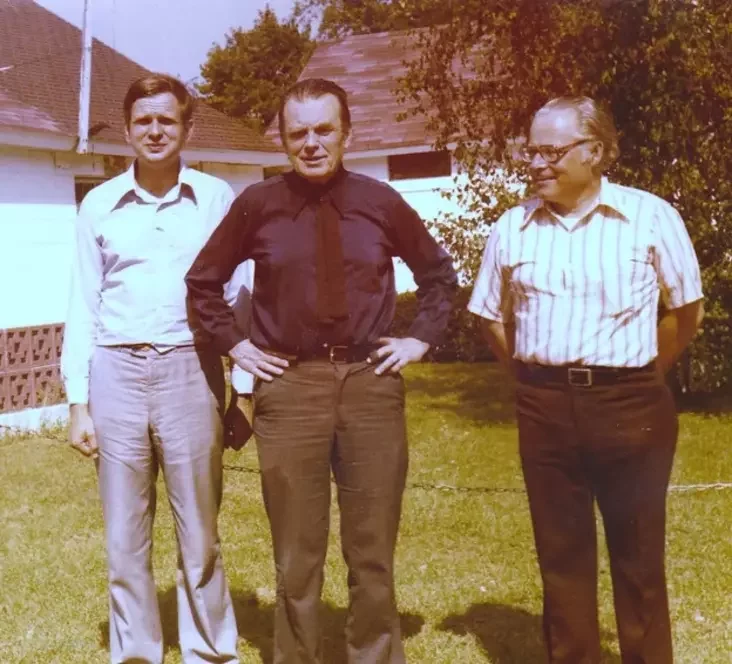
Tomas Venclova, Czesław Miłosz, Rimvydas Šilbajoris
At Yale University, the second oldest and highest quality American university, I taught Slavic literature for over 30 years. I didn't go into radio, like most political emigrants from the USSR; I only engaged in politics in my free time.
I didn't think I would ever be able to return to Lithuania.
The USSR was not going to change. However, unexpectedly, 10 years after my emigration, the Soviet Union began to rapidly disintegrate. And I was able to start visiting Lithuania.
— Why did you move from the USA to Vilnius in 2017, after 40 years of emigration?
— Because it's more interesting in Vilnius. I didn't fall in love with America. New Haven, the city where Yale University is located and where my wife and I lived, is a good place: there is cultural life, excellent museums, two theaters, etc. But in Vilnius, the cultural life is still more vibrant. Moreover, it's not foreign, but my own.
Thanks to my wife's persuasion, I decided to return to Vilnius. Why I'm glad: here we have more friends, more intense communication.
— I didn't persuade him, — the writer's wife Tatiana Milovidova-Venclova interjected at this moment. — I just said that I would like to live in Vilnius. Besides, I am Lithuanian through my grandfather.
— She recently found that out. Her grandfather died during the Siege of Leningrad. He was a true Lithuanian — from Samogitia, a Catholic. But during Stalin's time, he hid these facts: ethnic minorities were actively imprisoned then. By the way, he was a party member, but managed to avoid repression. He left the party in an interesting way: in 1932, he stopped paying membership fees. So when the Great Terror came, he was no longer in the spotlight and managed to survive.
— Today, due to the actions of Lukashenka's regime, there is much talk about the confrontation between Belarus and Lithuania. A question for you, as the author of the book "History of Lithuania for Everyone": but in the past, were Lithuania and Belarus ever at enmity?
— No, never. This is a rare case for relations between two nations. Perhaps there was no crazy mutual love, but there was no real enmity either. Lithuanians had enmity with Poles, Germans, Russians, and even Latvians (something like a small war in 1918-1920). But with Belarus, everything was normal.
Before the war in Ukraine, I visited Belarus several times: I went to Navahrudak, Mir, Niasvizh — looking at our shared historical heritage. I visited Kurapaty tract. In general, I visited almost all major and minor Belarusian cities.
And in the 1950s, a friend and I paddled a kayak from the settlement of Piasochnaje near Minsk (where the Neman River begins) to the Baltic Sea in 23 days. Then I saw a lot: Stoŭbcy, Ščorsy, Liubča, and Hrodna…. Remembering the Grand Duchy of Lithuania, we felt that to some extent it was our shared land.
By the way, on the Belarusian side, we met several Belarusians who could speak Lithuanian. In general, at that time, it was much freer in Lithuania than in Belarus; the Soviet authorities were much more intrusive there. Nevertheless, the closeness of the peoples was felt.

Tomas Venclova with Sviatlana Tsikhanouskaya. September 11, 2020. Photo: Arturas Morozovas/Getty Images
— What should Belarusians and Lithuanians do with the shared historical heritage that hotheads are trying to divide today?
— I spoke with a current Belarusian activist and asked him: "What percentage of history and culture in the Grand Duchy do you think was Belarusian?" He replied that it was 100%. Then I asked: "And how much was Lithuanian then?" He replied: "Also 100%." I liked that.
In the times of the Grand Duchy of Lithuania, everything was very intertwined. Even the languages at that time were closer to each other, and many knew both — Lithuanian and Slavic. Including Lithuanian princes. For example, the native language of Algirdas (Olgierd), who was the Prince of Vitebsk, was Lithuanian, but he also spoke Slavic — Proto-Belarusian or Early Belarusian. Moreover, probably on the latter even more often than on Lithuanian.
In general, the situation in the Grand Duchy of Lithuania was somewhat similar to the situation in Kievan Rus', where the princes were Scandinavians, Varangians. Igor is Ingvar, Olga is Helga. But they became Slavicized, adopted the contemporary Slavic language.
Sometimes I am asked: Mindaugas — is he Lithuanian or Belarusian? According to Lithuanian etymology, everything is clear: Mindaugas means "much thinking," "much wise." It is not a Slavic name. Although, undoubtedly, Mindaugas knew the Slavic language.
The same with Vytautas ("leader of the people"): already by the names of the princes, it can be established that by origin they were Lithuanians.
But Belarus was an important part of the Grand Duchy of Lithuania. More was spoken in Slavic, and literacy was mainly in Slavic — since the Slavs were baptized, and the Lithuanians remained pagans, and culture in those times was connected with Christianity.
In the late 19th — early 20th century, the Lithuanian and Belarusian national movements were very similar and very close. There were not only acquaintances but even marriages — Lithuanian figures married Belarusian women and vice versa.
There was a lot of Belarusian activity in Vilnius. Lutskievichs, Kupala, Bahdanovich, and many others.
By the way, much was connected with Königsberg, present-day Kaliningrad, for Lithuanians: the first Lithuanian book was published there. Königsberg had roughly the same significance for Lithuanians as Vilnius did for Belarusians (in the past, an important cultural center that does not belong to the country).
Interaction, mutual assistance, and joint work continued throughout the early 20th century. For example, the author of the Belarusian national flag, Duzh-Dusheŭski, lived and died in Kaunas.
Both among Lithuanians and Western Belarusians, there were anti-Polish sentiments. Under Soviet rule, interaction was colored by communism, but not always.
So nothing but good can be said about our relations, which is far from always the case in the relations of other peoples.
I think there should not be great disputes over historical heritage. Someone inflates the topic for political reasons, someone considers the so-called "Litvinists" to be the main enemies, but, in my opinion, this is all nonsense, the disagreements are not as serious as they try to portray.
By the way, from modern Lithuanian literature, I would recommend the historical novels of Kristina Sabaliauskaitė…
— …Literally in 2025, her first two volumes of Silva Rerum were released in Belarusian translation.
— Belarusians should find it interesting. It well describes old Vilnius, which in the 17th and 18th centuries remained semi-Slavic and semi-Jewish.
— In your book "Vilnius Names" there are many Belarusian surnames: Francysk Skaryna, Maksim Haretski, Ryhor Shyrma, Jan Pazniak, Uladzimir Karatkevich, and many others. Perhaps you even knew someone personally?
— Maksim Tank, who visited my father. My father, by the way, translated him.
— Why do Lithuanians and Belarusians today, despite close proximity and shared history, know so little about each other?
— Let's be frank: Lithuania is more interested in Western Europe than in its eastern neighbors. But it cannot be said that Lithuanians know absolutely nothing about Belarusians. I try to talk about the Belarusian question — including in my books "History for Everyone" and "Vilnius Names".
By the way, we don't know much about Poles either. And about Latvians, we know approximately as much as about Belarusians.
— Today there is a feeling that a new Iron Curtain is descending between Belarus and its western neighbors. Ordinary Belarusians practically cannot even get a visa to the EU, if they are not able to buy an expensive holiday tour.
— Yes, it's difficult, but war is war. For some time, Belarus was formally involved in hostilities. Although today they are not conducted from its territory. But when there is a war, then, unfortunately, an Iron Curtain descends. I see nothing good in this, but we are not to blame for this.
I think everything will end well — but, I'm afraid, I won't see it. On the other hand, I thought the same about Soviet power: "Everything will end well, but I won't see it." But to my surprise, I did.
— Why is small Lithuania independent, while Belarus, many times larger, submits to Russia?
— I wouldn't say that Belarus is completely dependent on Russia. Lukashenka conducts a cunning policy and tries to emphasize that he is somewhat independent.
Why did it happen this way? Well, first of all, before the collapse of the USSR, Lithuania had traditions of independence: in the period between the First and Second World Wars, it was an independent state for 20 years, where a strong intelligentsia emerged. After its inclusion into the USSR, the memory of independent Lithuania was preserved.
Belarus had no traditions of independence, and in the period since the collapse of the USSR, it has only been able to break free from Russia's embrace halfway. But it still succeeded halfway: today it cannot be said that Belarus is part of Russia.
— What, in your opinion, is the meaning of life?
— In work. Mandelstam has such an expression — "the honest tar of labor." It's not essential, but it's useful to have a good family.
-
«Attempts to create an image of 'the most humane person' for Lukashenka only emphasize the extreme inhumanity of the system»
-
Sevyarynets: Faces in the pre-trial detention center administration twisted at the mere mention of Tsikhanouski's surname
-
Yuval Noah Harari: Artificial intelligence has become a knife that will soon decide who to kill




Working in Poland or Lithuania? Support "Nasha Niva" — it's completely free for you, and we will be able to do more for Belarus and Belarusian culture!
Working in Poland or Lithuania? Support "Nasha Niva" — it's completely free for you, and we will be able to do more for Belarus and Belarusian culture!
Which intelligence service had the best information from Belarus in February 2022 and who told Budanov that the main Russian strike would be on Hostomel. A major publication has appeared

















Comments
"Первым в начале октября 1941 г. из Каунаса в Минск прибыл 2-й литовский охранный батальон (с ноября 1941 года он получил название 12-го литовского полицейского батальона) под командованием майора Антанаса Импулявичюса. Батальон нёс охранную и караульную службу, а также принимал участие в карательных акциях против партизан и в уничтожении еврейского населения."
О таких деятелях незабвенный Марк Твен писал:"«Выводя первое слово, ставя запятую и закругляя период, он уже отлично знал, что стряпает фразу, насквозь пропитанную подлостью и пахнущую ложью".