


"Long live!" or "Live forever!"? What's correct? A heated discussion has unfolded around this question
"Long live Belarus!" — this rallying cry is sacred for millions. But how to answer it correctly, so as not to violate historical tradition and preserve the rhythm?
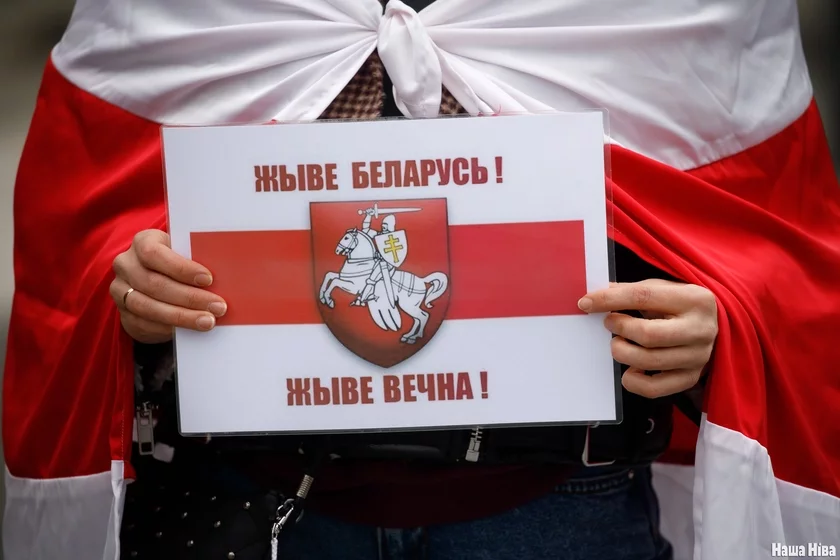
Solidarity rally, 2023. Photo: Nasha Niva
The debate was initiated by the iconic translator Siarhiej Shupa. On his Facebook page, he left an emotional post, in which he criticized the popular form of response today:
— Long live!
Where and when did this pathetic, dissonant, divisive, revisionist, unofficial "FOREVER!" come from? Every time I hear this discordant, chaotic chorus, some off-key, some off-tune — it makes me ashamed..."
Translator Mikola Ramanouski, in response, recalled that from old cultural figures, for example, from the political prisoner in interwar Poland and underground activist during World War II, author of the song "Zorachki" Siarhiej Novik-Piajun, he also heard exclusively the short and concise: "Long live!".
Another participant in the discussion cited lines from a poem by the People's Poet of Belarus Pimen Panchanka, written during World War II:
"Against the Prussian executioner
For the village and the home!" —
The cry of national vengeance calls.
Forest soldiers go on the attack,
Grenades rumble,
Machine guns thunder:
— Long live Belarus!
Long live!!"
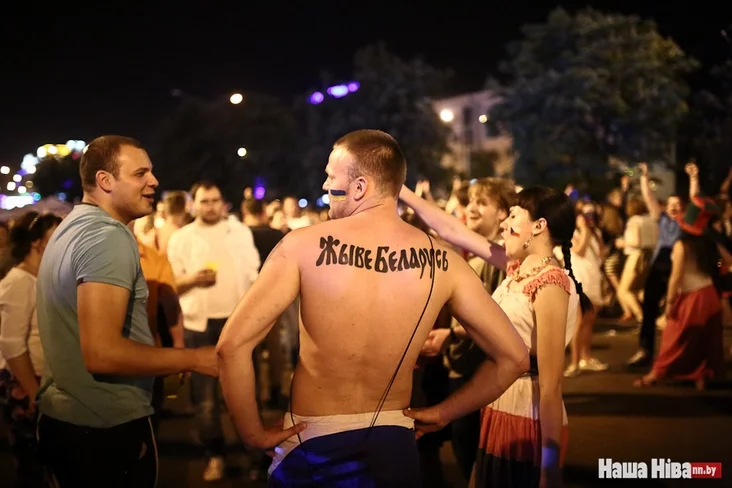
In Minsk, 2014. Archival photo: Nasha Niva
Where did "forever" come from?
The discussion revealed several versions of the origin of the addition "forever", which so irritates adherents of tradition.
Some recalled the ironic, expletive-filled rap "Zianon-hop". It appeared after the dispersal of the 2006 Square protests amidst general depression. It is there that the lines are heard: "Long live Belarus! Live forever!"
Musician and journalist Viktar Siamashka recalled that he first heard the variant "live forever" from activists of the BCD (Belarusian Christian Democracy) in the early 2010s.
Another version was voiced by a participant in the discussion who wished to remain anonymous. According to his information, the response "Live forever" comes from the circles of the sports and patriotic organization "Kraj" (Edge/Country), which was active in the late 1990s. This slogan was even printed on the cover of their newspaper "Holas Kraya" (Voice of Kraj).
According to him, later, after the start of Russian aggression in Ukraine in 2014, one of the former leaders of "Kraj" created the Belarusian Tactical Group, whose fighters preserved this call. Logically, after the full-scale invasion in 2022, the words became part of the ritual oath of the Kastuś Kalinoŭski Regiment.
"People create both traditions and modern heroes. We now have words with which people go into battle and to prisons. History is already written with blood and suffering!" — emotionally added the anonymous user, seeing no problem in the slogan's spread.

Graffiti. Photo: Nasha Niva
Why does "forever" cause debate?
The argument about "blood and suffering" did not convince Siarhiej Shupa. In his opinion, the heroism of people does not justify distorting a centuries-old tradition.
"People go into battle and to prisons, writing history with blood and suffering, not at all to add an extra word and desecrate a centuries-old tradition," Shupa remarked.
In his opinion, the words "Live forever" "cannot be rhythmically articulated clearly, cannot be extended by a thousand voices," because someone just added it without thinking about such important things. And now at large gatherings, one has to hear this indistinct mush, everyone going their own way. (...) "Usually it's like this:
— Long live Belarus!
— Liiive foooreeeveeeer!"
Some users tried to draw a parallel with the Ukrainian greeting "Slava Ukraini! — Heroyam Slava!", where the response also consists of two words. This is explained by a natural desire for semantic and rhythmic balance.
"I see in this a striving for parallelism, for equivalent, homogeneous structures." Such a striving is very natural for a "key-phrase" situation, — wrote one user.
But Siarhiej Shupa disagreed. In his opinion, there is no need to add this "forever".
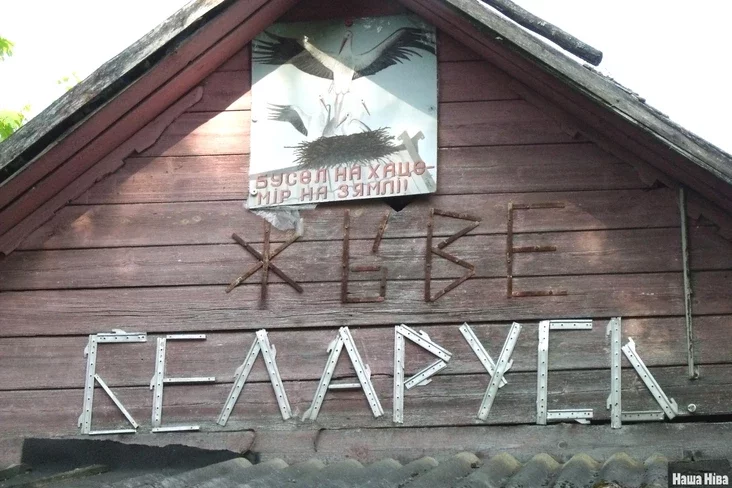
“Long live Belarus” on a house shield, Vitebsk region, 2021. Photo: Nasha Niva
What does "forever" mean for new generations?
Nevertheless, many participants in the discussion defended the new form. For them, the word "forever" carries an important semantic charge.
It is an affirmation of immortality:
"I always liked this 'forever' because it's like an affirmation that it's not just now, but forever: it was, it is, and it will be after us. I was very surprised that 'forever' is bad and that it's dissonance and even a destruction of unity."
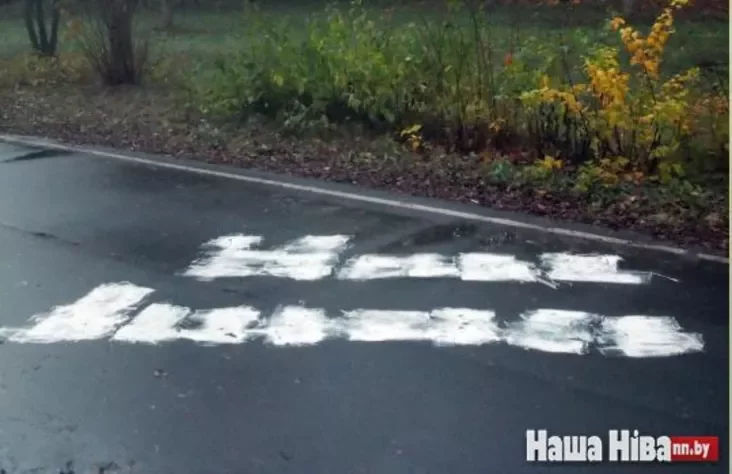
"Long live Belarus" on asphalt in Novapolatsk, 2020. Photo: Nasha Niva
The problem of the "neo-amateur"?
Educator Tamara Matskevich drew a parallel between the transformation of this cry and the fate of other well-known slogans — for example, "We want, we can, we will win!", created by Mikhal Anempadystau. "Someone pious replaced the first word [with "We believe"], and the meaning was lost," Tamara noted.
And Vintsuk Viachorka recalled that the now familiar phrase "Freedom Day" entered the masses from a newspaper headline.
According to Viachorka, the reason for such changes lies in the interrupted generational continuity: "The problem of the 'neo-amateur'. Foreign authorities consciously stopped the transmission of Belarusian cultural achievements and identity markers from generation to generation. Therefore, when a new generation still grew and sought itself, some, not knowing the tradition, thought that everything was a tabula rasa, and reinvented what had already been invented, sometimes incorrectly. But there is no nation without a foundation."
«Nasha Niva» — the bastion of Belarus
SUPPORT USNow reading




Belarusian "promised family prosperity" and enlisted for war. Disappeared without a trace in a 'meat assault' — and his wife cries that there's nothing to eat




Comments
І для кожнага беларуса інтарэсы свайго, беларускага народа мусяць быць на першым месцы. Беларусь перадусім!
Няхай стэндапераў беларускіх лепш пакрытыкуе за расейскія маты ў выступах на ютубе. Вушы вянуць.