


The funds of the Pinsk Franciscan Order Library have been found. They are in St. Petersburg
Andrei Kallaur, a Belarusian researcher from Masaryk University in the Czech city of Brno, shared on his Facebook page the fate of one of the oldest and richest libraries from Belarus, which was removed to Russia after the Red Army entered Western Belarus in 1939.
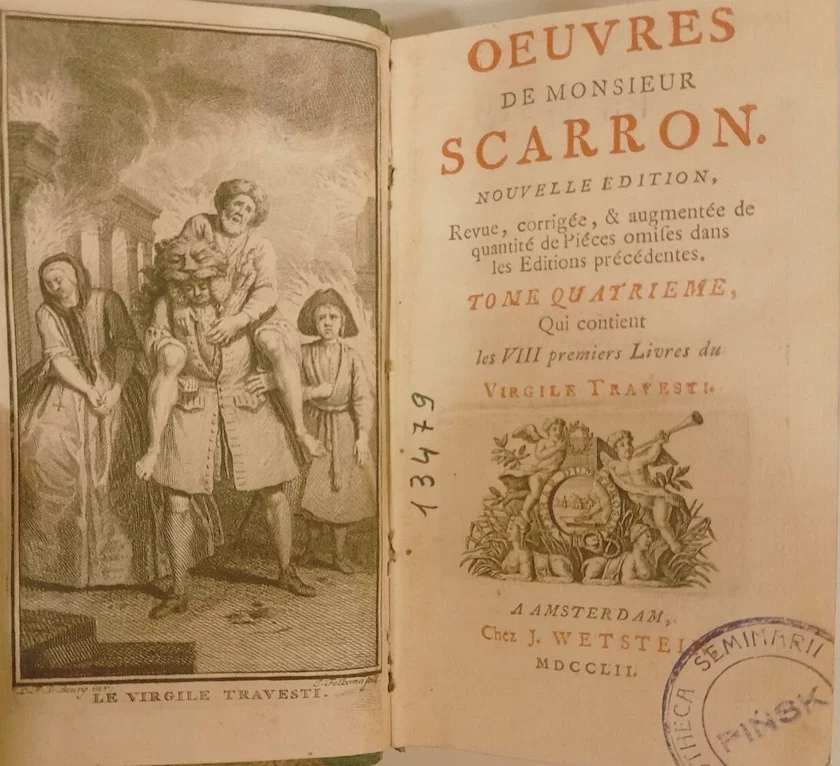
One of the ancient books from the collection of Pinsk Franciscans
This autumn, I had the opportunity to meet the descendant of Feliks Janiewicz (1762—1848) — a famous composer from the Grand Duchy of Lithuania who emigrated to England and made a successful career there. Josie Dixon, his great-granddaughter in the fourth generation, showed me a catalog with photos of Janiewicz's belongings and told me about the popularization of his work.
In one of the photos, I saw an imprint "Pro Lithuania". I tried to tell Josie about Lithuanians (Litvins) and Belarusians, but the words seemed to vanish into thin air: Feliks is a Polish composer.
This is an absolutely common situation. For example, relatives of the Litvin Napoleon Orda calmly handed over his belongings to the National Museum in Krakow. The same fate befell the Tyszkiewicz collection from Lahoisk: artifacts were sent to Warsaw and donated to the Society for the Protection of Historical Monuments.
The funds of the Pinsk Franciscan monastery library did not remain in Belarus for a different reason. It's one thing when children donate their parents' collection, and quite another when our valuables are simply illegally removed.
The library-archive at the Franciscan monastery in Pinsk is one of the oldest on the territory of Belarus. The first records of it date back to 1648, and the documents preserved there concerned the history of the Pinsk Principality and the Grand Duchy of Lithuania from the 14th century. From 1925 to 1932, Bishop Zygmunt Łoziński oversaw the library-archive.
What happened to the historical and cultural values in 1939—1941 is clarified by historian Raisa Zianyuk. From the published case "Correspondence about the Pinsk Seminary Library, February-May 1941", it follows that the library was removed to Moscow to the Central Anti-Religious Museum (TzAM) without the sanction of the Central Committee of the Communist Party (Bolsheviks) of Belarus or the Council of People's Commissars of the BSSR.
In 1940, Julius Margolin worked on systematizing the funds. He confirmed that they were awaiting a commission from Minsk, not from Moscow.
"In Pinsk, there was one of the rarest book depositories in Western Belarus. The local population did not even suspect about it... Within the walls of the Theological Seminary at the church of Romanesque-Polish style from the late 15th century, surrounded by a massive fortress wall, up to 50,000 ancient and new books had accumulated," wrote Margolin.
In 1941, the Anti-Religious Museum in Moscow replied to the Belarusian authorities:
"The Central Anti-Religious Museum, in accordance with the instructions of comrade Yaroslavsky, will strictly fulfill its obligation and return all books important for Belarus."
But this did not happen. The war soon began, and in 1947, the museum was disbanded.
It was not difficult to discover that the funds of the Anti-Religious Museum were transferred to the State Museum of the History of Religion (SMHR, St. Petersburg).
The first sign that the Pinsk funds were stored there appeared in 2022 [publication by Russian researchers Elena Kravtsova and Yulia Rogova "Parchment charters of the XVI—XVIII centuries from the archive of the Pinsk Franciscan monastery in the collection of the State Museum of the History of Religion"]. It then became known about 10 documents originating from Pinsk and located in the SMHR. Among them:
- documents of Yazafat Parysovich, thanks to whom the brick Pinsk Church of the Assumption of the Blessed Virgin Mary was built in 1730;
- a charter of Queen Bona from 1556 in Old Belarusian;
- two confirmation charters of King Władysław IV;
- a papal bull of Clement XI.
It remained only to get confirmation from the museum's management. I contacted the directorate as a researcher and a member of the International Council of Museums (ICOM) with a request to confirm the presence of the collection and digitize it. It is clear that the state should deal with the issue of returning such valuables.
Throughout January, I received letters from the custodian of the rare book collection. Indeed, a significant part of the books and manuscripts from our Pinsk library is with them, but they are scattered across different funds and not separated into a distinct collection (no one has ever dealt with it!).
Only in the rare book department, 10 editions were preliminarily found, a list of which I received. Among them: "Sermons on Time and Saints" by Bertrand de La Tour (1501), "Thoughts on the Means of True Government, Against Niccolò Machiavelli" by Gentillet Innocent (1578), "Virgil Travestied" by Paul Scarron (1752).
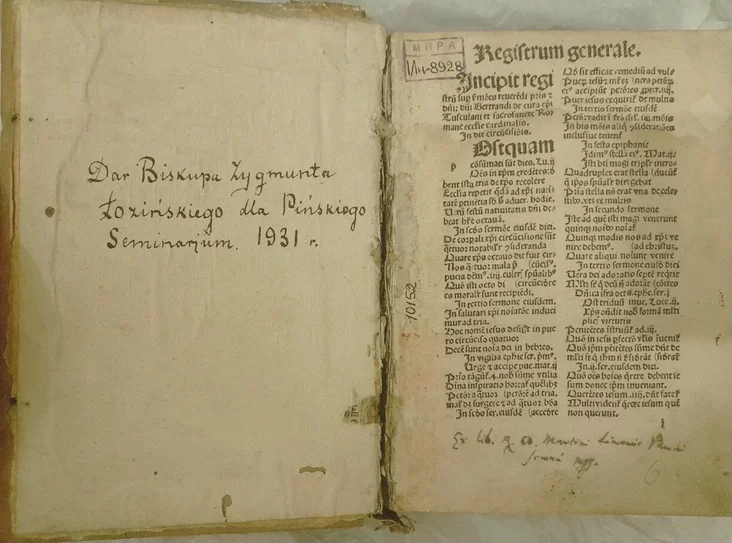
One of the ancient books from the collection of Pinsk Franciscans
As I was informed, in other departments the numbers are significantly larger: in the manuscript department, over 50 copies originate from Pinsk, and the scientific library has not yet determined the final number. The funds are open for research and partial digitization on site.
Thus, today we know where a significant part of the Pinsk Franciscan Library is located — our historical and cultural treasure, which, I hope, we will be able to return to Belarus at a favorable time.




































Comments