


Ukrainian to fight for "helmet of memory" at the Olympics. Who is on it — full list
The International Olympic Committee has banned Ukrainian athlete Vladyslav Heraskevych from competing in a helmet featuring photos of athletes who died during Russia's war against Ukraine. The IOC rejected Heraskevych's request and offered him to wear a black armband to honor their memory, writes BBC — Ukraine.

Andrew Milligan/PA Images via Getty Images
Skeleton racer Heraskevych placed portraits of Ukrainian athletes who died during the war on his helmet.
"A heartbreaking decision," Heraskevych commented on the ban on X. He reported that the IOC banned him from using this helmet for both competing and training.
According to him, after such a decision, there is a feeling that "the IOC betrays those athletes who were part of the Olympic movement." He says that the committee does not allow honoring them in the arena where these athletes will never be able to compete again. Heraskevych announced that he is preparing an official request to the IOC and will fight for his right to wear this specific helmet.
Vladyslav Heraskevych carried the Ukrainian flag at the opening ceremony of the Olympic Games in Milan.
Volodymyr Zelenskyy commented on the story. He thanked the Ukrainian athlete for "reminding the world of the price of our struggle."
"This truth cannot be inconvenient, inappropriate, or called a 'political action at competitions.' It is a reminder to the whole world of what modern Russia is," Zelenskyy noted.
Minister of Foreign Affairs Andrii Sybiha added:
"A helmet of memory cannot be banned — there is nothing political in honoring Ukrainian athletes killed by Russia. These crimes cannot be silenced. We insist on a fair final decision from the IOC."
"Helmet of Memory" and the list of the deceased
Vladyslav Heraskevych previously spoke about his "helmet of memory" in an interview with "Suspilne." It depicts images of some athletes who died over the past four years during Russia's invasion.
"Some of them were members of the Olympic movement, the Olympic family; some were just children who fell victim to Russian shelling. These were people who were closely connected to sports all their lives, rooted for us, were our friends," said the Ukrainian skeleton racer.
"Some of them were my friends," Heraskevych added.
In a comment to Tribuna.com, he provided a named list of all the people whose memory he wanted to honor:
-
Dmytro Sharpar — figure skater, silver medalist of the Ukrainian championship, participant of the 2016 Youth Olympic Games; died in battles near Bakhmut in January 2023.
-
Pavlo Ishchenko — four-time Ukrainian all-around champion, world and European powerlifting champion; died while performing a combat mission in 2025.
-
Maksym Halinichev — boxer, medalist of the Youth Olympic Games, European youth champion; died in March 2023 in Luhansk Oblast.
-
Yevhen Malyshev — 19-year-old biathlete, participant of the 2020 Youth Olympic Games; died in battles for Kharkiv in March 2022.
-
Andrii Kutsenko — multiple Ukrainian cycling champion, AFU volunteer; died in July 2024.
-
Oleksii Loginov — hockey player, goalkeeper for "Bilyi Bars"; died in Luhansk Oblast in 2023.
-
Karyna Bakhur — Ukrainian and European kickboxing champion; died during Russian shelling of Kharkiv Oblast in 2025.
-
Mykyta Kazubenko — Master of Sports of Ukraine in diving, coach; died in 2025 while serving in the National Guard.
-
Roman Polishchuk — track and field athlete (high jump), AFU serviceman; died in March 2023.
-
Andrii Yaremenko — Greco-Roman wrestler, multiple medalist of Ukrainian championships; died in December 2025.
-
Taras Shpuk — coach of the veteran "Invictus Games" national team; died at the front in September 2025.
-
Fedir Yepifanov — fencer, Master of Sports of Ukraine, participant of the World Cadet Championship; died at the front in 2023.
-
Kateryna Troian — track and field athlete, servicewoman of the 82nd Air Assault Brigade; died in June 2025.
-
Volodymyr Andrashchuk — track and field athlete, participant in European youth and junior championships; died in battles near Bakhmut in 2023.
-
Oleksii Khabarov — international master of sports in shooting, coach; died in 2025 in Donetsk Oblast.
-
Daria Kurdel — 20-year-old dancer, medalist of international tournaments; died as a result of shelling in Kryvyi Rih in 2022.
-
Ivan Kononenko — weightlifter, actor, AFU officer; died in 2025.
-
Alina Perehudova — 14-year-old weightlifter, candidate for the Ukrainian national team; died during the shelling of Mariupol.
-
Karyna Diachenko — 11-year-old gymnast; died with her family in Mariupol in 2022.
-
Viktoria Ivashko — 9-year-old judoka; died during the shelling of Kyiv in 2023.
-
Mariia Lebed — 15-year-old dancer; died during a missile strike on Dnipro in 2023.
-
Nazar Zuy — young boxer and football player; died with his parents in Mariupol in 2022.
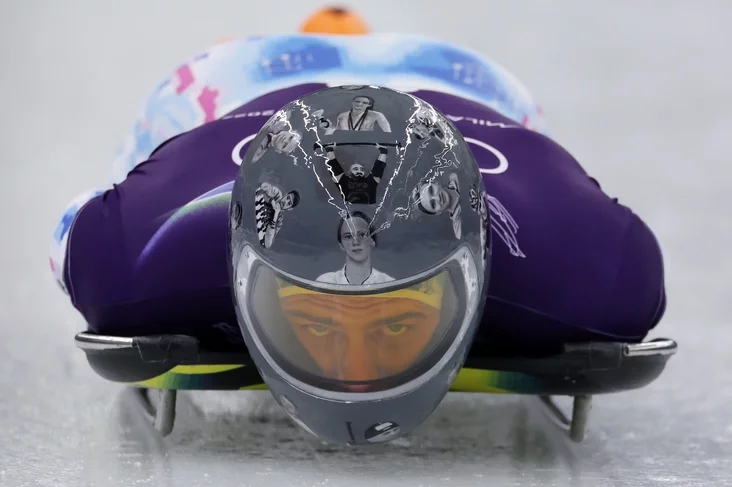
Photo: Al Bello/Getty Images
They offered a black armband instead of a helmet
The IOC explained that the helmet ban is related to the rules of the Olympic Charter.
"Rule 50.2 prohibits any demonstrations or political, religious, or racial propaganda within Olympic venues," stated IOC spokesperson Mark Adams. He added that the organization had been in dialogue with the athlete from the very beginning and was seeking a compromise solution.
"We fully understand the athletes' desire to honor the memory of those who died in the war in Ukraine and in other conflicts worldwide. But we must focus on sports and results, ensure equal rights for all athletes and keep the field of competition free from any interference," Adams noted.
According to him, the IOC concluded that the use of a helmet with portraits of the deceased contradicts current rules.
"We informed that this helmet violates the rules. At the same time, we allowed Vladyslav Heraskevych to use a black armband without text during competitions. He has already expressed his position on social media, and we consider this a reasonable compromise," the IOC representative added.
The IOC also emphasized that athletes from more than 90 countries participate in the Games, and each of them may have their own reasons for honoring memory, therefore the organization is forced to "maintain a delicate balance."
Vladyslav Heraskevych is not using the Olympic Games for the first time as a platform to remind the world about Russia's war against Ukraine.
At the Beijing Games in 2022, he held a "silent protest" with a poster "No war in Ukraine" — a few days before the start of the full-scale invasion.
On Thursday at the Olympics, skeleton qualification will take place, with finals on Friday.
Now reading




Gomel Civil Registry Office told about the most unusual wedding: in the morning after the first wedding night, the groom disappeared with the gifted money
Gomel Civil Registry Office told about the most unusual wedding: in the morning after the first wedding night, the groom disappeared with the gifted money




After returning from Poland, the co-founder of GlobalTips startup was arrested. She was given three years in a penal colony for helping political prisoners




Comments