


Successful startup founder or Baroness Munchausen? How Tatsiana Zaretskaya joined the United Cabinet and why she left it [Archive]
«Millionaire», «person from the Forbes list». This is how Tatsiana Zaretskaya presented herself, and this is how the media described her, based on her words. But when Nasha Niva investigated the past of the «successful entrepreneur» who was invited to the position of «Minister of Finance» in the United Cabinet, it became clear that there were many questions about Zaretskaya's business. It seems that Zaretskaya had to leave the Cabinet anticipating that the details would be revealed. But publicly, her departure is presented as a consequence of bullying and threats. Written by Artsiom Harbatsevich. We are republishing this article in 2026 because new details about the story have become known.
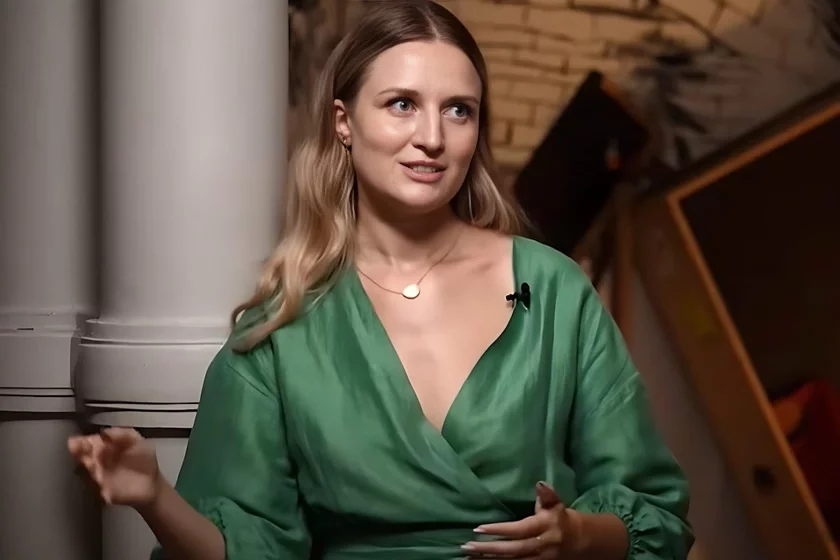
Tatsiana Zaretskaya in the program «Zhytsyo-Malina» (Life is Raspberry). Screenshot from video
Tatsiana Zaretskaya made a name for herself by creating a startup for the production of innovative LED lamps and software, which allegedly will reduce electricity costs by up to 75% and at the same time improve plant yields in greenhouses by 20%.
However, there is no evidence that these lamps and software actually exist and are being sold.
And besides those lamps and software — which, probably, do not exist or do not yet exist — as Nasha Niva's investigation shows, there is nothing else yet.
«It's a failure of Tsikhanouskaya's Office that she got there, and a failure of the media that uncritically trusted Zaretskaya's narrative about herself,» says a well-known Belarusian economist from opposition circles. «She understands nothing about economics, which becomes clear to any adult after half an hour of private communication.»
A Fair of Grandiosity
End of October 2022. American publication VanityFair conducts a major investigation into a pseudo-investor conference in Monaco under the auspices of Prince Albert II, who was not actually there.
It turns out that the organizer, «Knight Antonio Ritosso», is in reality a Sydney native with a fabricated biography, who consistently lies and creates an impression of solvency to gain the trust of rich and influential people in this world, subsequently organizing paid conferences in their name, supposedly to attract investments.
This harms the good name of wealthy investors who actually exist but do not know that their names appear on the fraudster's posters, as well as the wallets of those who genuinely seek funding and pay for entry, unaware that they are being deceived and that the promised roster of financiers and investors will not be there.
The basis of the «knight's» performances is actually made up of impostors who themselves have no money — Rebecca Sharps of our time, as if in William Makepeace Thackeray's classic novel.
“I was at the event and realized that no one here has money; everyone is just looking for it,” the Americans quote one of the participants.
The publication draws attention not only to the person of the «knight»-organizer but also to the «talking heads» at the conferences organized by the «knight».
The topic of fraudulent speakers begins to unfold in other publications as well, and an anonymous website, Just Diligence, publishes an analysis of the pseudo-knight's conference participants.
Among the dossiers on Münchhausens is… the name of Tatsiana Zaretskaya, «Minister of Finance» in the Belarusian United Cabinet.
The authors of Just Diligence dedicate a lengthy text to her, analyzing Zaretskaya's personality, her statements, and real achievements, coming to disheartening conclusions.

Screenshot from Zerkalo.io website. Zaretskaya boasts about participating in a forum organized by a fraudster. Prince Albert II of Monaco was not present at the forum.
Zaretskaya, indeed, received a thorough treatment in the investigation — significantly more text was dedicated to her than to others, which is why some are inclined to see in this a subtle game by special services to compromise a Cabinet member.
We actually don't know who wrote this text. The authors of the website state that they «work anonymously to ensure the security of investments against fraudsters and scammers» and are representatives of journalism, finance, and business.
In any case, whoever wrote this text, something else is important — it contains facts that caused a stir in narrow circles but did not leak to the public.
The authors primarily drew attention to the inconsistencies in «business lady» Zaretskaya's stories about herself.
Thus, in one interview she states that she was never interested in business and joined a startup accelerator because it «was the last chance to participate in creating a business.»
In another interview (which has since been deleted from YouTube but preserved), Zaretskaya, against a backdrop of crowing roosters, claims that she sold her first company at the age of 20, even before moving to Estonia. But Zaretskaya never mentioned her «first business» again in interviews.
Besides this, the video mentions that she is a laureate of Lukashenka's award for supporting talented youth.
Information about laureates is publicly available; we asked Zaretskaya to recall the year she received the award to verify this fact — Zaretskaya did not respond to our inquiry. In an interview with Mikita Mielkaziórau on the «Zhytsyo-Malina» channel, she said that she «never received anything from the state.»
Next, the authors analyze Zaretskaya's main startup, the firm Laava Tech, on which, according to public legend, she earned millions.
The authors conclude: «There is almost no information on how her solution actually works,» and support this with excerpts from Estonian registers, from which it follows that Zaretskaya disinformed about the company's turnover sizes in certain years.
The reporting can indeed be viewed in open Estonian sources. From the most recent report, dated late 2020, the startup had assets of €149,876, of which debts were €56,000, and €94,000 were shareholder investments of unknown origin.
Zaretskaya is also caught on minor points, such as a misunderstanding of the nature of photosynthesis, accused of the existence of «dead souls» (fictitious employees), and discrepancies between the official number of staff and that presented to investors, and so on.
The most serious accusation against Zaretskaya is that, having received an EU grant for the development of her Laava Tech, she allegedly demonstrated the profitability of the main Estonian firm by opening another firm in Poland and receiving a grant for small business support from the Polish government (amounting to 176.4 thousand zlotys — 37.5 thousand euros today, and nearly 45 thousand at the time of receipt). She then allegedly transferred this sum as a payment for a service to the account of her Estonian startup, thereby misleading donors by showing fictitious product commercialization, which became the reason for issuing the next grant tranche.
The fact of receiving the grant is easily confirmed; it is public. However, confirming the actual transfer between affiliated companies is problematic.
«Nasha Niva» asked the authors of the Just Diligence investigation where they obtained the information they published. They replied: «Our responsibility to the source does not allow us to reveal it. We can, however, say that the source worked with Tatsiana Zaretskaya (we verified this), and, accordingly, we have reason to consider the information reliable.»
Zaretskaya herself did not comment on this accusation.
“In any case, why open two identical companies that are not even related to each other?” the authors ask.
Moreover, as «Nasha Niva» discovered, after receiving 176 thousand zlotys, «LAAVA TECH SPÓŁKA Z OGRANICZONĄ ODPOWIEDZIALNOŚCIĄ,» founded by Zaretskaya in Poland, was… liquidated by a Polish court due to inactivity.
As «Nasha Niva» learned, the content of the online investigation was brought to Tsikhanouskaya's attention, who was outraged, but Zaretskaya allegedly managed to convince her of her honesty.
“Many Threats”
Zaretskaya began to build a defense line, starting from the thesis that she was being threatened. «Recently, I have been receiving many threats and slanders,» she wrote, without specifying who and why was threatening her, or what the slander entailed.
In parallel, «Nasha Niva» conducted its own investigation into Zaretskaya's activities, some details of which became known to her through mutual acquaintances.
Zaretskaya knew that both former and current Laava Tech employees had agreed to speak with «Nasha Niva». Perhaps that is why she submitted her resignation of her own free will, framing it as a departure made «under pressure from threats.»
We have every reason to believe that Zaretskaya indeed did this due to a threat, but one specific threat — the threat that the true results of her startup's activities would become known.
Therefore, we tell her story.
Who is Zaretskaya and what is her startup?
Zaretskaya was born in 1994 in Minsk into a family of chemists. Her father, Aleh Zaretski, is a scientist. Before moving to Estonia, he worked at the National Academy of Sciences of Belarus.

Tatsiana Zaretskaya. Photo: Zerkalo.io
According to Zaretskaya herself, while studying at Belarusian State University's Faculty of International Relations, she realized it wasn't for her: «international relations cannot be studied in Russian,» so she found a program and enrolled in Estonia.
There, she got the idea to optimize plant growth, and in her final year, she won a small grant with her concept at a university startup competition.
And then she started developing the startup. It's called Laava Tech. The story dates back to 2017.
Either a Fundamental Breakthrough in Science, or Lysenkoism
Here's how Zaretskaya herself explains the essence of the startup's idea.
«Using a special control unit and software based on machine learning and artificial intelligence, Laava Tech regulates the operation of LED lamps, reducing electricity costs by up to 75% while improving yield by 20%. A special interface is downloaded to a smartphone, which receives information from the control unit that monitors the operation of the LED lamps. The control unit and lighting fixtures are proprietary developments of Laava Tech.
All together, this allows remote control of lighting settings in a greenhouse, for example, the spectrum and intensity of LEDs,» she said in one of her interviews (in other interviews, she cited an electricity saving percentage of 90% and also promised to increase yield by 20%).
In other words.
This is about growing plants indoors. For growth, plants need nutrients and water, as well as sunlight, which they consume during photosynthesis — the process of converting light energy into the chemical energy of organic substances.
For this process, pigments in plant tissues absorb the energy of photons of specific wavelengths, and then use this energy to initiate the chemical reaction chains of photosynthesis.
Phytolamps using specific wavelengths can replace sunlight.
Energy costs represent a large share in the economics of plant cultivation, so people have long figured out how to save — by making the light flicker. This is not something new.
The light does not stay on constantly but is supplied in portions, accordingly — energy consumption is reduced.
Zaretskaya promises to reduce energy consumption either by up to 75%, or up to 90%, or simply «tenfold,» as stated in some speeches.
This effectively means that the light from the lamps, during very short flashes, will be almost invisible to the human eye, but plants will not only receive the necessary rays but also grow 20% better.
Moreover, Zaretskaya claims that a special program will analyze individual plants in real-time and, using artificial intelligence, analyze a specific plant and regulate the light according to its precise needs (different plants, according to research, «prefer» different light spectra depending on their development stage, which affects their growth).
This all sounds excellent.
“Technological giants are battling for meager percentage points in reducing the energy consumption of their plant lamps. It seems no one has yet gone beyond 20% savings. And 75% with a 20% increase in yield — that is either a serious fundamental breakthrough in science or another case of Lysenkoism,” a biologist from the National Academy of Sciences of Belarus told Nasha Niva after reading the project description at our request.
Zaretskaya presented her idea at various hackathons and pitching events.
For example, in her interviews, she boasts that she presented her startup in icy water, which impressed the jury and earned her money. These were some of the first funds she attracted to the startup — 10 thousand euros.
On her personal website, she emphasizes that this marked the origin of the story.
But her performance, preserved online, is a classic example of misleading.
Listen for yourself, starting from 2:52.
«[…] We have two more people from Belarus with over 30 years of experience in software development with background in chemical and electrical engineering», — Zaretskaya presents her startup team.
She refers to two other Laava Tech shareholders — her father, chemist Aleh Zaretski, and his friend, chemist Siarhei Radzionau, both citizens of Belarus.
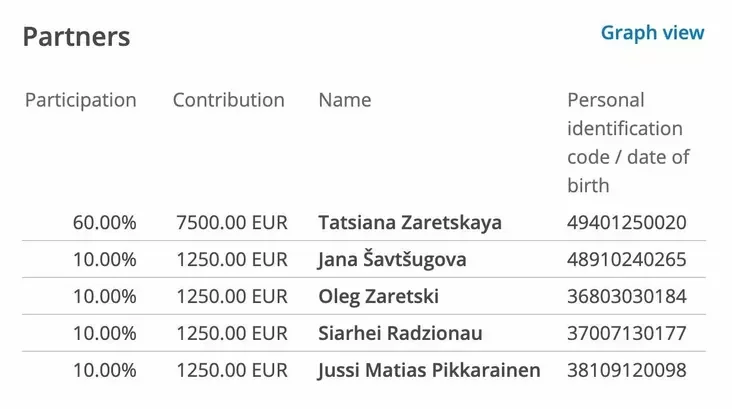
List of Laava Tech beneficiaries: at least three are close relatives
But do they truly have «30 years of experience in software development»? Thanks to «Cyberpartisans,» we know where these people worked. They worked together in companies that were not involved in software development but sold air purification filters.
As well as in other organizations, including departments of the National Academy of Sciences of Belarus, which in no way intersect with programming. Radzionau also worked at the Minsk Youth House.
Zaretskaya also subtly avoided mentioning that another team member is her husband (though there's nothing wrong with that), simply referring to him as a «marketing specialist with 15 years of experience.» Her Finnish husband is also an activist in various startup programs; Nasha Niva's interlocutors call him a generator of ideas for Zaretskaya's startup.
After presenting the jury with a team that included «two people with 30 years of experience in software development and a background in chemical and electrical engineering,» Zaretskaya received the title of pitching (presentation) winner and 10 thousand euros for development.
At this point, the reader needs to understand what the startup market itself entails.
“These are Business Risks”
“People invent their product, raise money for it, convincing that it will eventually pay off. And then sometimes the product enters the market, and sometimes it doesn't take off — the idea doesn't work. Can the development team be accused of fraud here? They asked, they believed, they created, but it didn't work out — it's very difficult to accuse them here. These are business risks.
Most startups operate this way; very few develop with their own money. And 99% of startups fail. Everyone knows the reality and the rules of the game.
Meanwhile, in Western countries, where money is very cheap and abundant, it is believed that creative youth should be supported — let them practice creating and thinking there. They sow the field with relatively small grant funds, and perhaps something will grow, and someone among them will invent a new Uber or Instagram; this is roughly how European funds and accelerators think.
Opportunities for self-presentation are arranged for youth, and small grants, in the amounts of a couple of tens of thousands of euros, are given to winners,» explains a person who himself is involved in venture investments in startups.
After receiving initial funding, Zaretskaya, having no real achievements yet, and managing a company deeply in debt with very modest turnovers, focused on building an image of a successful businesswoman.
She first appeared in Belarusian media in 2020, thanks to being included in Forbes' «30 under 30» ranking.
But the reality is that this ranking is promotional; it does not reflect the size of capital or the success of companies, but is compiled based on recommendations from those who were once mentioned in it themselves. Representatives of real business described it to us as «garbage.»

Three main achievements of Zaretskaya according to her website: Forbes ranking, a chat in social networks, participation in a pseudo-conference. Besides that, Zaretskaya sells her own consultations on her website, with prices starting from $100, which is quite modest for an alleged dollar millionaire.
But this did not prevent Zaretskaya from not only refuting the claim of being a millionaire in interviews but also telling what she felt when she «earned her first million.»
Website Inaccessible
In principle, the success of a product is easy for anyone to assess — a product is considered successful if a) it is used/bought, and b) it generates profit. «Nasha Niva» decided to find out how Zaretskaya earns millions. But this proved difficult from the start — Zaretskaya's startup website simply does not work.

It hasn't been working for at least a week — we started observing it a week ago. How long it has actually been inaccessible is unknown.
The cached version of the site only contains information about beneficiaries and a general description of the technology, but without the possibility to order finished products. Even if the site were working, it would not have commercial functionality.
This is not only strange but also, in business theory, causes direct damage to the business in the form of unrealized profits due to lost orders.
How then can one see the innovative LED lamps that are allegedly the source of capital and, according to Zaretskaya, have existed for several years already? How can they be bought?
«Nasha Niva» could not answer these questions and did not receive responses to inquiries sent via messengers to Laava Tech employees.
We found no evidence that any lamps designed and manufactured by Laava Tech currently exist in principle. We only saw their photos in the form of renders.
Another Laava Tech employee, on condition of anonymity, expressed to «Nasha Niva» the opinion that the company does not have self-produced lamps that meet the stated characteristics. In what is called a «laboratory,» he saw lamps purchased from other manufacturers. Experiments are conducted with them, let's call it that. Zaretskaya's father and another co-founder, Siarhei Radzionau, tried to construct some lamp. But they are chemical engineers, not biologists. According to the employee, they achieved nothing in terms of the stated efficiency.
“This is like a perpetual hobby for them — assembling the ideal lamp, searching for the philosopher's stone,” says the startup employee.
This was the employee's opinion. But what does the company's reporting on the European grant tell us? How does the company describe the results of its work after receiving more than 2 million euros in funding?
“During the first 12 months […] we have been working to ensure that our control unit is compatible with other systems on the market. We conduct continuous testing to train our AI and provide it with the maximum possible amount of data along with data from our pilot projects,” Laava Tech reports.
What opinion do employees express on this matter? That they are unaware of any facts indicating that a finished analytical or technical solution from Laava Tech has been delivered to consumers, either now or in the past.

“No available results,” — description of current project results on the website of the organization that issued a large European grant to Zaretskaya's company.
Similarly, nothing is known about any scientific research substantiating Zaretskaya's claims.
The figure of 75% reduction in energy consumption with a simultaneous 20% increase in yield is something that exists only in the entrepreneur's words, never proven by anyone.
We contacted Zaretskaya with a question about the scientific methods used to measure what she declares, as well as the sources where the methodology and results of scientific research are published. We received no answer.
A Laava Tech employee, in conversation with «Nasha Niva,» expressed the opinion that the company cannot conduct deep scientific research because it does not possess a sufficient set of tools.
«The company cannot technically prove the possibility of increasing yield by 20%,» the employee admitted.
We also do not know if there are biologists on Zaretskaya's team — she refused to answer questions about the competencies and names of employees.
“Perhaps a thousand will gather”
Twenty-four hours before Zaretskaya's resignation announcement, «Nasha Niva» asked her to answer questions regarding her business, namely:
— How did you conceive and develop the startup?
— How did you create your lamps, what is their uniqueness, how are they better than competitors' products? Where can they be bought, who uses them? How many have you sold and to whom?
— Tell us about the scientific research on the effectiveness of your technology — how did you conduct them, where can publications be read?
— How did you develop your AI? Who developed it and how does it work?
We also asked Zaretskaya to explain how exactly she earned her alleged millions — was it a cash-out from Laava Tech or profits from product sales? We also asked her to comment on the facts from the JustDiligence investigation.
Zaretskaya initially refused, citing busyness. She was «at a summit in Lisbon, with a rather tight schedule planned weeks ago.»
Another day later, she asked for «a list of more specific questions» about Laava Tech.
Soon after, Zaretskaya issued a statement about «threats to her and her business partners,» based on which «she decided to resign from her position.»
After a clarifying question from a «Nasha Niva» journalist, asking whether her silence could be considered an indication that there would be no comments, Zaretskaya responded with threats.
“Firstly, I do not grant you or your publication the right to publish anything related to me or affecting my interests (or the interests of my company) without my knowledge and agreement with my lawyers.
Secondly, I warn you that there is legislation in the European Union that prohibits publishing knowingly false testimonies and references to them.
Thirdly, I reserve the right to inform your management and those who finance your publication about the rude manner in which you communicate with people. I would advise you to speak in such a tone with your acquaintances, but no one deserves such treatment,” she wrote to a «Nasha Niva» journalist.
By «rude manners,» she likely referred to our persistent questions about the practical results of her business.
Despite the «tight schedule» that prevented Zaretskaya from answering «Nasha Niva's» questions, on November 2, she found time to tell many media outlets about the «barrage of threats» she had received.
“We're talking about hundreds of threats, perhaps even a thousand in total. It was a continuous attack from all directions. Dozens of anonymous messages on all possible social networks and messengers, calls from unknown numbers, emails to all relatives, close ones, acquaintances, employees of my firm, partners, and investors,” Zaretskaya stated in written responses to inquiries from Radio «Svaboda».
— And all of this eventually came back to me: employees started to fear for their safety, partners didn't understand how or when it would end, investors — they were simply in shock,” claims Tatsiana Zaretskaya.
As circumstances would have it, the Estonian company Laava Tech, by decision of its shareholders, postponed the start of the company's fiscal year by 2 months: they were supposed to submit their financial statements on November 1st — right at the peak of journalistic interest in the company and Zaretskaya's person.
But four days prior, on October 27, for unknown reasons, the shareholders took a two-month timeout, formalizing this with changes to the company's articles of association (this can be viewed via the link, by going to the «articles of association» section).
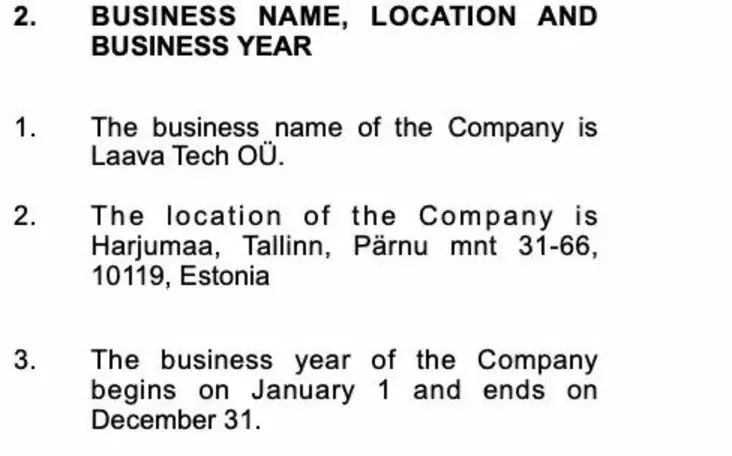
A fiscal year is the period for which reporting is submitted. Either they are not completing the report on time, which is usually not a reason to change the company's charter, or they want to delay its publication, or they want to accomplish something within the next two months.
How did Zaretskaya get into the United Cabinet?
Zaretskaya's resignation raises questions about the vetting of individuals aspiring to leadership positions in Tsikhanouskaya's Office, given the difficult conditions in which the Office operates.
«Nasha Niva» asked a representative of the Office for a comment on how Zaretskaya's competence and business reputation were assessed, but has not yet received a response.
As «Nasha Niva» learned from two interlocutors who requested anonymity, the Cabinet was specifically looking for a woman for the position of «Minister of Finance.» This was the Cabinet's response to criticism voiced after its first composition, with an exclusively male lineup, was announced: Latushka, Sakhashchyk, Azarau, Kavaleuski.
However, there are not many public women economists in Belarus who are both competent and willing to openly speak out against the dictatorship.
Successful businesswomen are not rushing into politics, and prominent figures like Tatsiana Marynich or Katsiaryna Barnukova are busy with their own projects.
Zaretskaya herself publicly stated that «BEROC recommended her» — this is a reputable economic research organization where stars such as Pavel Daneika, Dzmitry Kruk, Lev Lvoúski, and Katsiaryna Barnukova work.
Did BEROC really recommend her?
“BEROC as an organization did not recommend anyone,” Katsiaryna Barnukova, the academic director of the organization, told «Nasha Niva». “And I personally named her among a number of other candidates, all of whom, apart from her, refused. I regret having named her without thoroughly studying the figure.”
“Office's Failure, Media's Failure”
Another Belarusian economist, who asked «Nasha Niva» not to mention his name, believes: «Zaretskaya understands nothing about economics, which is perfectly clear to any adult after half an hour of private communication. It's a failure of the Office that she got there, and a failure of the media that uncritically trusted Zaretskaya's narrative about herself,» this respected economist, who had encountered Zaretskaya, told us.
“When I watched her interview with Mielkaziórau, I saw nothing but red flags. Her image doesn't align with my perception of genuinely successful women who actually create and sell things,” a top manager of a large IT company and a participant in the free elections movement in 2020 told «Nasha Niva».

Tatsiana Zaretskaya became a guest of the most popular talk show on Belarusian YouTube, «Zhytsyo-Malina»
An opinion also formed in IT circles regarding the creation of an illusion of success.
“This is a common story: when you ask for large sums of money, you behave in a way that prevents suspicion of frugality; you create an impression of solvency.
The issue of loans and investments is a matter of trust. It's important to be able to pull the wool over people's eyes, to convince them that you are Midas, and everything you touch turns to gold. And if it doesn't work out, you'll pay from your own pocket.
In this regard, she does everything correctly. I don't even perceive her appointment to the cabinet as something bad, because if her role is to find money, then she is in the right place.
The real question, however, is who will ultimately use whom. Will she use this entry on her resume, or will Belarus use her as a negotiator?” said another IT sector businessman.
Over a week of gathering information on Tatsiana Zaretskaya, we did not hear any positive feedback about her in IT business and economist circles.
“I understand the startup has been around for several years, and all these years they promise to reduce energy consumption tenfold through software and hardware means? It reminds me of an advertisement where men were offered to increase their member tenfold, and those who paid were sent a magnifying glass.
I think this is not a story about «deliberately setting an unattainable goal to jump as high as possible,» I think it's a story about trying to cheat physics, — the businessman believes. — Then one would have to admit that everyone else around is short-sighted: LG, Panasonic can't do it, but we can. It looks like a money vacuum cleaner for gullible investors, in our case — a fund. To me, it looks like that.
And a couple of grant millions is not really such an achievement. There have been more high-profile cases — remember Theranos and Elizabeth Holmes.”
But our interlocutor admits that one cannot speak of dishonesty until we see and examine the results of Laava Tech's work.
“Generally, in startups, it's not easy to determine if an idea is unsuccessful because it didn't materialize, or if the idea was fundamentally not designed for success. But as soon as I saw Zaretskaya near Tsikhanouskaya, the thought occurred to me that Zaretskaya would use her position to further seek money for her startup,” a respected investor in Tallinn's IT circles told «Nasha Niva».
«Nasha Niva» — the bastion of Belarus
SUPPORT US




































Comments
Отсутствие фактчекинга, неразборчивость в связях, излишняя доверчивость, наплевательское отношение на безопасность начинается от рядовых активистов и заканчивается офисом Тихановской.