


Gutenberg: The story of an exile who forever changed the world for the better
From secret experiments in Strasbourg to a lawsuit that deprived him of everything on the verge of triumph. Johannes Gutenberg's life resembles a thrilling detective story, full of financial risks and bold decisions. From using horsehair pouches to throwing a piece of bread into boiling linseed oil. We tell the story of how one man sparked the first information revolution.
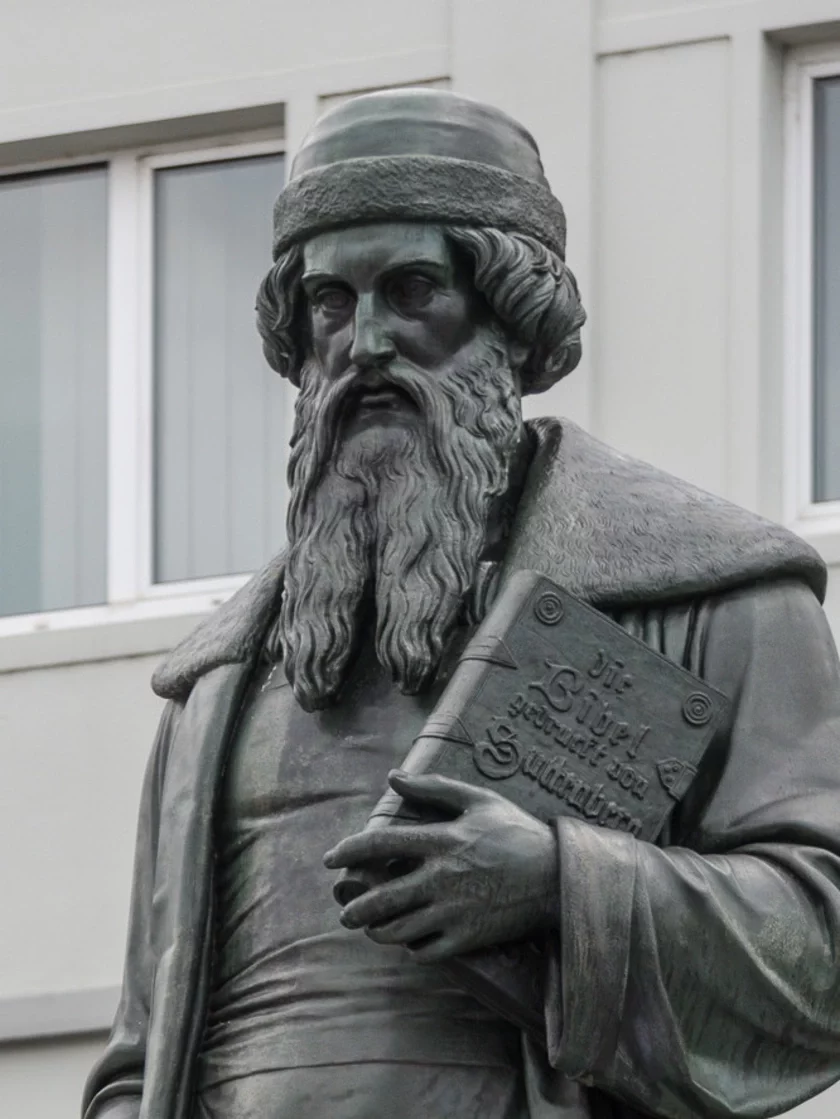
Johannes Gutenberg's surname often appears on the pages of «Nasha Niva» — when we talk about new books from the Belarusian publishing house Gutenberg Publisher. However, today we are talking about the person in whose honor the publishing house received its name. Gutenberg's influence on civilization is so significant that the Canadian philosopher Marshall McLuhan introduced the concept of the «Gutenberg Galaxy» into academic use, describing a new stage in human history. And in 1999, the American television channel A&E declared Johannes Gutenberg «Man of the Millennium».
Up to the middle of the 15th century, knowledge resided almost exclusively within monastic walls. Medieval monasteries were the primary guardians of the word, but the process of creating a book there resembled more a spiritual feat or severe physical suffering.
The true birth of a book took place in scriptoria. These were special rooms, often located either near the monastic kitchen or in small rooms that were easier to heat.
The reason was prosaic: the scribe needed warm and nimble fingers to hold the quill and perform delicate work. In winter, when ink could freeze in inkwells, the work became a real ordeal. As dusk fell, monks worked by the flickering glow of candles, which irreversibly damaged their eyesight.

Numerous testimonies of this arduous work have been preserved in the margins of ancient manuscripts. Medieval scribes left desperate notes that have reached us across centuries: «Three fingers write, but the whole body suffers,» «Oh, how difficult it is to write: it tires the eyes, bends the back, and breaks all bones.»
Monks complained about constant cold, numbness of their limbs, and cramps in their hands from having to maintain an immobile posture for hours. Any error made at the end of months of work could become a catastrophe, as corrections on parchment were very difficult.
At that time, a handwritten Bible was a luxury that only kings or the wealthiest cathedrals could afford. The Church carefully guarded its monopoly on knowledge, but the human factor created problems: even the most experienced scribes inadvertently made mistakes, skipped lines, or misinterpreted words. This led to different copies of the Holy Scriptures beginning to diverge from one another.
To preserve Christian unity and combat heresies, a single, universal, and infallible version of the text was required. Meanwhile, the demand for books began to explode outside the monasteries: universities were opening throughout Europe, and a new class of intellectuals demanded textbooks that could not be supplied by the monks.
It was during this pivotal time in Mainz, one of the most important cities of the Holy Roman Empire (the Archbishop of Mainz officially held the title of Archchancellor of Germany and was the second most powerful person in the state after the emperor himself; over several centuries, 7 coronations of monarchs took place in Mainz Cathedral), that the journey of a man who would forever change this order began.

His name is Johannes Gensfleisch zur Laden, but he would enter history under the surname Gutenberg.
Little is known about Gutenberg's childhood and youth, but the facts preserved in court and city records allow us to reconstruct his path. He was born between 1394 and 1404.
Since his exact birth date cannot be determined, the Gutenberg Society at the end of the 19th century designated 1400 as the birth year of Johannes — the third child in the family of Friele Gensfleisch and his second wife Else Wirich.
Historians believe that his birthplace was most likely his father's urban estate in Mainz, which bore the name «Hof zum Gutenberg» (Gutenberg Courtyard).
Surnames were not yet static in those times: among patricians, it was customary to supplement the family name with the name of the house owned by the family. The family name «Gensfleisch» (Gensfleisch) literally meant «Goose Meat,» which sounded rather mundane for the elite. The addition «zum Gutenberg» (which can be translated as «from the Good Mountain») began to be used by the family only from the 1420s.
The Gensfleisch family belonged to the patriciate — the urban aristocracy of Mainz. Its representatives sat on the city council and held power and money in their hands. The family possessed a hereditary privilege to participate in the work of the mint, supplying the archbishop with gold and silver for coinage.
Since his father was directly involved with the archiepiscopal mint, young Johannes likely first became acquainted with metallurgy in his childhood: he observed the casting of coins, worked with punches and dies, and learned to assess the quality of alloys. These fine craft skills — the ability to work with hard metals and create precise forms — would later become the foundation of his printing invention.
Johannes's youth was far from calm and monotonous. Mainz at that time was an arena of fierce social clashes. In 1411, Friele Gensfleisch and his family were forced to leave Mainz. This was a massive political demarche: more than a hundred patrician families simultaneously left the city, refusing to yield their privileges to the burgeoning craft guilds.
The patricians demanded the preservation of their privileges, such as exemption from taxes and customs duties. The family most likely found refuge in Eltville, where his mother's ancestral home was located.
Two years later, in 1413, Mainz was shaken by a new wave of unrest — the so-called «hunger riots.» A shortage of grain and high bread prices provoked popular anger, which erupted in attacks on patrician estates. This again forced the Gensfleisch family to leave their hometown in search of safety.

Regarding Johannes's education, there is also no precise information. Historians assume that as the son of a wealthy patrician, he most likely attended a Latin school, and later — a monastic school at the Monastery of Saint Victor, located near Mainz.
Some historians believe that Johannes may have studied at the University of Erfurt, where the lists of 1418 include Johannes de Altavilla (Altavilla is the Latin name for Eltville, the town from which his mother originated).
The first official document in which Johannes is mentioned by his own name dates from 1420. The reason for this record's appearance was quite prosaic for those times — property disputes. After the death of his father, Friele Gensfleisch Sr., in 1419, serious disputes over inheritance began between Johannes, his full siblings, and their half-sister.
Although chronicles do not report how this process ended, for historians this document was a true discovery. The fact is that Johannes appeared in court on his own, without a guardian. According to the laws of that time, this meant that he was already 14 years old and was recognized as legally entitled to manage his own destiny.

The next decade — the 1420s — remains a true «dark spot» in the inventor's biography. Where he was and what he did during this period remains a mystery: no chronicle, no commercial register preserved his name. Gutenberg seemingly vanished from the radars of history, only to reappear in the early 1430s.
In 1429, Mainz was gripped by a new wave of political conflicts between craft guilds and patricians, forcing many aristocrats to leave the city again. Documents confirm that Johannes was not in Mainz at this time. His interests in complex negotiations with the magistrate were represented by his mother, Else Wirich. She sought to obtain a lifelong annuity from the city — annual interest that Mainz was obliged to pay to the Gensfleisch family in exchange for capital they had once lent to the city treasury.
A key moment occurred in 1430. The new Archbishop Conrad III, wishing to calm the city, offered the exiles to return to Mainz without any additional conditions or penalties. This was a kind of amnesty for the patricians. Johannes Gutenberg's name is listed in this «agreement of reconciliation» among the patricians living outside Mainz. But, unlike many of his compatriots, he rejected this offer.
In 1433, his mother died, after which the estate was divided among the three children. The authorities of Mainz were still reluctant to pay him the due annuity. Perhaps due to the city's financial difficulties or a desire to punish the emigrant. As a result, his debt continuously grew and by 1434 reached 310 gold gulden.
Strasbourg
The period from 1434 to 1444 in Gutenberg's biography is firmly linked with Strasbourg. However, life in the free city required significant funds, and the first thing Johannes encountered was acute financial problems. The fact is that Mainz, taking advantage of Gutenberg's absence, definitively stopped payments on his lifelong annuity. For Johannes, this became a serious ordeal.

In March 1434, Gutenberg decided to act resolutely and even boldly. Learning that Mainz city clerk Nikolaus Wörstat was passing through Strasbourg, Johannes exercised his right and secured the official's arrest. Wörstat ended up in debtor's prison — thus Gutenberg took a high-ranking hostage to force his hometown to repay the debt. Soon, to avoid souring relations with the Strasbourg authorities, he agreed to release the clerk, and his plan worked: frightened Mainz resumed payments in 1436 and fully settled the debt.
The money received allowed Johannes not only to maintain his patrician status but also to launch his own activities in Strasbourg. In 1437, Gutenberg took Andreas Dritzehn as an apprentice, teaching him «gem grinding» (coin striking and goldsmithing), and after some time, he formed a commercial partnership for the production of metal mirrors for pilgrims preparing for the great pilgrimage to Aachen.
Religious beliefs of the time created an unusual demand: believers thought that during the display of Christ's holy relics, they emitted healing light. Since approaching the holy sites through huge crowds was impossible, pilgrims bought small concave mirrors. These were held high above their heads towards the relics to «catch» and preserve the holy rays, which could then be «brought» home.

Gutenberg promised his partners — Andreas Dritzehn, Hans Riffe, and Andreas Heilmann — to teach them the «secret art» of mass-producing such mirrors using special molds and alloys. But the carefully planned business plan failed.
In 1439, Europe was once again struck by an epidemic of plague, and the pilgrimage was postponed until the following year. For the company, this was a disaster: capital had been invested, goods produced, but there were no buyers. The situation was further complicated by the fact that at the end of the same year, Andreas Dritzehn suddenly died.
Here begins the most interesting part of the story, recorded in court protocols. The brothers of the deceased Andreas, Georg and Klaus, seeing the financial collapse, tried through court to recover their brother's money or forcibly join the company. They were interested not only in the production of mirrors but also in some secret knowledge that Gutenberg possessed.

It was in the witness interrogation materials for this case that historians found mentions of Johannes' true work. The documents feature the name of another, secret project — «aventur und kunst» (adventure and art/craft). Witnesses reported mysterious purchases of large quantities of lead and, most importantly, the construction of some kind of press in Gutenberg's workshop.
The court records preserved the name of another important participant in this secret story — the carpenter Konrad Sasbach. It was he whom Gutenberg hired to create the most massive part of the invention — a wooden press. Sasbach confirmed that he completed this order back in 1438. He also told the court about a dramatic episode that occurred immediately after Andreas Dritzehn's death.
Gutenberg, fearing that the secret of the machine would fall into the wrong hands, sent his servant to Sasbach with an order: immediately go to the deceased Andreas's workshop, dismantle the press into four parts, and remove them from the frame so that «no one could understand what it was.»
It became clear: the production of mirrors was merely a «financial cushion» and a convenient cover for Johannes, while his main efforts were directed towards creating a machine capable of printing texts.
From 1441 to 1444, Gutenberg's name still appears in Strasbourg's tax lists, but after that, his traces abruptly disappear. Where he was during the next four years is unknown.
The Invention of the Printing Press
Historians and engineers still try to reconstruct the exact moment when Gutenberg was visited by the idea of a revolutionary printing method. His engineering genius lay in his ability to adapt and improve already known reproduction methods, combining them into a single, flawless system.
Metal casting, the hand press, xylography (printing from wooden blocks), and stamping techniques existed before him. However, it was Gutenberg who developed a unique method for casting metal letters, constructed the printing press, and found the optimal ink composition, combining these innovations into a holistic process of book printing using movable type.
It is important to understand: no original Johannes Gutenberg press has survived to this day, nor are there any of his drawings or descriptions made during the master's lifetime. Everything we know about this wondrous device is the result of extensive historical reconstruction and technical analysis of the first printed books.
Gutenberg's press became a creative reinterpretation of the traditional screw press, which winemakers and papermakers had used for centuries in those times. The working principle was based on screw mechanics: when the printer turned a lever, a massive spindle moved and forced a heavy vertical plate — the platen — downwards. It was this plate that ensured the main condition for quality printing, evenly distributing enormous pressure across the entire surface of the printing form.

For ease of work, Gutenberg used a movable bed, or carriage. The printing form rested on a heavy stone slab (most often marble), which was rolled under the press on rails. This allowed the printer to easily roll the type form out to apply ink unhindered or replace the sheet. A well-designed system of frames was used to secure the paper: the tympan, on which the sheet was placed, and the frisket — a frame with cut-out «windows» that covered the paper from above to prevent ink from soiling the clean margins of the sheet. This system ensured that the text would hit the exact same spot every time.
In the protocols of the Strasbourg trial of 1439, the carpenter Konrad Sasbach mentions that Gutenberg ordered him to dismantle the press into four parts. This is the only specific numerical mention of its construction. Historians believe that these parts were: the vertical frame, the spindle, the platen, and the movable bed (carriage).
To prevent the press from swaying under immense load, it was either fastened to the ceiling beams or its legs were made to protrude significantly forward for better balance. This powerful, though slow-working, device transformed the crude force of a medieval press into a high-precision instrument and became the foundation for the birth of printing.
On his printing press, Gutenberg could make about 20 impressions per hour. Analysis of the 42‑line Bible shows that Gutenberg's press had a fundamental difference from later, faster machines. It was a «one-pull press.» While printers of subsequent centuries would place two pages of text on the press at once and press them alternately, Gutenberg worked with only one page at a time. This made the process much slower, but it was precisely in this slowness that the secret of its fantastic quality lay.
Since the full force of the press was concentrated on the small area of a single page, the pressure was maximally even and deep, which allowed for achieving that ideal clarity of letters that does not fade even after five hundred years.
How Gutenberg Cast Printing Letters
However, the true secret of Gutenberg's invention lay not in the press itself. The most challenging task was to create a system that would allow for the rapid and jewel-like precision production of thousands of identical metal letters. The solution Johannes found — manual letter casting — became a decisive step in the history of printing.
This process was multi-stage and required colossal preparation. It all began with the punch (German: Patrize) — the master stamp of each character. Gutenberg carved it by hand in a mirror image on the tip of a hard metal bar. This was meticulous work: carving a single character could take a whole day. The finished steel punch was forcibly struck into a soft copper plate, creating a matrix — an indented impression of the letter.
To transform this impression into many ready letters, Gutenberg invented his main device — the hand mould. This was a small, complex mechanism made of wood with two metal «cheeks» (clamps) inside. The wooden casing was necessary so that the master would not burn his hands, as hot metal was poured inside.
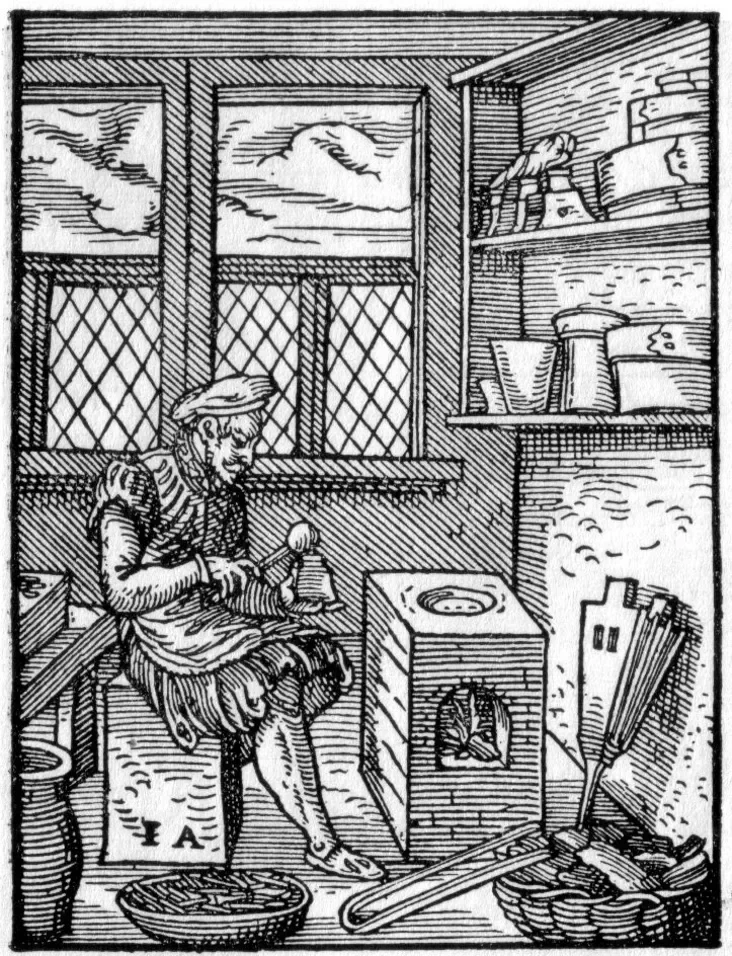
The casting process looked like this: the matrix was inserted into the lower part of the mould and secured with a steel spring. The master closed both halves of the mould and poured molten metal into the opening. Thanks to its ingenious design, the mould allowed for adjusting the width: for a narrow letter «i» it was compressed, and for a wide «w» it was expanded, but all letters maintained an absolutely identical height and depth («body size»).
No less important was the composition of the metal. Through numerous trials, Gutenberg invented an ideal alloy of tin, lead, and antimony with the addition of bismuth. Lead and tin provided plasticity, while antimony and bismuth had the unique property of expanding slightly upon cooling. Thanks to this, the molten metal instantly and densely filled the finest curves of the matrix, ensuring perfectly sharp edges of the letter.
The metal solidified almost instantly. The master opened the mould, shook out the finished letter, and immediately poured the next one. After cooling, all letters underwent final processing: excess metal was trimmed, and they were adjusted to a uniform height so that they stood perfectly straight in the print line. After this, they were sorted into typecases.
Gutenberg was obsessed with aesthetics. For his Bible to look as perfect as the best handwritten books of the monks, it was not enough for him to have a standard alphabet. He wanted to achieve a perfectly straight right margin of the page without unsightly gaps between words.
For this purpose, he created a gigantic set of approximately 290 different characters. These included not only uppercase and lowercase letters but also many ligatures (joined letters) and special abbreviation marks that imitated the handwriting of professional scribes.
In one hour, an experienced typefounder could cast up to a hundred such letters. This transformed book creation from a laborious art into a powerful industry. The movable type technology allowed for the production of thousands of elements that could be «distributed» after printing and reused for the next page, which forever shattered the scribes' monopoly on knowledge.
Printing Material
The next fundamental challenge for Gutenberg was ink. Scribes in monasteries used water-based ink, which was well absorbed by parchment, but it was unsuitable for metal letters. Water-based ink simply rolled off the smooth metal in droplets and spread across the sheet in indistinct smudges.
Gutenberg also had to become a chemist. He developed a unique emulsion based on drying oil (linseed oil) and soot. This was a true technological breakthrough. The new ink was very thick and viscous, allowing it to evenly coat the metal type. It dried much faster than traditional ink, and it was this that made possible recto-verso printing (on both the front and back of the sheet) without fear of the text smudging.
The production of printing ink required great attention. Its base was drying oil — boiled linseed oil. To determine its readiness, a piece of bread was thrown into the boiling oil. If it toasted to the desired degree, it indicated that the oil had reached the necessary temperature and viscosity. Such bread was the favorite food of printer apprentices.
Gutenberg's «black magic» recipe, besides soot and oil, included other substances: turpentine, resin, iron pyrite, copper, and lead. This complex cocktail made the ink so durable that even after 500 years, the text of the Bible remains shiny and vibrant.
However, it is important to remember that Gutenberg's press at that time only printed black elements. All the beautiful red headings (rubrications), ornaments, and initials that we see in the Bible were added later by hand by artist-illustrators. Gutenberg created the foundation, but each book still required the final touch of a human hand.

When all the components — the press, metal type, paper, and the correct ink composition — were prepared, Gutenberg's workshop began to operate as a single mechanism. The slow process of copying books was replaced by a clear rhythm and strict sequence of actions.
The Art of Layout and the Secrets of Printing
The process began in the typecases (Setzkasten), where cast lead letters were stored. Typesetting was meticulous work that required the master not only perfect literacy but also an exceptional sense of space and textual rhythm.
Individual letters were assembled into lines using a special tool — the composing stick (Winkelhaken, or Setzwinkel). To ensure equal spacing between letters and words, the typesetter used special metal plates, shorter than the type height, which did not leave an impression on the paper.

Gutenberg's true masterpiece was his Bible, in which he achieved perfect «block» text justification (Blocksatz). To ensure the right edge of each column was flawlessly even, approximately 290 different character variations were used: letters of varying widths, ligatures, and special abbreviations. If a line didn't fit, a standard letter could be replaced with a narrower one or an abbreviation could be used, avoiding unsightly «holes» between words.
Finished lines were transferred from the composing stick to the galley (Setzschiff), where they were assembled into a column or an entire page. After this, a metal printing form was composed and secured from the typeset text, serving as the basis for printing.
But before making an impression, the ink and paper had to be prepared. For applying ink, printer's balls were used — in our lands, they were called «mazza,» from the Italian mazza — special leather pouches made from dog skin (it was considered the most durable and poreless) and densely filled with horsehair. With these balls, the ink was evenly «pressed» onto the surface of the metal type.

The paper was always moistened before printing. This was done so that the linen fibers would become soft and their pores would open. At the moment of printing, the paper, like a sponge, absorbed the oil-based ink. After drying, the pores closed, forever trapping the ink within the sheet. This ensured the incredible durability of the text that we see five centuries later.
The printing process required mathematical precision. The sheet of paper was fastened to the press lid with special pins — points. From above, the paper was covered with a wooden frame (frisket), which protected the clean margins of the sheet from accidental ink stains.
The use of points was critically important for printing on the reverse side of the sheet. Thanks to the small holes from the pins, the printer could perfectly align the text on both sides of the page. This prevented text overlay, ensuring that lines on different sides matched and did not show through, which created a sense of absolute order on the page.
Gutenberg's metal letters, unlike the preceding wooden blocks, which were unique and unrepeatable, withstood the colossal pressure of the press.
Gutenberg's Return to Mainz
Gutenberg was able to implement his technical developments in his hometown. It is documented that he reappeared in Mainz only in October 1448. In that month, he borrowed 150 gold guilders from his cousin Arnold Gelthus. Historians believe that this money was invested in creating a new printing workshop on the territory of the Gumbelbrechtshof city estate, which had long belonged to his family.
However, Gutenberg understood that he needed much greater capital to realize truly ambitious plans. He began to seek contacts with major financiers and around 1449 met the Mainz merchant Johann Fust. Fust, seeing the potential of the invention, granted him an interest-free loan of 800 gold guilders. But this generosity also had a catch: all the printing equipment that Gutenberg acquired or created became collateral for this money.
Around 1450, Gutenberg's experiments had progressed so far that he was finally able to begin full-fledged printing of individual sheets and books. The first items to emerge from his press between 1450 and 1454 were not holy texts, but small editions that had a stable demand. These included textbooks of Aelius Donatus's Latin grammar and dictionaries. Closer to 1454, the assortment expanded: calendars and papal indulgences began to appear.
But Johannes's main dream remained the Latin Bible, work on which he began around 1452. The endeavor required even greater investments, so Fust issued Gutenberg a second loan, becoming a full partner in the project.
Gutenberg spent about two years preparing the first typesetting of the Bible. The first finished sheets of the future edition were demonstrated in October 1454 in Frankfurt. Aeneas Silvius Piccolomini (the future Pope Pius II), who was in the city at the time for the imperial diet (Reichstag), later testified in his letter that he had personally seen fascicles of the Bible presented by a «wondrous man» (Lat. vir mirabilis; it is unknown whether this was the inventor himself or his assistant).
Piccolomini noted that the typeface was so clear and beautiful that the text could be read even without glasses, and all copies of the upcoming edition were sold out even before printing was completed.
The book turned out to be monumental — about 1300 pages of text. It entered history as the « 42‑line Bible» (or B42), because precisely that number of lines per page provided the ideal visual harmony and mathematical precision that the master so strived for.

Gutenberg and his Creditor
When the publication was effectively completed, a rupture occurred between the partners. Fust, sensing that the technology was ready to yield profit, filed a lawsuit against Gutenberg. He accused the master of irrational use of funds and demanded immediate repayment of the entire loan along with enormous interest.
This was a planned trap. In 1455, according to a court decision (known as the «Helmasperger Notarial Instrument»), Gutenberg was forced to hand over his workshop, all equipment, and — most painfully — the entire finished edition of the Bible to Fust in repayment of the debt.
Johann Fust, together with Gutenberg's talented apprentice Peter Schöffer, took possession of the printing house and successfully continued the business, reaping the benefits of an invention that was not theirs. For Gutenberg himself, this was a catastrophe, but not the end. He was able to establish another, smaller workshop, although his technical capabilities were no longer the same. He no longer created editions on the scale of the Bible, focusing instead on producing calendars, textbooks, and Psalters — a total of about 50 books came out from his new press.
The tragedy of losing his first workshop also changed Gutenberg himself. If earlier he meticulously hid his secrets, fearing competition, after the trial he became more open. The master began to help other printers, share knowledge with apprentices, and promote the spread of the technology. He participated in the publication of the 36‑line Bible in Bamberg, educating followers who later spread the «art of printing» throughout Europe.
At the end of his life, Gutenberg finally received peaceful recognition: Archbishop and Elector Adolf von Nassau took him into service, granting him the title of nobleman and a lifelong provision of food and clothing. Johannes Gutenberg died in 1468, leaving no wealth behind, but leaving a world that was forever changed.
The Spread of Printing
The technology, which began in a single workshop in Mainz, spread across the continent with immense speed for that era. By about 1480, printing presses were operating in 110 locations throughout Europe — from Germany, Italy, and France to Spain, the Netherlands, Belgium, Switzerland, England, Bohemia, and Poland. By the end of the 15th century, printing had encompassed at least 271 cities in Central and Western Europe. This allowed millions of books to be printed and laid the foundations for mass communication.

The wave started by Gutenberg quite quickly reached the Grand Duchy of Lithuania as well. Already in 1517, just 62 years after the release of Gutenberg's Bible, our compatriot Francysk Skaryna printed his first book in Prague, becoming the first printer in the entire East Slavic world.
In the 1520s, Skaryna moved his printing press to Vilnius, and in the mid-16th century, printing houses opened in Brest (1553), Nesvizh, and other cities.
The spread of printing had profound societal consequences. It ushered in an era of mass communication, broke the elite's monopoly on knowledge, sharply increased literacy rates, and allowed revolutionary ideas to quickly cross state borders. This contributed to the Reformation, the strengthening of the middle class, and the beginning of early modernity. As early as 1620, the English philosopher Francis Bacon noted that printing had changed the face of the entire world.
Gutenberg's influence on civilization is so significant that the Canadian philosopher Marshall McLuhan introduced the concept of the «Gutenberg Galaxy» into academic use, describing a new stage in human history.
International recognition of the master's greatness was cemented in the 20th century: in 1997, Time magazine named the printing press the most important invention of the second millennium, and in 1999, the American television channel A&E declared Johannes Gutenberg «Man of the Millennium.»
Modern Continuation of Tradition: Krakow and Gutenberg Publisher
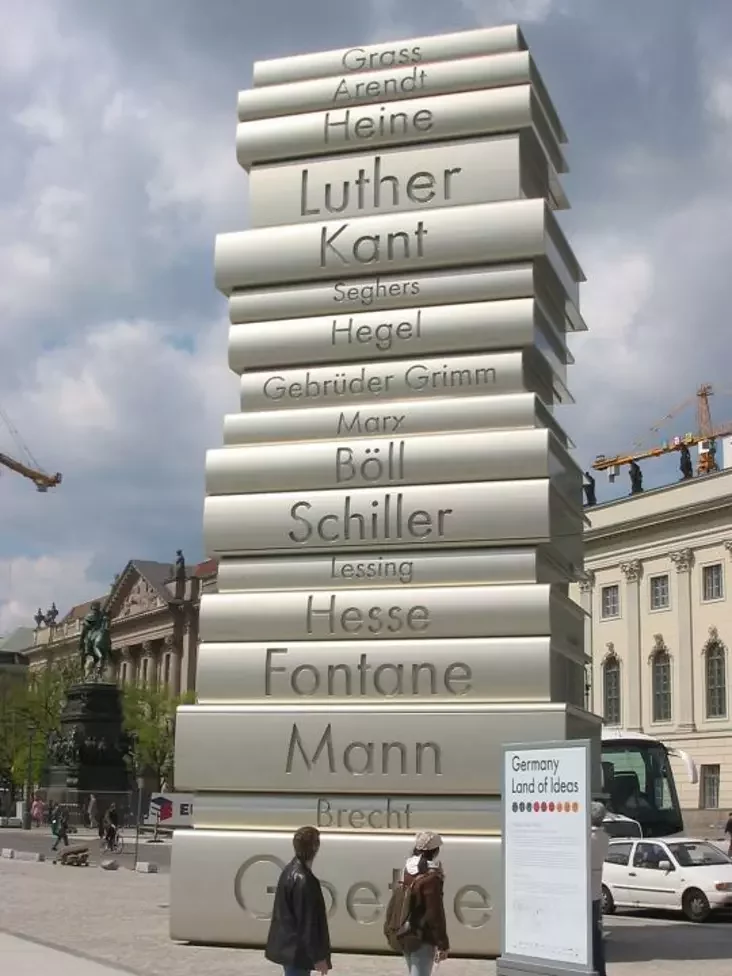
The history of printing has come full circle and returned to our days in a new guise. One of the first cities where Gutenberg's followers arrived back in the 1470s was Krakow. Today, this ancient city, which for centuries was a center of science and printing, has become home to the Belarusian publishing house Gutenberg Publisher.
The publishing house bears the name of the great master not by chance. It inherits his main mission: to make knowledge and culture accessible, transcending borders.
Today, Gutenberg Publisher in Krakow serves as an important cultural bridge, focusing on publishing Belarusian books and preserving intellectual heritage in the new digital and print era.
This is living proof that the «Gutenberg Galaxy» continues to expand, and the traditions of quality and enlightening printing remain relevant 500 years after the birth of the first printed Bible.
And to support Belarusian publishing today — order books from Gutenberg Publisher. Delivery is worldwide, to Belarus and the USA.
-
First Step Towards BNR: 108 Years Ago the First Constituent Charter Was Proclaimed
-
How Orthodox Latvians wanted to take over a church from Catholics near Vitebsk
-
What new holidays should be added to the Belarusian calendar and why shouldn't everything Soviet be condemned? Historian Timokh Akudovich explains
























Comments
[Зрэдагавана]