


A Big Conversation with Lesia Rudnik about sexism, her wrestler husband, the salary of a Doctor of Science in Sweden, the opposition, and the European Union's mistake
"European Woman of the Year - 2022", former head of the "Belarusians of Sweden" organization, Doctor of Political Sciences, former director of the Center for New Ideas, author of a project on the regulation of Big Tech and AI in the European Union and several authoritarian countries, which became one of nine supported projects in social sciences across Sweden — all this describes Lesia Rudnik from Hrodna.
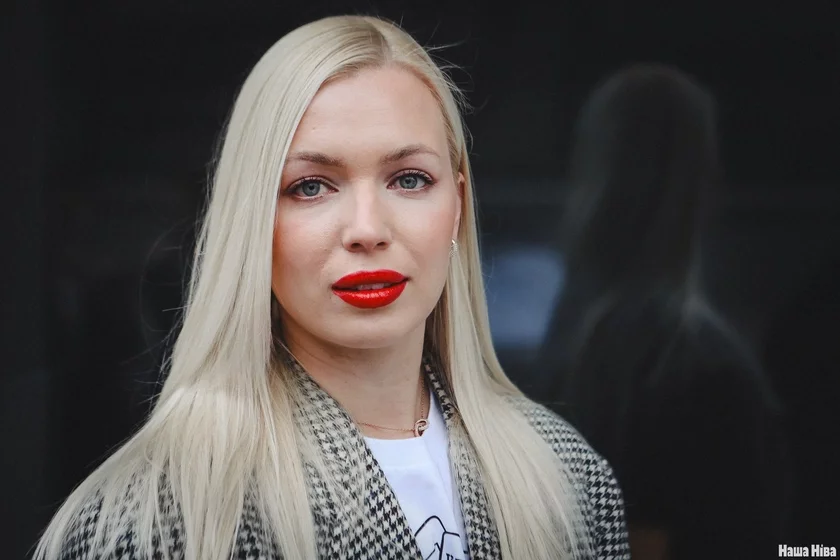
Lesia Rudnik. Photo: Nasha Niva
But in our conversation — not only about professional life and politics, there will be a lot of personal things here — about shaming, sexism, stress, relationships with her husband and parents, American football and dancing, money and the dream village Navasiolki.
"After defending my doctorate, my salary in Sweden increased by about 15 percent."
"Nasha Niva": You decided to leave the post of director of the Center for New Ideas to devote more to your academic career in Sweden — has your pace of life changed noticeably?
Lesia Rudnik: Just the other day I reflected on this for the first time. First and foremost, new colleagues appeared around me — no longer Belarusians, but people with a completely Swedish or international context. Now I can go several days without reading Belarusian news, although, of course, something reaches me from friends' stories or just in chats. But due to my work, my focus today is on international news.
I work at Södertörn University in the Department of Media and Communications, and we have a lot of discussions and talks just over coffee. For me, it's enough to go to the website of a publication I like and just read the news summary. Of course, at CNI I had to be aware of all trends, including what propagandists said (especially when we were researching Belarusian propaganda).
Accordingly, I also give fewer comments to the media. I decided myself to give fewer: in my opinion, it's right to admit to myself that I currently don't have time to closely follow the Belarusian agenda.
And a lack of information would limit me in a quality analysis of the situation. And in general, for the last year and a half, I have repeatedly openly said that I try to comment more based on data or in a comparative perspective, because I no longer have the same feeling for the situation in my homeland, not even at the level it was five years ago, when there were still sources that could tell me more frankly and in detail about events in Belarus.
Work stress has also decreased: I think everyone understands that being a director is not an easy task. Especially when you are an NGO in exile. But it seems to me that despite all the difficulties, I did quite well. And the main indicator here is that after my departure, CNI continues to operate effectively. However, with one part of myself (probably my mind), I remain at the Center at a strategic level. I also continue to manage the CNI Women fellowship program, which launched at the end of the year.
"NN": Will you continue teaching students?
LR: Most researcher contracts include a teaching component, usually 20% of working hours. My personal grant from the Swedish Research Council is without teaching; the contract stipulates that for three years I will only work on research — this is a condition of the grantor. In my department, this is considered a very luxurious situation.
"NN": Is it realistic to feel comfortable in Sweden for three years on a research grant?
LR: I will have a guaranteed average academic salary. Since it was a grant, I calculated it myself. And let's just say, if I lived in the USA, this money wouldn't be enough for me, but for Swedish life, these are normal conditions.
"NN": And how much did your salary increase after defending your doctorate (Lesia Rudnik received a PhD in Political Science in 2025 — NN)?
LR: By about 15 percent. Well, and according to the rules of Södertörn University, where I currently work, every employee's salary must increase by a certain percentage annually. In general, the rules for annual salary growth, if an employee stays with the company, are regulated in Sweden by a so-called kollektivavtal — an agreement between employers and trade unions.
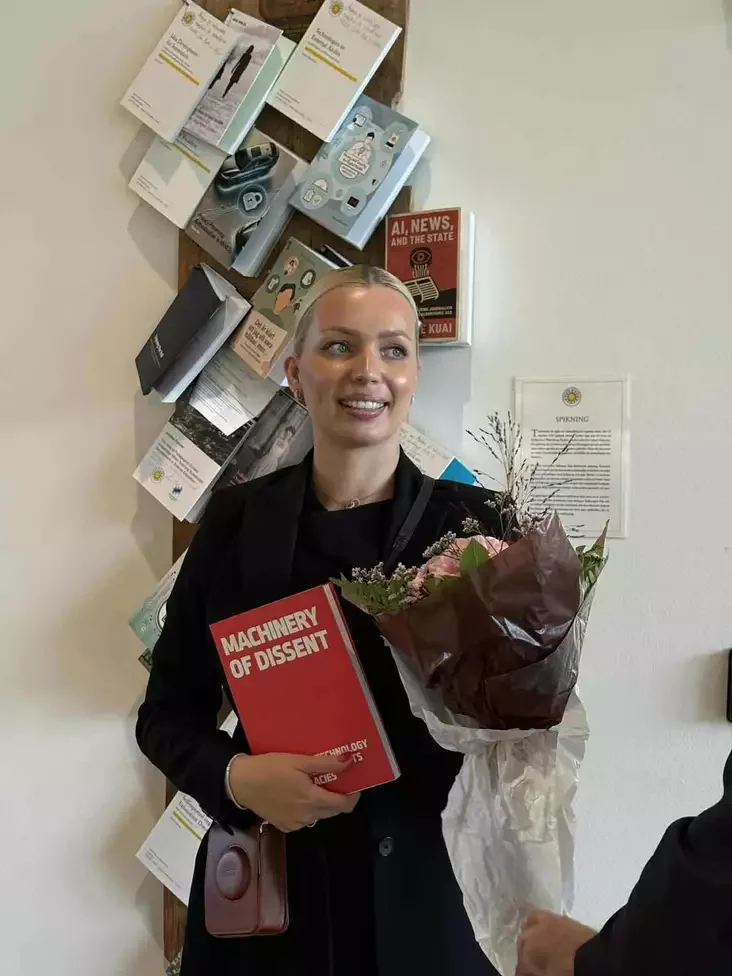
Lesia Rudnik after defending her doctorate. Photo from personal archive.
"My husband and I have almost equal salaries."
"NN": Who is the main breadwinner in your family (Lesia is married to Mikola Lapkouski — NN)?
LR: My husband and I have almost equal salaries. But my salary is always the same, while his, as a barber, depends on seasonality: for example, at Christmas and New Year there's always a larger flow of clients. At the same time, again, Swedish trade unions ensure that employers compensate for overtime or weekend work.
With expenses, everything happens naturally for us.
For example, we have a mortgage, and we agreed that each of us contributes half of the amount every month. He pays for all insurances, I pay for subscriptions — "Spotify", "Netflix" and so on. We discuss and agree on investments or savings in terms of: "Okay, your salary has increased, maybe it's worth starting to save more into a savings account?"
And when it comes to going to cafes or shops, we don't even think about it: simply, hypothetically, whoever's phone is first at hand pays.
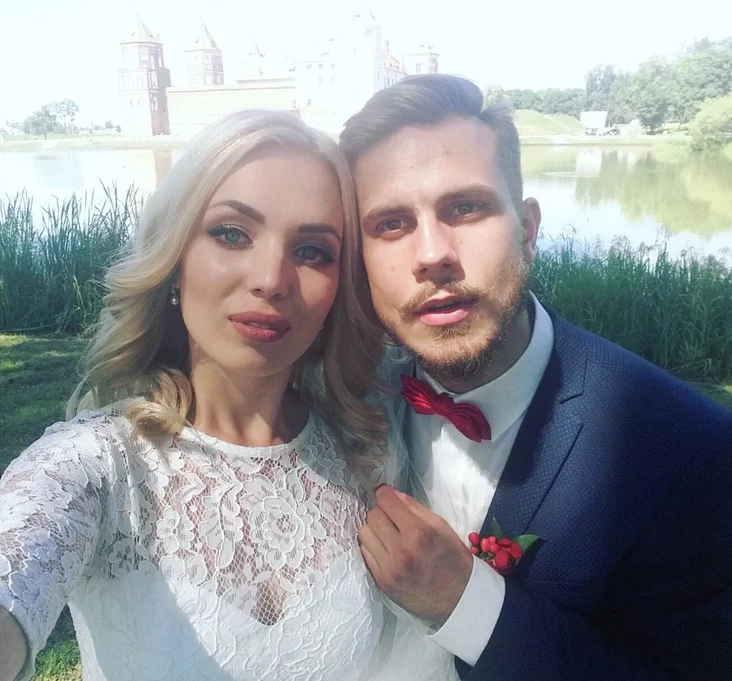
Wedding of Lesia Rudnik and Mikola Lapkouski. Photo from personal archive.
"NN": Does your husband also continue to wrestle? (Mikola Lapkouski once achieved good results in American football — he was recognized as the best receiver in the Hrodna team "Barbarians". Now he performs at wrestling shows under the pseudonym Dmitry, "Beast from the East" — NN.)
LR: Yes, it's his hobby, but it takes a lot of time — primarily due to physical training. He needs to go to the gym, always take care of his health, and be as prepared as possible for various injuries. He trains thoroughly because he has shows at least twice a month. And he performs not only in Sweden but also in Finland and Estonia.
"Beast from the East." How Belarusian Mikola became Dmitry the wrestler in Sweden
"NN": Of course, there are fewer injuries in wrestling than in American football, which you both played — but how is it emotionally to be the wife of a man who is regularly beaten?
LR: I don't worry too much because I see how he prepares himself, how responsibly he approaches it (on the other hand, he hasn't had any very serious injuries yet).
Well, indeed, I myself played American football for two years, and then I understood why it's so captivating, despite the injuries. It's adrenaline, a team thing — you strive to be like stronger athletes and want to be part of them, part of the event.
"NN": You met back at the Hrodna Lyceum, right?
LR: Yes, I saw him for the first time when I was taking a written exam for the lyceum. My friend and I were sitting at the back of the assembly hall, and Mikola was late for the exam (he's still late everywhere (smiles)). I remember then, just by looking, I commented to my friend: "Oh, what a handsome guy!"
Then we met on September 1st for a walk after the school assembly — during which graduates go with the newcomers to Kalozhski Park, where they play guitars and talk about some lyceum traditions.
I approached Koli myself, tried to get acquainted, but he was very cold, only saying that he had a girlfriend. But literally a month later he found me himself, we started attending a drama club together, and everything started.
"Classmates listened to Russian pop music, while I'd heard 'Krama' and NRM since childhood."
"NN": At what point did you realize that you were not born into an average Belarusian family? (Lesia was born into a family of creative intelligentsia: her mother and father are the founders of the well-known School of Young Journalists, which operated for 20 years, as well as the University of the Golden Age — NN).

"Tvoi Styl" (Your Style) — a Hrodna youth internet radio and internet newspaper, whose editor-in-chief was Vitaut Rudnik. It operated from 2007-2016. It served as an information resource for the School of Young Journalists. As a result of rebranding, the portal was renamed Hrodna.life.
LR: In my opinion, it was already in kindergarten; there, only the caregiver spoke Belarusian with me, and no one else. Of course, I remember little from when I was three, but subconsciously I was definitely uncomfortable, as I didn't speak Russian at all then.
Then, at six years old, I went to the zero grade and there I already spoke Russian. That is, Russification occurred primarily through the education system. I remember how all my classmates listened to Russian pop music, while I, from childhood at events organized by my parents, heard NRM, "Krama," and all that.
I recall how my dance teacher (I studied at a gymnasium with an aesthetic focus) overheard my dialogue with my dad, and the next week asked me why we were speaking Lithuanian (!) — but we were speaking Belarusian.
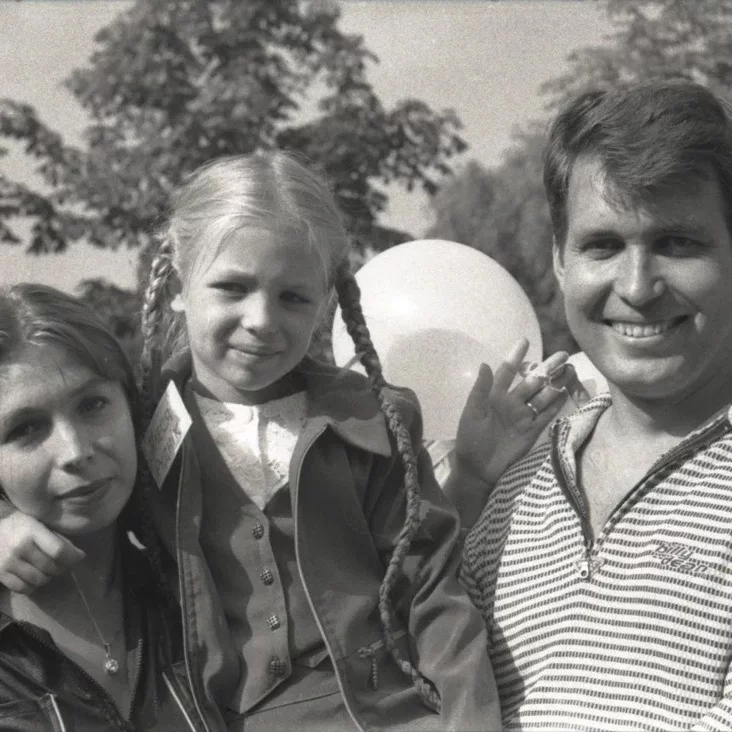
Lesia with her parents. Photo from personal archive.
My father would still let me perform at Dozhinki (harvest festival), but not for November 7th (October Revolution Day) anymore. And at some point I resisted, because I didn't want to stand out from the group, but in the end, he explained everything to me, and later I myself refused to dance in the May 9th parade. Of course, all these situations were stressful, but it seems that through such stories I learned to defend my opinion and position. I wasn't traumatized by all this, and shaming like comments from the teacher that I had "lips like a hippo" didn't bother me, because my parents immediately raised me to be very independent and self-confident.
The turning point came when I went to the "Science" summer camp. There were smart, talented, and sometimes unusual teenagers: some dressed more informally, some listened to heavy music, some spoke Belarusian. With them, I felt in my element. Afterwards, we formed a Hrodna punk-rock get-together of smart kids who planned their future and dedicated time to learning. And the lyceum itself had a freer spirit: I didn't get grief for my favorite black skirt and red hair. At the first student concert, I sang Evanescence on stage.
"NN": There's your famous photo, where you, as a child, on the cover of the newspaper "Pahonia" from 1999, are holding white-red-white flags. It's known that this was your first rally, which you attended with your parents. Did you go to more after that? Because it's known that in 2006 your mother didn't want you to go to the Square in Minsk.
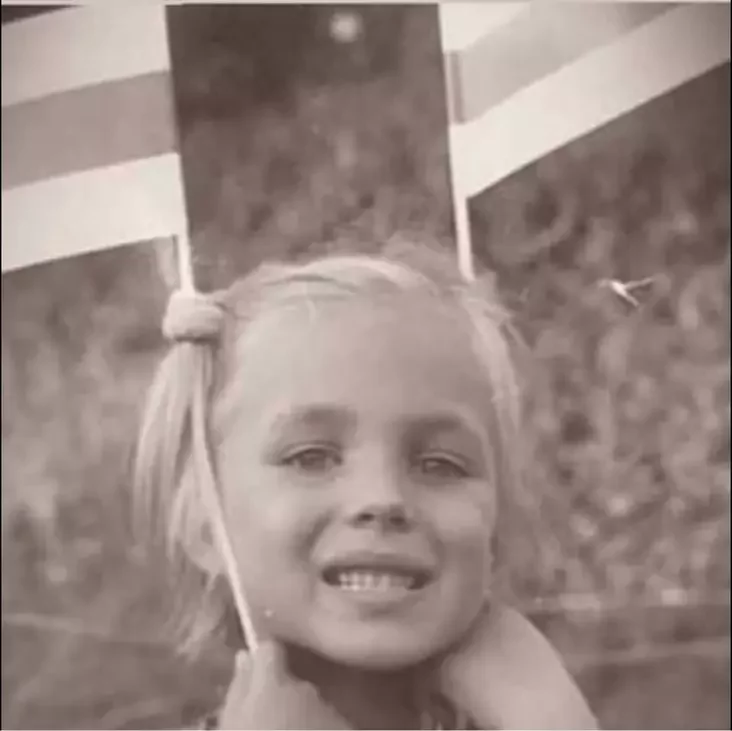
1999. Lesia's first rally. Photo from personal archive.
LR: With my parents, I attended various rallies in Hrodna, including the Freedom Day ones, and at a more adult age, I wore a white-red-white ribbon on my arm. By the way, I only learned in adulthood that my father was detained after one of the actions. Pavel Mazheika, with whom they worked together at "Pahonia," was detained then, and my father, along with Andrzej Poczobut, Andrei Mialeshka (pictured below. — NN), and other colleagues, went out for several pickets.
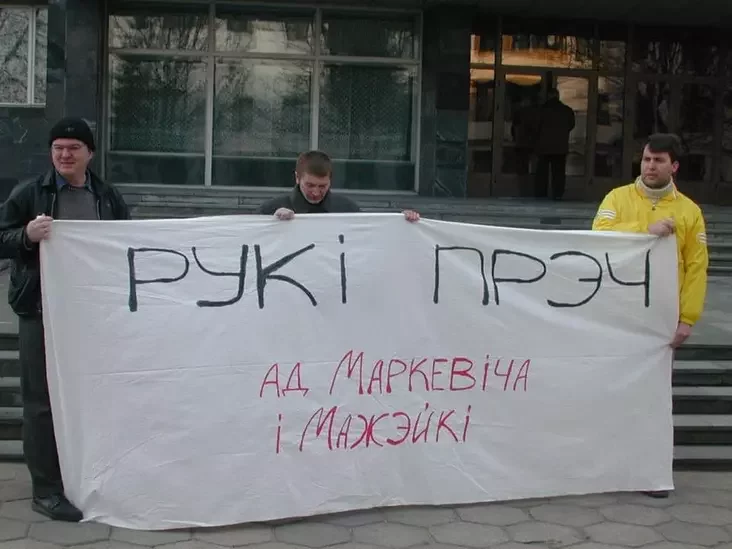
Photo from the family's personal archive.
In 2006, I was very worried about my mother: even though I was 12 years old, I already understood what was happening. Especially since that's when BT (Belarusian Television) began broadcasting stories about protestors with syringes, bottles... That image strongly impacted the consciousness of some of my classmates.
I remember, the day after the elections, before a Belarusian literature lesson, I started telling what had happened yesterday, saying that Milinkevich should have won the elections (he, by the way, worked with my father in the same building then), but some classmates only replied that there were drug addicts there — they didn't understand how I could support those people. I was very upset then, I just burst into tears before the lesson.
"NN": And who did you vote for in the elections?
LR: I only voted in local elections in Belarus in 2014, before the 2015 presidential elections. In 2010, I was underage, then I moved to study in Vilnius, and after that — to Stockholm. In 2020, I really wanted to vote, but didn't manage to, as I was organizing election observation in Sweden and didn't wait for my turn. At this point, it turns out, I've voted in Swedish elections more than in Belarusian ones.
"The future Belarusian leader currently lives in Belarus, and we don't yet know who she or he is."
"NN": Who do you consider the most promising Belarusian politician today?
LR: I'm not sure I want to answer that question. Because I might descend into criticizing everyone. The future Belarusian leader is, most likely, currently living in Belarus, and we don't yet know who she or he is.
At the same time, I deeply respect what Sviatlana Tsikhanouskaya has done in recent years. Not without the competence of her advisors. Continuing female solidarity, Masha Kalesnikava will always remain the Joan of Arc of the Belarusian revolution. Although for me, she is Pippi Longstocking — strong, heroic, and very brave, while also a bit quirky.
Compared to 2006 or 2010, the opposition and society have taken a step forward towards each other. No one is reinventing the wheel: the same arguments about European identity and national identity are almost at hand, but society itself has become closer to these ideas. And in this sense, the role of opposition politicians is more real. At the same time, of course, there are problems that I would rather not delve into at the moment.
Among non-marginal Belarusian politicians, there are no very strong ideological differences, as there are in Sweden or the USA. There are only slightly different views on international politics. The last serious disagreements are not about how the country should be governed, but about how to gain the opportunity to govern the country.
Sometimes there are a lot of comments like: "Oh, they are constantly bickering." But I don't even know how parties could logically form now: well, Zianon [Pazniak] would perhaps be much more right-wing than the rest. In general, almost everyone in the formal structures of the opposition here is more or less center-right. There is no strong value-based gap in the opposition regarding what future Belarus might look like.
"Siarhei [Tsikhanouski] is not yet in the role of a politician."
"NN": What do you think about Siarhei Tsikhanouski's forced deportation and return to activism, and now also the Babaryka team's?
LR: Siarhei Tsikhanouski's first conference deeply touched me. And the first thing I thought then was: it would be good for him to rest, to rehabilitate. But it was clear that a person with such charisma and experience would strive for public action. I think he is currently going through a stage of accepting the situation and searching for a new professional identity. These are all very complex processes, and when they are happening, I find it very important to maintain some distance from commenting.
The same I can say about Babaryka and Masha: there are moments when you need to pause, when it's important to come to a conference simply to say that we are okay, we have been through this and that.
Today, I perceive Tsikhanouskaya as an opposition politician. Siarhei, probably, strives for this role, but for now, he is not in that role.

Lesia Rudnik. Photo: "Nasha Niva"
"Merkel's calls in November 2021 were too late."
"NN": Dialogue and trade with Lukashenka — people for sanction removal — is this a victory or a defeat? Considering that repressions in the country have not subsided.
LR: I think this is more a defeat for the European Union than for the Belarusian opposition. If the narrative about dialogue with Lukashenka's regime had appeared in the first half of 2021, when there was no Ryanair landing, no crackdown on Tut.by and other media, no war, it would have been an initiative that would not have caused so much criticism and would have been more image-acceptable for the EU. And most importantly, it would have helped to free people sooner.
We all know from history that the Belarusian opposition does not influence the release of people through direct dialogue with the regime. It was always influenced by who would pick up the phone and call Lukashenka. The opposition, accordingly, can help keep this issue on the agenda of Western actors. And this is an experience that, unfortunately, was somewhat forgotten during the unfolding of the current wave of repression. Even Merkel's calls in November 2021 were too late.
Today, we find ourselves in a very difficult situation where it is awkward for the EU to engage with the dictator, as it would damage their image. There is an opinion that it would be a betrayal of civil society and the democratic forces they have supported all this time. Thus, the space for negotiations for a structure like the European Union is almost closed today. This is not the Trump administration, which can just come and say: "Okay, everything is new now." This is a union of almost three dozen countries with their own interests.
Of course, I view the release of people positively. And as far as I understand the system: arrests of people and their releases are two parallel tracks.
It is also very important for people working on releases to demand an end to repressions. And not in the format of "we urge you, stop immediately!" But in the format of specific conditions and proposals.
But, of course, that's the second stage. Right now, the more pressing issue is to free those who have been in prisons for a long time. And then it must reach those abroad. So that repressions stop not only within the country but also for Belarusians in emigration. So that people like me can go home without fear.
"NN": When a country that was the main defender of democracy in the world allows itself to seize the leader of another country, even if he is a bad guy, and threatens to seize another one — how do you feel?
LR: All of this can be characterized as the normalization of lawlessness. It's testing the boundaries — how much they can be expanded. Trump has been doing this since 2016.
Some of my acquaintances who are Trump supporters convince me that there are specific, tangible positives from him. Well, I can find some positives too. For example, political prisoners are being released — great. The problem is that we don't think 10 years ahead, we don't think about the long-term consequences.
The main consequence of Trump's politics is that politics as a phenomenon becomes absolutely unpredictable. And this expands the boundaries of what is permissible. Here, I wouldn't even think about China, which might again attack Taiwan, but rather about smaller regional stories. People see that the USA is primarily concerned with major conflicts: Iran, Israel, Palestine, Venezuela, Ukraine, Russia. And everything else might just fly under their radar and remain unnoticed by the world.
I'll also add about areas of responsibility, where everything depends very much on one person's personal interest. Various humanitarian support initiatives, programs for water, climate, and so on — all of this, as we saw with Trump, can be rolled back in one day simply due to a lack of personal interest. And this is dangerous because we still live in a world where some people are very poor or live in critical ecological conditions.
In summary, I see a multifaceted danger in us moving towards a very personalized, unpredictable macho-style of politics, and this could set a precedent for other democracies.
"NN": Why did Lukashenka need a Year of Women given his well-known arrogant attitude towards the opposite sex?
LR: I don't want to try to read Lukashenka's logic. And besides, when has assigning a theme to a year ever really influenced anything? I think they just bring him various proposals, and he picks something based on his mood; most likely, it's all very random.
Anyway, without looking for connections, it turned out to be very ironic: Tsikhanouskaya is the main opposition leader, and here Masha Kalesnikava is also released during the Year of Women.
"A fairly common thing I encountered: if she's a blonde, then she's a doll and unintelligent."
"NN": When was the last time you encountered an act of sexism or an inappropriate comment directed at you?
LR: In person — a couple of months ago. I emphasize that this never happens in Sweden. We held the last Unconference with CNI. I was speaking, and afterwards, a man (I won't name names) complimented me on "how beautiful my lips are." Well, what can I say, if that's the only impression after my speech. It was supposed to be a compliment, but in fact, the person doesn't take you seriously.
Or under a film for "Honest People" about artificial intelligence, where I appeared as an expert, there was a comment in the style: "Look, a stupid doll is saying something." This is a fairly common thing I've encountered: if she's a blonde, then she's a doll and unintelligent. I've adapted to this and don't take it seriously. I call all of this "sexism light," because much worse things happen to other women.
Of course, I would like there to be less sexism of any kind. But I would also like us, women, to learn to treat it more ironically, where possible.
This doesn't mean that everything should be accepted as it is, but it also doesn't mean that we should be severely traumatized by such things. It's important, first and foremost, to be self-confident, not to be afraid to push back. No one will do this for us.
But it's noticeable that in my environment, sexism has become slightly less prevalent over time. Even in our conservative society, the situation is already better. But, of course, there's still work to be done. Take, for example, the recent publication by activist Mikola Dziadok with his thoughts on banning abortions. It's very frustrating that men still think they have some greater intellectual advantage or physical control over women. And they even state this loudly and publicly.
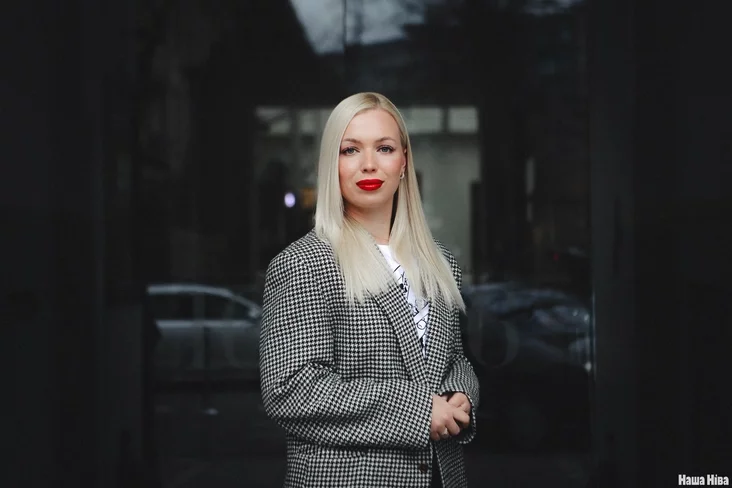
Lesia Rudnik. Photo: Nasha Niva
"NN": How much effort (and what kind) do you put into maintaining your appearance, which always receives many compliments?
LR: Good physical condition is my most important condition for functioning. If I go to the gym less than twice a week, I don't feel in my best state: my legs start to swell, my back hurts, because I have a sedentary job. For me, it's not so much about beauty as it is about health.
After we finish talking, I'm going to dance. I'd also like to try swimming, tennis, and learn to ride a horse in the future — I hope I succeed.
Regarding grooming: my hair is entirely my husband's merit. He dyes it and cuts it.
"NN": How convenient!
LR: And cheap! (smiles)
I believe that in today's world, proper self-care for both men and women is fundamental. It's something that can make our appearance more satisfying for ourselves.
I always invest in a good cream, serum, and masks. Thanks to this, I can calmly go without makeup. Dental care is also an important thing.
As for the latest cool thing, I can tell you I gifted myself a red light face mask for New Year's — a device that emits red light and improves skin condition. I can't share the effects yet, as too little time has passed. Additionally, I periodically do microcurrent treatments, go to a cosmetologist, and get massages. At home, I have a vibrating platform that you stand on, and it supposedly boosts blood circulation.
"NN": Earlier in an interview, you said that it would be great for Belarus to adopt Sweden's experience in the education system, health, and the desire to lead an active lifestyle at any age. What is the most annoying thing about Sweden for you?
LR: It's about a common trait of theirs, characteristic of people who live on the same territory for a long time (I don't say 'mentality', because I'm critical of that word). Swedes, at least in Stockholm, are very afraid of conflicts. It seems like a very abstract thing, but in reality, it influences many processes — how you communicate with colleagues or build any small talk with a stranger. People will just tell you: everything's okay, you're right, all good, agreed. And then they'll do everything their own way. It's a non-confrontational attitude mixed with insincerity.
"I didn't leave in 2020 and deliberately applied to study abroad."
"NN": Given that you've stepped away from CNI affairs and shifted your focus from Belarus to international matters — does this also imply internal transformations — a move towards Lesia the Swede, the European?
LR: One must think strategically about their career. It would be very naive to say that I, having lived in Sweden for over 10 years, and outside Belarus for over 14, intend to work exclusively for Belarus with the aim of returning at some point.
I did not leave in 2020, and I deliberately applied to study abroad. It just so happened that at some point, I was interested in dealing solely with Belarus — being the head of the Swedish diaspora, conducting research, writing academic articles about Belarus, and writing my dissertation about Belarus.
Furthermore, partly to be more career-sustainable, I need to have a broader profile. Before making my choice, I had another position where I would delve deeper into the Eastern European region, but I chose a slightly different geographical focus. In my research on the regulation of Big Tech and AI in the European Union and several authoritarian countries, I will be able to work with the case of Belarus, and the case of Sweden, and the case of Venezuela, and others. For an academic career, a PhD is like your driver's license, just the beginning.
Additionally, I can say that next year a book about Belarus and the protests will be published — I am writing it with three other colleagues. It will be academic, in English, and styled to feature the voices of Belarusians who participated in the protests. As I say, this will be, as it were, my final chapter in writing a purely Belarusian history.
"NN": You once mentioned that in 2020, you strongly wanted to go to Belarus, but it would have been dangerous. If you could go there now, where would you go first?
LR: I would probably go to the village of Navasiolki, in Hrodna region. Relatives of my mother's friend once lived there. There's such incredible rural freedom there! A large field, beyond the field a forest, and in it horses, there are mushrooms, there's the Kotra river — you can kayak down it, you can fish, you might even see a viper there! Such wild, wild nature! These are the very simple landscapes in my mind.
«Nasha Niva» — the bastion of Belarus
SUPPORT US

















Comments