


The Power of the Gaze: How Charlie Chaplin Played the Greatest Final Scene in Cinema 95 Years Ago
Ninety-five years after its release, Charlie Chaplin's silent comedy "City Lights" is called one of the greatest films of all time. To a significant extent, the film owes this fame to its brilliant final scene, writes the BBC.

When Life magazine asked Charlie Chaplin in 1966 which of his films he considered his favorite, he named "City Lights," modestly downplaying his own contribution with the words: "I think it's a good film, well made."
Since its premiere at a Los Angeles theater on January 30, 1931, film enthusiasts and directors have been much more generous in praising the romantic film, in which Chaplin's character — the Tramp — falls in love with a blind flower girl (Virginia Cherrill) who mistakenly believes him to be a millionaire.
When the British Film Institute published its first list of the greatest films of all time in 1952, "City Lights" took second place alongside Chaplin's film "The Gold Rush" (1925).
Stanley Kubrick, Orson Welles, and Andrei Tarkovsky called it one of their favorite films, and "The Night of the Hunter" screenwriter James Agee wrote that the film contains "the best acting and is the pinnacle" in the history of cinema.
The moment in question is the very end of "City Lights." The Tramp finally reunites with the girl, who can now see, and simply looks at her while the light remains in the frame.
This shot contains such pure emotion and simple poignancy that for many years it has been called the best ending in film history.
In the 95 years since "City Lights" was released, many have tried to recreate its subtle artistry and the power of its acting.
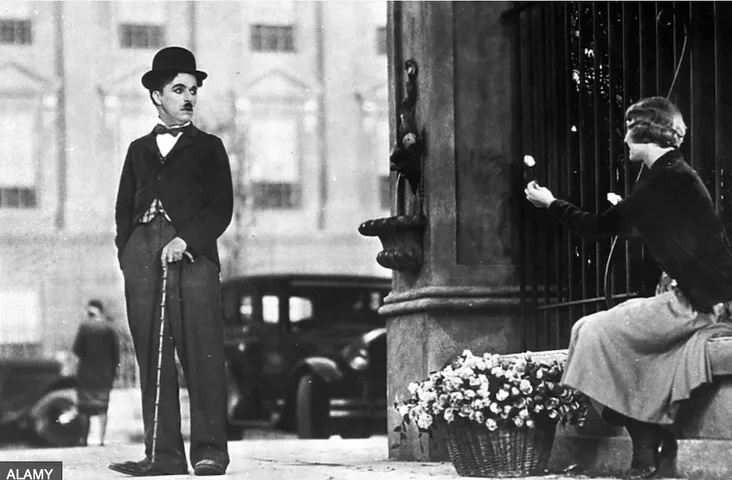
A whole story leads us to the film's final scene.
After the Tramp learns that the flower girl is about to be evicted from her apartment, he tries to earn money as both a street sweeper and a boxer. Eventually, he receives money from a drunken millionaire, who, upon sobering up, accuses the Tramp of theft. But before being arrested, he manages to give the money to the girl — she can pay for the apartment and see a doctor who can cure her blindness.
A few months later, when the Tramp is released from prison, he discovers that the girl can now not only see but also runs her own very successful flower shop.
When the shabby Tramp appears near the shop, the girl recognizes him, and on her face, we see deep gratitude. He smiles back — and the film ends there.
Charles Marland, author of "Cinema Classics," believes that the last scene in "City Lights" is a clear example of Chaplin's mastery as a director.
"He knew how to storyboard the film to enhance the emotional effect of the scene. The camera moves from a medium shot to a close-up," he explains and notes that Chaplin once said: he uses wide shots for comedy, and close-ups for tragedy and drama.
"And then there's the soundtrack — complex, emotional, and thought-provoking," Marland adds.
But all these professional techniques would have been in vain without the acting of Chaplin and Cherrill, who impressively debuted in "City Lights."
After shooting several takes of their last conversation, Chaplin felt they had overdone it — overacted and exaggerated the emotions, says Marland.
Therefore, Chaplin decided that the Tramp should simply look at Cherrill more intently. According to Marland, Chaplin once described the filming of this scene as "a beautiful feeling of not acting, a feeling of being outside oneself."
"The Tramp looks at the girl and wonders what she's thinking. It was so pure."
Years after the release of "City Lights," Cherrill told Jeffrey Vance, author of "Chaplin: Genius of the Cinema," that Chaplin usually had dry skin, but she felt his palm become moist when they filmed this scene.
"She understood that something unusual was happening to him," Vance tells the BBC. "She played as he wanted, but he reacted differently. He reacted as a character."
One of the main reasons why "City Lights" has resonated for decades is Chaplin's decision to end the final episode before we conclude how it all ends.
Romantics argue that, despite the Tramp's shabby appearance and lack of money, the flower girl accepts him with all her heart for what he did for her.
But there are also those who believe they have no chance of "riding off into the sunset together."
"I don't consider it romantic at all," says Vance. "We see her vanity when her sight returns. She looks in the mirror. Combs her hair. She's disappointed that the rich man isn't him. When she first sees the Tramp, she snorts and gives him money out of pity."
The transition from joy, horror, and shame to fascination — Chaplin's performance in the film's final moments is so multifaceted and subtle that viewers themselves can decide what happens next.
Complex Simplicity
When filming for "City Lights" began on December 27, 1928, Chaplin was the most famous man in the world. He had risen from London poverty to become a multimillionaire who had full creative control over his films.
So much so that when the first sound film, "The Jazz Singer," was released 14 months earlier, and Hollywood lost interest in silent films, Chaplin was able to insist that "City Lights" have no dialogue.
"He was adamant that the Tramp was a silent film hero," says Vance.
"But he also understood that he had to make a perfect film. He felt that only this way would audiences accept a silent film."
Chaplin wanted to make "City Lights" so flawless that he spent a year in pre-production, and filming lasted until September 1930.
The Tramp's first encounter with the flower girl, where she mistakenly takes him for a millionaire, was so important to Chaplin that the film still holds the Guinness World Record for the most takes filmed for a single scene — a total of 342 times.
But it was worth it. "City Lights" grossed three times its budget at the box office and won the love of audiences for many years.
In the decades since then, "City Lights" has proven to be Chaplin's most enduring and appealing film, although the biting satire of "Modern Times," the captivating finale of "The Great Dictator," and the iconic comedic scenes of "The Gold Rush" are also remembered to this day.
"Like Dickens' novels and Shakespeare's plays, Chaplin's films come in and out of fashion," says Vance. "But the beauty of "City Lights" lies in its simplicity. And Chaplin knew that achieving simplicity is very difficult."
The power and poetry of "City Lights" are best embodied by the final image of the Tramp, full of hope and with a smile on his face — an ending that, in almost a hundred years and tens of thousands of sound films, no other movie has been able to match.
Now reading





















Yesterday — in a Lukashenko prison, today — in Kyiv helping Ukrainians survive. A former political prisoner and relative of Tsikhanouskaya has become a volunteer at the Point of Invincibility

Yesterday — in a Lukashenko prison, today — in Kyiv helping Ukrainians survive. A former political prisoner and relative of Tsikhanouskaya has become a volunteer at the Point of Invincibility

Want to live long — look for an area with normal trees. Scientists have found that trees save lives from heart attacks, while lawns can even harm health












Comments