


How much longer Ukraine will be able to hold the cities of Pokrovsk and Myrnograd in Donetsk region
Hostilities near the Pokrovsk-Myrnograd agglomeration in Donetsk region have been ongoing for almost a year and a half, and in late October, the Kremlin announced their encirclement. But Ukrainian servicemen still hold the northern outskirts of Pokrovsk and maintain a presence in the center of Myrnograd. How long this can continue, writes BBC — Ukraine.
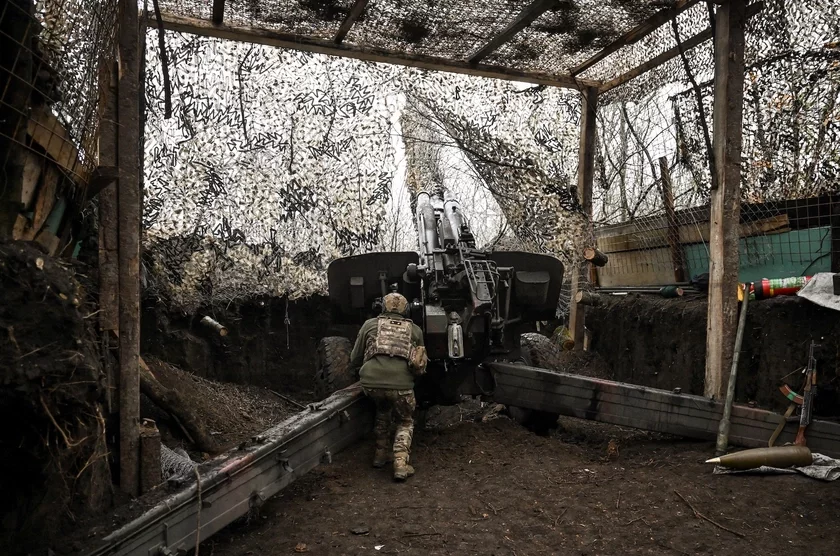
Photo: Dmytro Smolienko/Ukrinform/NurPhoto via Getty Images
Two months have passed since Russian authorities announced the "encirclement" of an almost 5,500-strong Ukrainian grouping in Pokrovsk and Myrnograd (the Kremlin uses their Soviet names — Krasnoarmeysk and Dimitrov).
“I want to congratulate all personnel of the Joint Grouping of Forces on these results. At the same time, as has already been noted, a large, complex work awaits us to eliminate the encircled enemy formations,” President Vladimir Putin stated on October 26 during a meeting with the Russian command.

Russian Chief of General Staff Valery Gerasimov reported to Putin about the encirclement of Pokrovsk and Myrnograd on October 26. Photo: Russian Ministry of Defense
On the evening of December 1, Russian Chief of General Staff Valery Gerasimov once again reported to Putin on the "capture" of Pokrovsk, and on December 18, he repeated this, adding that in neighboring Myrnograd, the enemy is blocked and half of the city is already under the control of the Russian army.
However, events "on the ground" show that in this sector of the front, as well as, for example, in the Kupyansk direction, Russian authorities rushed to announce their successes, effectively announcing the capture of cities "on credit".
What is happening in Pokrovsk
Already in late October – early November, the Ukrainian command redeployed reserves to this sector of the front to maximally slow down the enemy's advance. Additional forces, in particular, were taken from the neighboring – Dobropillya – direction.
These actions allowed to slow down the Russian troops, who for the capture of Pokrovsk and Myrnograd mainly used the tactics of massive air strikes and infiltration of small infantry groups.
According to the estimates of the General Staff of the Armed Forces of Ukraine (AFU), the Russian army has concentrated about 150,000 soldiers in this sector of the front, which is more than in any other.
Over the past weeks, the situation in Pokrovsk has not changed fundamentally, BBC sources in the Ukrainian command say.
Russia has entrenched itself and holds the southern part of the city, which is divided by railway tracks. Russian servicemen gather in these areas, take photos here with their flags, and allow Russian military correspondents to film, demonstrating control over the territory.
Ukrainian forces keep the northern quarters under fire, where low-rise buildings and private houses are mainly located. Here they prevent the enemy from accumulating and bringing in equipment, as well as drone operators.
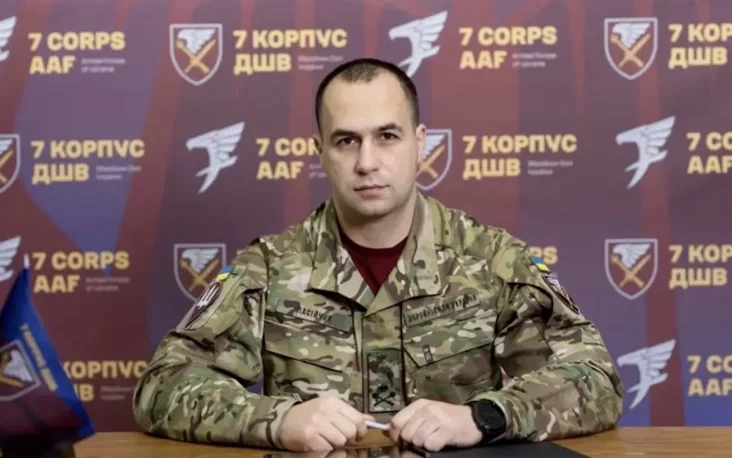
General Yevhen Losiichuk – commander of the Ukrainian grouping holding Pokrovsk and Myrnograd. He says Russians may intensify assaults before the New Year. Photo: 7th Corps
However, the entire territory of the central and northern part of Pokrovsk is effectively a "grey zone", meaning neither side has stable control over it due to the large number of strike and reconnaissance drones flying over the city. They destroy personnel and equipment entering these areas.
Since early December, the Russian army has somewhat changed its tactics in this sector of the front, according to the Ukrainian command. Firstly, it began actively "rocking" the AFU's defense, attacking the flanks of Pokrovsk and Myrnograd with mechanized assaults, and also transferred reserves here. In particular, the 76th Guards Air Assault Division.
“Some enemy units that planned to advance on Zaporizhzhia were also redeployed specifically to Pokrovsk. We expect that before the New Year, the enemy will try to intensify the offensive and carry out active assaults, particularly mechanized ones,” stated on December 21, the commander of the 7th Rapid Response Corps of the AFU, General Yevhen Losiichuk.

Footage of the destruction of Russian armored columns that attacked north of Pokrovsk in the direction of Dobropillya on December 22.
Mainly, Russian mechanized assaults on key flank points – villages along the routes to Pavlohrad and Dobropillya – have not yet brought significant success for the Russians. Ukrainian servicemen have already published several videos showing the destruction of such enemy columns.
For example, on December 22, units of the First Corps of the National Guard "Azov" detected and destroyed several Russian armored columns that tried to break through towards Dobropillya.
As a result of the defeat, according to AFU data, Russia lost 6 tanks, 15 armored vehicles, 10 units of motor equipment, and dozens of personnel. This is accompanied by a video showing the destruction of such columns.
What is happening in Myrnograd
The situation in Myrnograd is more complex than in Pokrovsk. A garrison of Ukrainian servicemen remains in the city center, forced to fight virtually in full encirclement.
There is no verified information on whether the AFU still maintains a "corridor" for the logistics of this garrison. The route passed through the small villages of Rivne and Svitloe, located on the highway between Myrnograd and Pokrovsk.
But Russia reported on December 7 that its army had captured Rivne, and on December 20 — Svitloe. The Ukrainian command insists that the "corridor" is still functional. Moreover, the AFU reportedly makes efforts not only to maintain it but also to expand it.
A statement from the 7th Corps on December 24 indicated the reinforcement of the sector in Myrnograd with new forces and means. “In particular, the logistical "corridors" to the western part of Myrnograd have been strengthened with new units. This allows for the uninterrupted supply of Ukrainian units in this direction,” the statement reads.
However, the perimeter controlled by the AFU in the city has significantly shrunk in recent weeks. Ukrainian units were forced to retreat 5-7 km north of the southern outskirts of Myrnograd.
General Losiichuk explained that this was done for the "preservation of people".
“This was not an easy decision for me personally. It concerned an important foothold for the defense of Myrnograd. But we were forced to do this to save lives and facilitate our logistics,” he noted.
The OSINT project DeepState indicates that there is no longer a perimeter as such that the AFU held in Myrnograd. The entire city, according to analysts, is now a large "grey zone".
According to Roman Kostenko, secretary of the parliamentary committee on national security and defense, Myrnograd is currently under "operational encirclement".
“The enemy, with the help of its means, keeps the city in operational encirclement, preventing logistics from entering. The situation there is difficult overall,” said he.
The command of the 7th Corps does not hide that logistics for the Ukrainian garrison are significantly complicated: only 30% of supplies are delivered by land, the rest – by air and ground drones.
How much longer can these cities be held, and for what purpose?
Roman Kostenko calls the situation in the Pokrovsk-Myrnograd agglomeration "particularly difficult".
However, the Ukrainian command still continues to hold its garrisons in these cities. Servicemen are forced to conduct exhausting urban battles virtually in a situation of complete encirclement.

Russian servicemen display the Russian flag in the village of Svitloe, the capture of which the Kremlin announced on December 20. Near this settlement passes the logistical corridor of the Ukrainian garrison in Myrnograd.
Some politicians and military figures called for the withdrawal of Ukrainian servicemen from these cities already in early November. However, the General Staff of the AFU chose a different plan of action.
AFU Commander-in-Chief Oleksandr Syrskyi directly states that the goal is to exhaust the enemy and stop its advance. Moreover, according to him, near Pokrovsk, Ukrainian forces are even managing to seize the initiative and liberate territories.
“Ukrainian units are holding the defense and seizing the initiative. As a result of counter-offensive actions, they regained control over 16 sq. km in the northern part of the city. They also repelled 56 sq. km of territory in the areas of Hryshyno, Kotlyna, Udachne settlements to the west of Pokrovsk,” he stated on December 17.
Indeed, the Russian army's "getting stuck" in battles for Myrnograd and Pokrovsk clearly was not part of the plans of the Russian General Staff.
Had this agglomeration fallen before the start of winter, these large industrial cities with high-rise buildings would have become a convenient logistical center for accumulating troops and equipment for Russian servicemen, as well as a bridgehead for further movement towards the administrative borders of the Donetsk region.
Considering that the only more or less significant obstacle here could be the city of Dobropillya, it is not excluded that the Russians would have reached these borders quite quickly.
In addition, the obvious falsity of the Kremlin's statements about full control over Pokrovsk and Myrnograd also has political significance.
At least, this is pointed out by the former Commander-in-Chief of the AFU (in 2014-19) Viktor Muzhenko. In his opinion, the effective actions of the AFU in these cities were one of the factors that influenced the European Union's decision to allocate Ukraine a 90 billion euro interest-free loan on December 22.
“If we had surrendered Pokrovsk and Myrnograd and there had been no operation to liberate Kupyansk, then, apparently, the debates (regarding the loan. — Ed.) would have continued to this day. That is, there would have been no trust in Ukraine, in the Ukrainian army, or its ability to contain the enemy,” the former Commander-in-Chief believes.
But how much longer will the Ukrainian army be able to hold this agglomeration? Opinions on this matter differ. For example, military analyst Kostiantyn Mashovets believes that the time for a "painless" withdrawal of the AFU from Myrnograd was already missed in late November.
But the commander of the First Separate Assault Regiment, Dmytro Filatov (call sign "Perun"), who is fighting in this sector of the front, is confident that the defense of Pokrovsk will last for several more months.
“Will we lose Pokrovsk? Given the current course of events – yes, I think, somewhere in spring – mid-spring. If nothing changes and everything continues as it is,” the commander expressed his opinion.
For comparison, the operation for the Russians to capture the large industrial city of Avdiivka lasted 4 months — from mid-October 2023 to February 16, 2024. Ukrainian units also conducted combat operations in semi-encirclement and were able to exit the city via a logistical corridor only at the last moment and only due to the redeployment of additional forces to this direction.








«General Beda flew through the side window of the 'Chaika'». A little-known 1976 accident in which the second most important person in the BSSR and a combat pilot-general died











Comments