


«Europe needs to tell Donald 'enough!'. A programmatic article appeared in a European publication
German magazine Der Spiegel published an article that can be called a true political manifesto. In it, the authors call on the European Union to unite and become a real political and military force on the continent, even if it harms the national interests of individual countries. According to the article's authors, similar principles should become the "roadmap" for the EU for the next decade. The authors argue that if this is not done, "old Europe" will not survive.
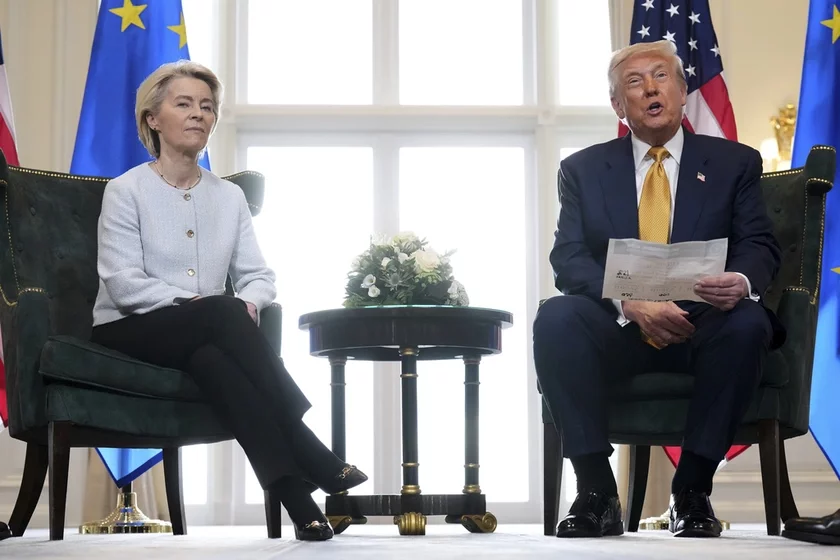
European Commission President Ursula von der Leyen and US President Donald Trump. Photo: AP Photo/Jacquelyn Martin, File
It is noteworthy that this call was published in a mass European publication, and not in analytical reports, which happened for the first time in the last four years. It is also interesting that the article came out a few hours before Volodymyr Zelenskyy's speech in Davos — and the tone and content of the materials coincide.
The article notes that since the beginning of Donald Trump's second term, European policy towards the US has been aimed at appeasement, compromises, and "smoothing over" contradictions. For instance, French President Emmanuel Macron solemnly met the American president in the restored Notre Dame, and European Commission President Ursula von der Leyen agreed to a trade deal beneficial to the US, as a result of which Europe paid more duties.
This led to Trump announcing the possibility of a 25% tariff for eight European countries if the EU did not give him Greenland. Negotiations with Trump by NATO Secretary General Mark Rutte temporarily postponed this threat, but whether for long or not is the question.
The European Union was once a miracle: after centuries of wars and destruction, a union based on dialogue, not force, was created. Despite its problems, the EU has become a story of incredible success.
But in the modern world, Europe must act practically: to survive, it needs to develop "imperial reflexes" – defending territory, using economic power as a political weapon, and strategically developing industry. This requires determination similar to the feats of Hercules, and Europe has not faced similar challenges since World War II.
Previously, politicians and journalists said it was impossible, but now the situation does not allow for delaying real action. On the contrary, the situation has become favorable for change.
Trump's actions make it difficult even for the far-right in Europe — like "Alternative for Germany" or Marine Le Pen's political force in France — to explain their closeness to the American leader to the electorate. And under such circumstances, Europe must take practical measures to strengthen security — military, political, economic, and technological.
Specific steps that must be taken:
1. Nuclear weapons. The authors note that Europe can no longer fully rely on the American "nuclear umbrella" for defense and must begin to create its own nuclear arsenal. France could extend its "nuclear umbrella" to other European countries, but far-right politicians, such as Marine Le Pen, are against such a scenario. Therefore, it is proposed to create a "coalition of the willing" countries led by Germany to jointly develop nuclear weapons.
2. Standardization of armies. Europe needs to introduce unified standards for armaments — from bullets to tanks. While the US has about 30 types of military systems, Europe currently has about 180, which creates significant logistical chaos. To address this, the authors propose introducing the position of an armaments commissioner who will make decisions on the procurement of the most necessary types of weapons. Although this might be politically uncomfortable, there is no other way out.
3. New alliances. The creation of an alliance of the most militarily capable countries, which will be responsible for the security of the continent, is proposed. Among them are Germany, France, Great Britain, Italy, Poland, and ideally Ukraine, as its army is the largest and, most importantly, battle-tested.
4. Political unity. The US perceives Europe as a group of "whimsical political romantics." To combat modern threats, Europe must be pragmatic.
Yes, it is necessary to strengthen the institution of the EU leader: currently, leadership is scattered between the head of the European Commission and the head of the European Council — the authors propose combining these positions into one.
The principle of unanimity in foreign policy is a relic of the past and weakens the EU: any decision requires the consent of all 27 countries, which gives small countries (such as Hungary, Slovakia, the Czech Republic) the ability to block important decisions. This, according to the authors, is an obstacle to a truly effective and strong EU.
5. Economic measures. Just as American farmers depend on soybean imports from China, American IT companies depend on the European market.
Europe is a large market: 450 million consumers, a total GDP of €18 trillion. If the EU starts imposing restrictions, the US will lose a large portion of its consumers and will be left only with the markets of Africa and South America.
Europe can use levers of influence by cutting ties with the US in areas where it is less painful: for example, 1/3 of the German Bundesbank's gold reserves are currently held in the US Federal Reserve (around €180 billion) — these could be moved to Europe.
50% of the EU's international transactions are conducted in dollars; they could be converted to euros to strengthen economic independence.
6. Technology. Europe significantly lags behind the US in the IT sector: it lacks its own competitors to Google, Meta, or Microsoft, and it isn't keeping pace with the development of artificial intelligence. However, with its population and education level, if a goal is set, the US can be caught up.
For example, in the 1970s, Europe lagged in aircraft manufacturing. And the leader of the German CSU party, Franz Josef Strauss, then said: "The question is whether Europeans will be able to produce wide-body commercial aircraft. If not — the flag of Europe will disappear from the sky."
With political support, the Franco-German consortium Airbus was created in 1970, which today is a world leader and the main competitor to American Boeing.
Now reading












Yesterday — in a Lukashenko prison, today — in Kyiv helping Ukrainians survive. A former political prisoner and relative of Tsikhanouskaya has become a volunteer at the Point of Invincibility
Yesterday — in a Lukashenko prison, today — in Kyiv helping Ukrainians survive. A former political prisoner and relative of Tsikhanouskaya has become a volunteer at the Point of Invincibility


Want to live long — look for an area with normal trees. Scientists have found that trees save lives from heart attacks, while lawns can even harm health











Comments