


Kazakhstan was determined to cull about a million saiga, but the animals escaped to Russia
Kazakhstan summed up the results of attempts to reduce the number of saiga, but the plan effectively failed. Instead of the planned significant reduction in the population, a significant portion of the animals simply migrated to Russia, escaping mass culls, RTVI reports .
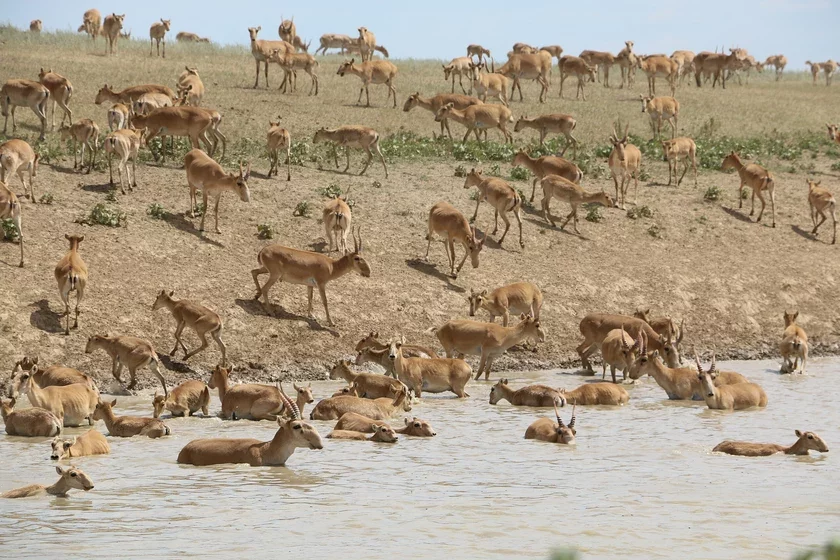
A herd of saiga in Kazakhstan. Photo: Wikimedia Commons
According to the plan, from July 1 to December 1, Kazakhstan was supposed to reduce the saiga population by approximately 20% — to cull about 800 thousand individuals. However, in practice, only about 200 thousand animals were culled, which is approximately a quarter of what was planned.
This did not have a significant impact on the total number: in 2025, the population reached a record 4 million, and in 2026, according to forecasts, it will grow by another million — to 5 million individuals.
Kazakhstan's Minister of Ecology and Natural Resources, Yerlan Nysanbayev, reported that the culling was carried out in accordance with scientific recommendations, and the carcasses were transferred to meat processing plants.
At the same time, he admitted that a significant portion of the saiga, with the start of the campaign, moved to other regions, including the territory of Russia, especially in border areas.
The problem of saiga is acute in both Kazakhstan and Russia: huge herds migrate across borders in spring and summer, damaging fields and destroying crops, causing significant losses to farmers. The West Kazakhstan region and Russian regions, including Saratov Oblast, suffer particularly from this.
One of the key reasons for the program's failure is the lack of a clear understanding of what to do with the culled animals. Problems with processing, disposal, as well as strict international restrictions on the trade of saiga horns significantly reduced business interest. Only in December 2025, at the CITES conference in Uzbek Samarkand, Kazakhstan received permission for limited and strictly controlled trade in horns, but this does not mean an immediate opening of exports.
Experts note that the optimal number of saiga for the territory of Kazakhstan is about 800-900 thousand individuals. Today's population exceeds this level by more than threefold, threatening ecosystem degradation, increased social tension in rural areas, and potential outbreaks of epidemics among both animals and humans.
At present, the authorities of Kazakhstan have effectively maintained the status quo: they have acknowledged the problem, but have not yet developed an effective mechanism for its solution. In 2026, the government has been instructed to prepare a new strategy for 'sustainable management' of the saiga population.









Head of Criminal Investigations at the Ministry of Internal Affairs saw the KGB pre-trial detention center's exercise yard from his office window, and then became a prisoner himself

Head of Criminal Investigations at the Ministry of Internal Affairs saw the KGB pre-trial detention center's exercise yard from his office window, and then became a prisoner himself


«I will still fight for Ukraine». The story of an 18-year-old relative of Tsikhanouskaya who was detained for attempting to join the Armed Forces of Ukraine

























Comments
Это вам не на донетчине наступать,тут опыт нужен.
- "... дзе ж цябе мне пахаваці?"
- "... не лажыце ўскрай дарагі -
дратаваці будуць ногі..."
Пісаў хтосці з беларускіх савецкіх паэтаў. Але хто, як і больш даслоўна, зараз не магу ўспомніць.