


How Khatyn changed after reconstruction: now they sell burgers and children's toys there
We looked at how the most famous memorial to the victims of Nazi terror in Belarus lives after a large-scale reconstruction, and found many strange things there — from burgers near the tragedy site to souvenirs that raise questions.
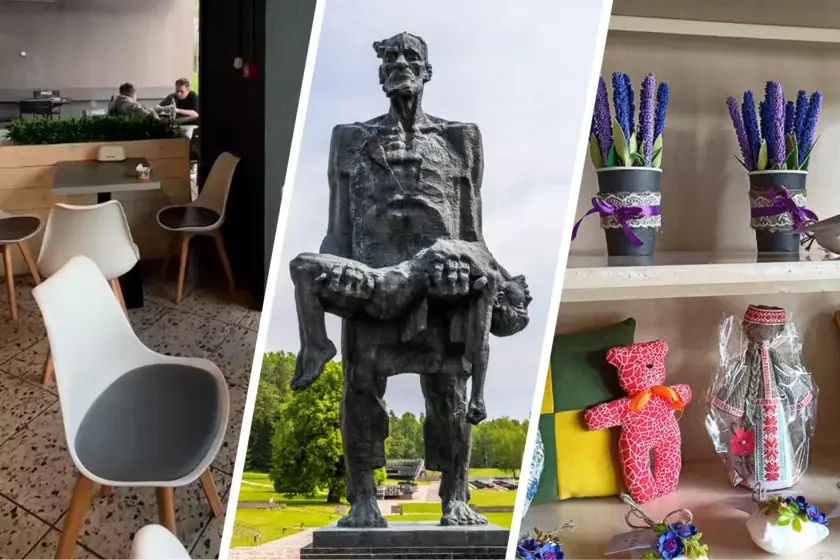
After the reconstruction, the Khatyn memorial complex became not only a place of sorrow, but also a place where you can buy cheerful souvenirs and have a tasty meal. Collage: Nasha Niva
In March 2023, for the 80th anniversary of the tragedy, a new museum opened in the Khatyn memorial complex. This event had more political than cultural significance.
For the current regime, Khatyn is primarily a tool of ideological warfare. The memorial is used not so much for the quiet honoring of the memory of the dead, but rather for justifying modern political narratives: about the "genocide of the Belarusian people", about the "hostile West" and about the necessity to "defend the truth" with weapons in hand.
The construction, carried out by "Beldzyarzhpraekt" and "Mastatski kaminat", is presented in state media as a personal merit of Alexander Lukashenka — no report was complete without mentioning his "contribution". However, along with ideological pathos, banal commerce also came to Khatyn. A whole complex grew up next to the memorial, which, in addition to the administration, includes an exhibition hall, a souvenir shop, and a cafe.
Lunch with a view of sorrow
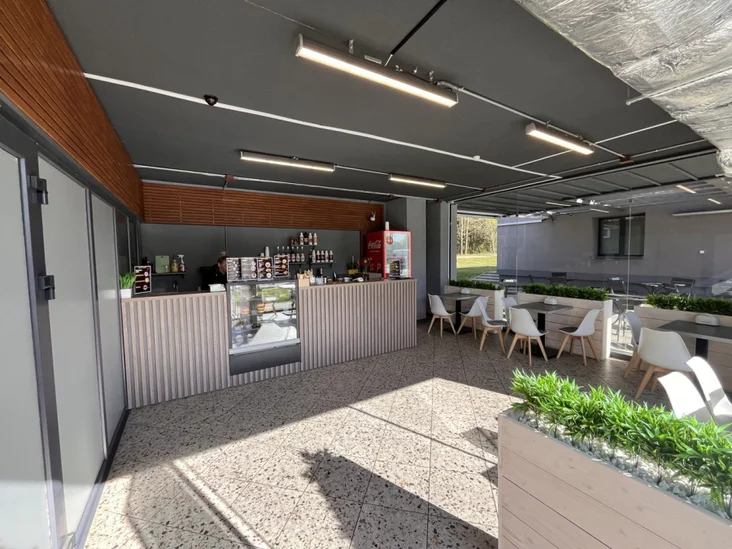
Summer cafe in Khatyn. Photo: khatyn.by
The summer cafe in Khatyn operates from late April to early November. The menu here is quite varied and democratically priced. For example, potatoes with sausage can be ordered for 11 rubles, a chicken burger — for 10 rubles, draniki (potato pancakes) — for 6 rubles, and dessert — for 7 rubles. You can drink latte or cappuccino for 6 rubles, or even a glass of mulled wine for 7 rubles.

Snacks on the menu of the summer cafe in Khatyn. Photo: khatyn.by
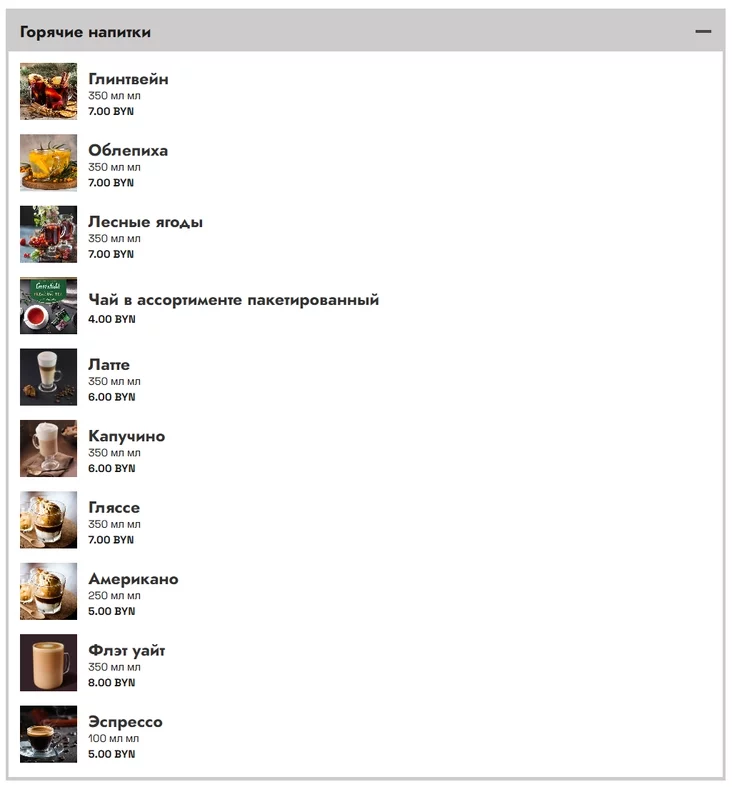
Hot drinks on the menu of the summer cafe in Khatyn. Photo: khatyn.by

Desserts on the menu of the summer cafe in Khatyn. Photo: khatyn.by

Hot dishes on the menu of the summer cafe in Khatyn. Photo: khatyn.by
It would seem that caring for visitors is a good thing. But the location of the catering establishment, serving burgers and fried sausages, in immediate proximity to the place where 149 people were burned alive, raises ethical questions. In this place, the market, obviously, has triumphed over ideology.
"Probably a good museum, but a cafe with a terrace is too much,"
"Cemeteries of villages... and there are also cafes on the territory..."
"A cafe with a terrace is inappropriate,"
"For me, the words: 'terrible museum', 20 rubles, excursion and cafe, in essence, do not stand next to the word 'Khatyn'," — such comments are left by Belarusians under one of the reviews of the renovated memorial complex on social media.

Summer cafe in Khatyn. Photo from social media

Summer cafe in Khatyn. Photo from social media
It's interesting that in Soviet times the approach was different, not so capitalist. Near the turn from the M-3 highway to the memorial, the famous restaurant with the characteristic name "Partisan Bor" (Partisan Forest) was opened, where Pyotr Masherov brought Fidel Castro in 1972. But this establishment is located more than 5.5 km from the place of sorrow itself, which does not evoke a feeling of blasphemy. Today, fast food has come directly to the places where civilians were massacred.
Souvenirs: from "genocide" to teddy bears
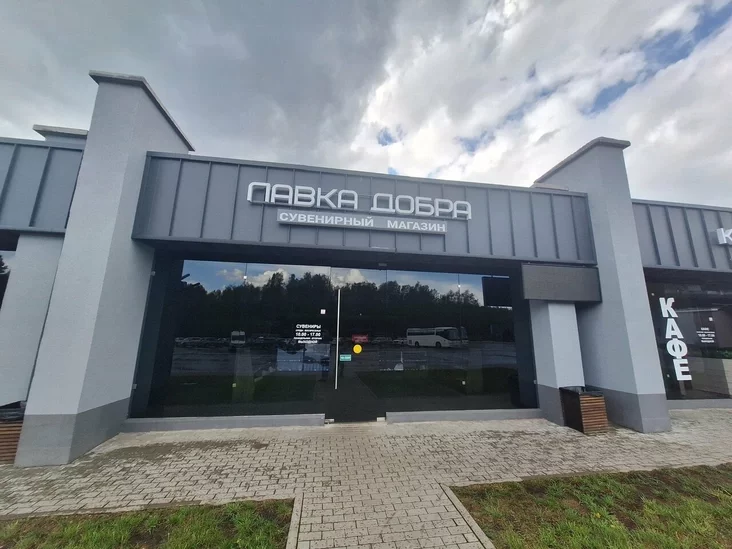
Souvenir shop "Krama dabbra" (Shop of Good) on the territory of the Khatyn memorial complex. Photo: Yandex Maps
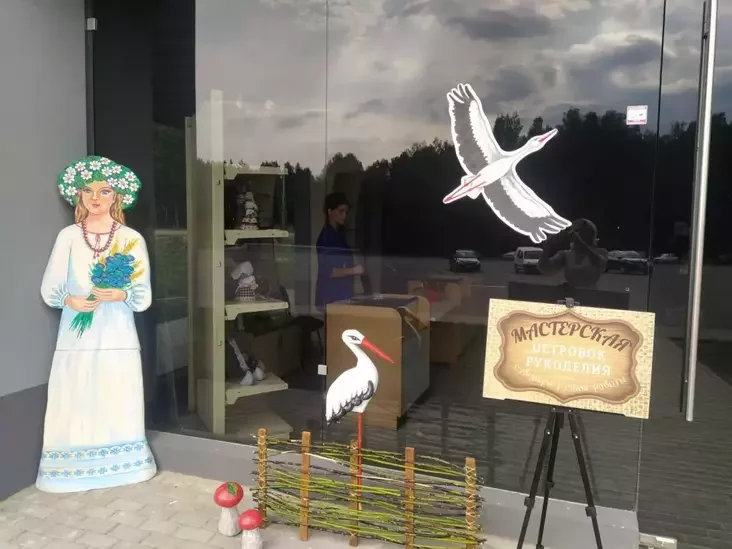
The souvenir shop in Khatyn also sells products unrelated to the tragedy of wartime. Photo: zorkanews.by
The assortment in the souvenir shop is an intricate mix. On one side — books about the war and badges with images of the memorial. On the other — a typical set of Belarusian souvenirs that does not match the mournful context of the place.
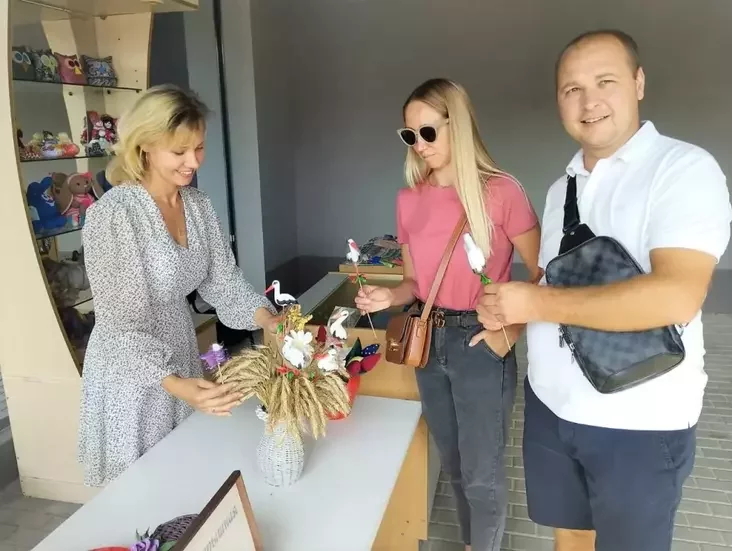
According to officials, the site of the mass extermination of Belarusians is an excellent place for selling funny handmade storks. Photo: zorkanews.by

Employees of culture houses from the Minsk region are brought to sell their products in the souvenir shop in Khatyn. Photo: Center for Children and Youth Creativity of Smalyavichy District
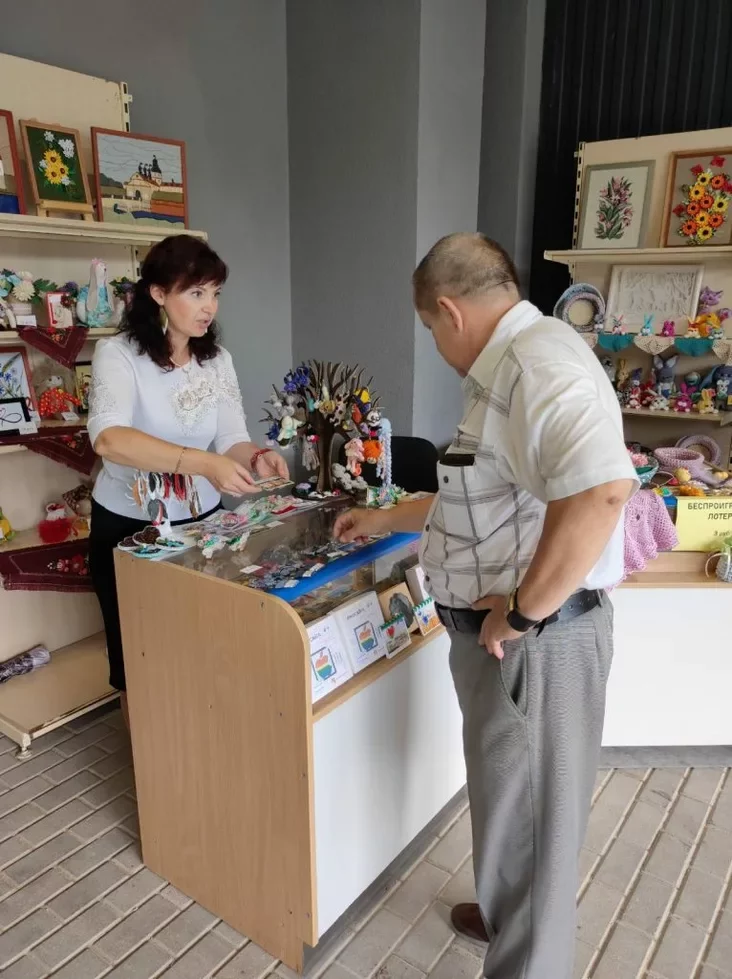
Employees of culture houses from the Minsk region are brought to sell their products in the souvenir shop in Khatyn. Photo: Center for Children and Youth Creativity of Smalyavichy District
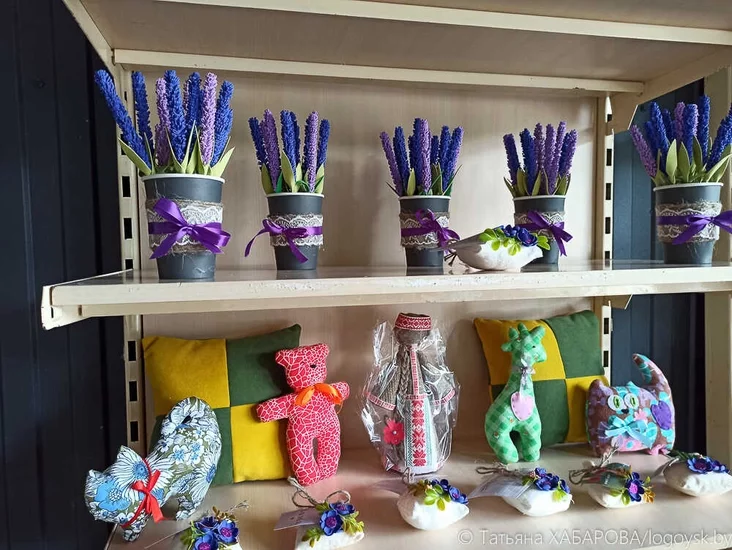
Toys and other products, created by the hands of disabled and elderly people who attend the Smalyavichy Territorial Center for Social Services. Photo: logoysk.by

Stationery with state symbols in the souvenir shop. Photo: logoysk.by
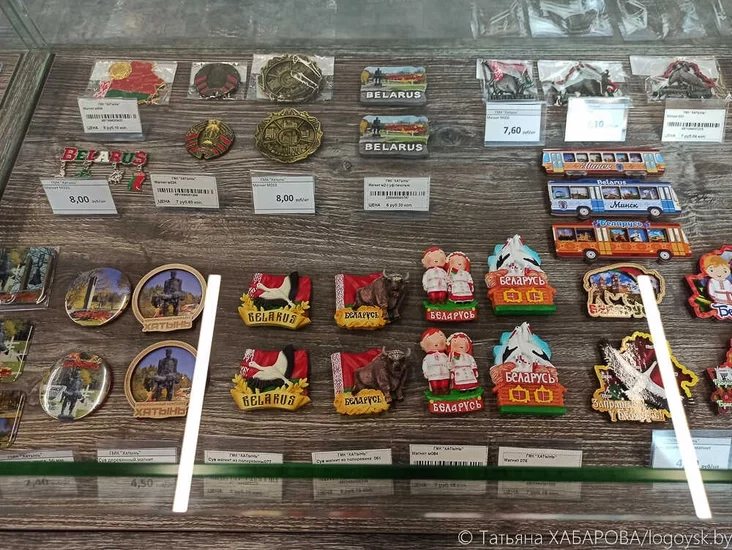
Refrigerator magnets. Photo: logoysk.by

The souvenir shop has several books about the Khatyn tragedy itself, as well as about the genocide of the Belarusian people during the war. But their number is incomparable with the souvenir entertainment. Photo: logoysk.by
On the shelves, you can find magnets with state symbols, bisons and storks, plates with Minsk landscapes, and mugs with the museum's logo. Moreover, handmade crafts are sold here: embroidered cats, straw headbands, and even children's toys.
"Bloody River" and holograms: what is shown in the new museum?
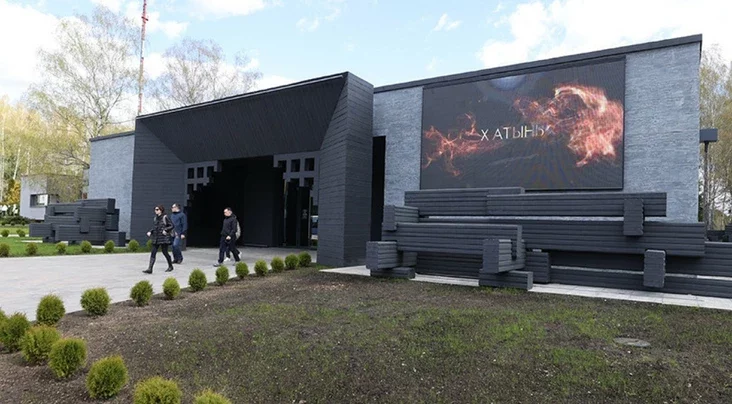
Newly built museum in Khatyn. Photo: BelTA
The new museum itself consists of six halls and relies on a strong emotional impact, using modern multimedia technologies. The concept is built so that the visitor feels the hell of war. A symbolic installation "Bloody River" runs through all the halls under a glass floor.
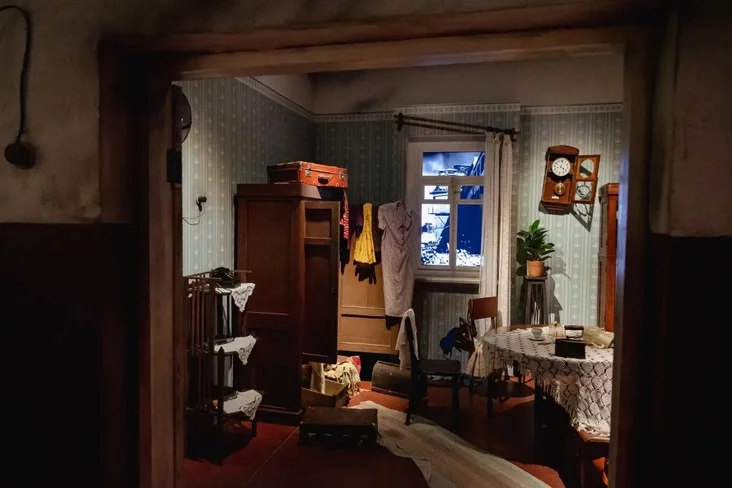
Hall "Escape from War" in the museum. Photo: travel.by
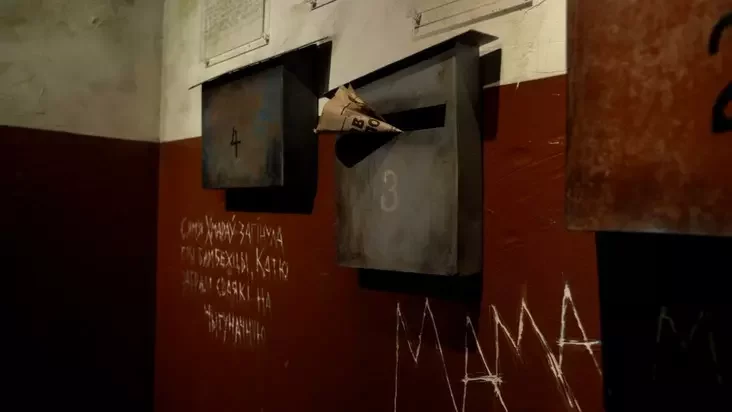
Hall "Escape from War" in the museum. Photo: Minskaya Pravda
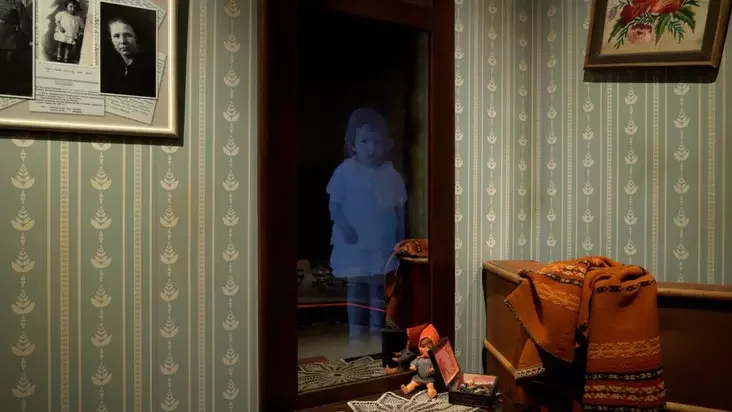
Mirror with a ghostly image of a three-year-old girl in the hall "Escape from War". Photo: Minskaya Pravda
The exposition begins with the hall "Escape from War". Here, the interior of an abandoned apartment with scattered belongings is created, where a phone call is interrupted by the sound of an explosion. One of the most terrifying elements is a mirror in which a ghostly image of a three-year-old girl appears. The hologram tells the story of a child who ended up in a German orphanage, where blood was pumped from her for wounded Wehrmacht soldiers.

"Hall of Burned Villages" in the museum. Photo: Minskaya Pravda
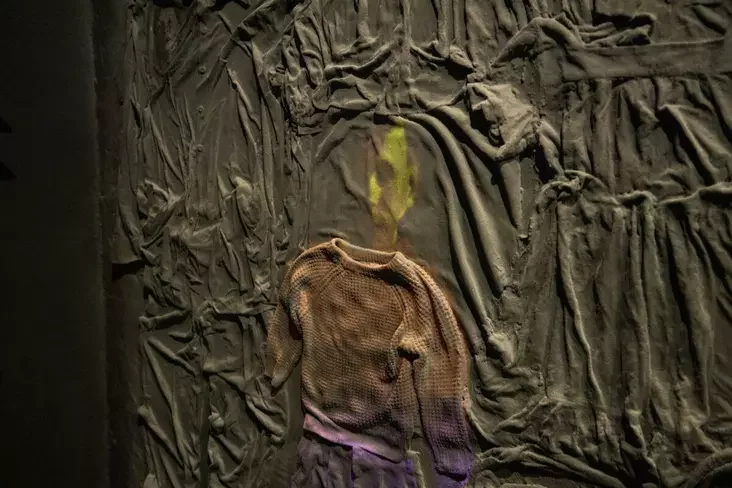
Hologram of seven-year-old Viktor Zhelabkovich, one of the few children who survived in Khatyn. Photo: Minskaya Pravda
The next location — "Hall of Burned Villages" — simulates a burning barn. Red light and smoke penetrate through the cracks in the charred boards, and cries and gunshots are heard. Here, visitors are met by another hologram — of seven-year-old Viktor Zhelabkovich, one of the few children who survived in Khatyn. The virtual boy tells how he and his mother tried to escape from the burning barn, how the Germans opened fire on them with automatic rifles, killing his mother and wounding him in the shoulder. He lay under his mother's body until the Germans left the village.
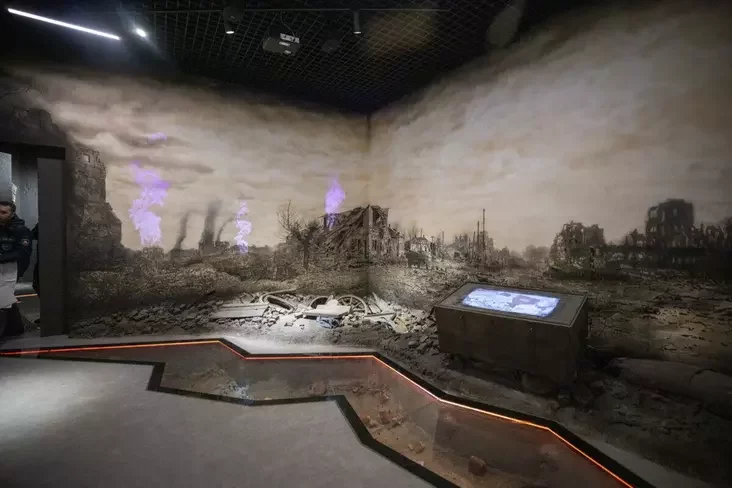
Photo: Minskaya Pravda
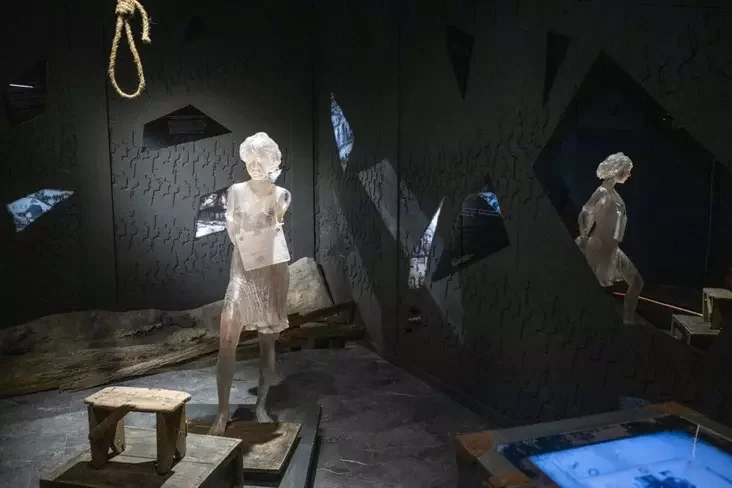
Transparent sculpture of a girl standing under a gallows noose. Photo: Minskaya Pravda
The museum also features a unique transparent, life-size sculpture of a girl standing under a gallows noose. Her prototype was a real person — the Borisov underground activist Kima Klambotskaya.

Hall "Memory" in the museum. Photo: travel.by
Next is the "Memory" hall. It is dedicated to post-war events: the investigation of Nazi crimes and the history of the creation of the memorial complex itself. Here, the architects of Khatyn and writers — Ales Adamovich, Yanka Bryl, Vladimir Kolesnik — who collected testimonies for the book "I am from a Fiery Village" are mentioned. This is a kind of transition from tragedy to its understanding by descendants.

Hall "Eternity" in the museum. Photo: travel.by

Rye field under the glass floor of the "Eternity" hall. Photo: Minskaya Pravda
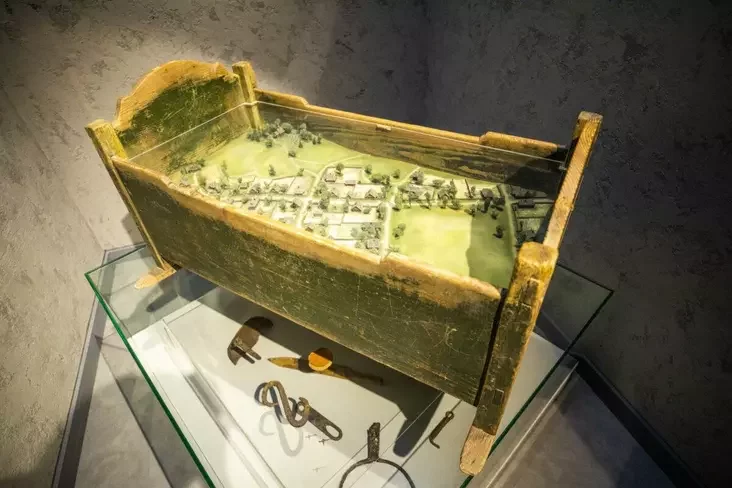
Cradle with a village model in the "Eternity" hall. Photo: Minskaya Pravda
The final "Eternity" hall is intended for reflection. Here are bright walls with the names of the dead carved into them, and under the glass floor, instead of blood, there is a rye field and a child's cradle with a model of a peaceful village.
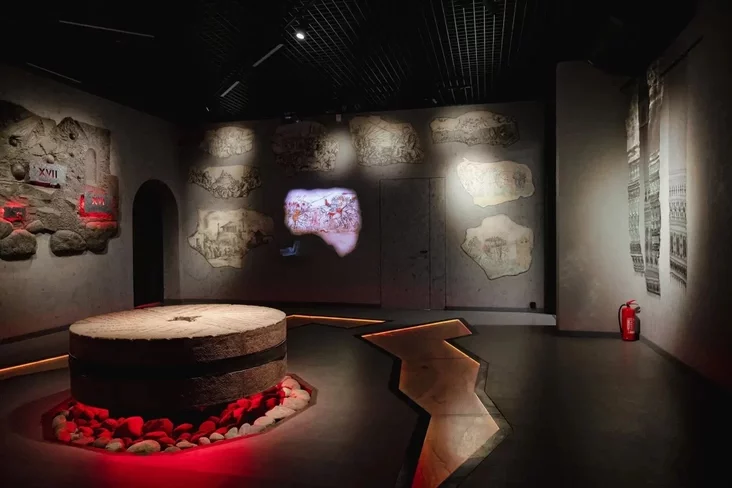
Chronological zone "Millennium" with large millstones. Photo: travel.by
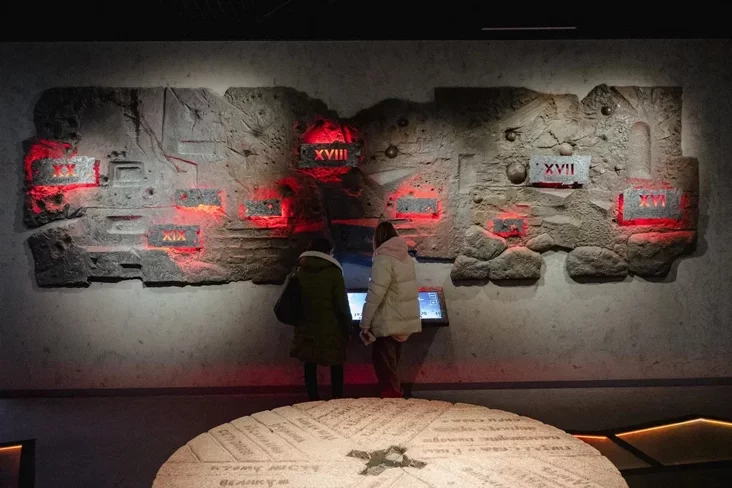
Chronological zone "Millennium" with a large millstone. Photo: travel.by
Separately, it's worth mentioning the chronological zone "Millennium". The authors of the exposition decided not to limit themselves to the events of World War II, but to cover history from the 10th to the 20th century. In the center of the zone are large millstones — a symbol of time grinding years and centuries, as well as human destinies.
The museum is positioned as a place with a harsh emotional atmosphere, so visiting is not recommended for children of primary school age.
Double standards
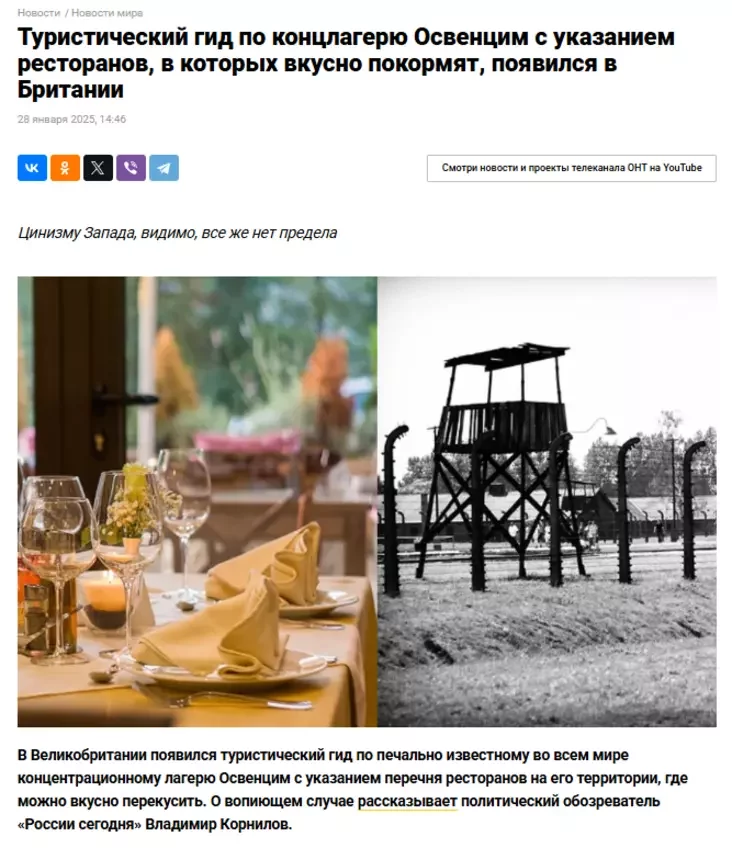
"The cynicism of the West, apparently, has no end." Belarusian propaganda eagerly picked up the Russian fake about a tourist guide to a concentration camp with restaurants where one can eat deliciously. Screenshot of ONT website
The situation in Khatyn exposes the hypocrisy of state ideology. Propaganda resources often like to accuse the West of "cynicism" and disrespect for history. This year, they actively propagated a fake that tourist guides to restaurants are allegedly issued in Auschwitz. The basis for this was an article in The Times about the preservation of Jewish culture in Krakow, which was distorted beyond recognition.
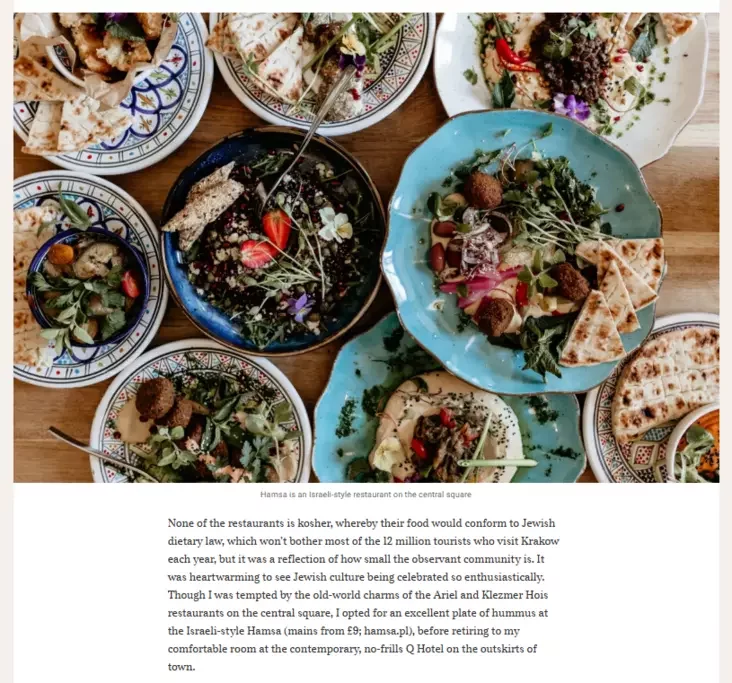
The Times journalist, whose relatives died in Auschwitz, describes in her article a trip to Poland following the footsteps of the film's heroes and draws attention to Jewish cuisine restaurants in Krakow — as an example of the illusion of "revived culture" without its bearers, annihilated during the Holocaust. Screenshot of The Times website
In fact, in The Times article, the journalist, whose relatives died in Auschwitz, describes her own journey following the footsteps of the film "True Pain". She visits the memorial in Auschwitz, and then goes to Krakow — 70 kilometers from the former death camp — where in the historically Jewish quarter of Kazimierz she tastes Jewish cuisine in local restaurants. It is there that she keenly feels the artificiality of "revived" Jewish culture without living bearers, annihilated during the Holocaust, and describes her own moral dilemmas and guilt over combining the memory of genocide with personal comfort.
State propaganda cynically merged these two different spaces — the memorial and tourist Krakow — into one image, creating a fake, against which it tries to justify its own lack of spirituality.
On the territory of the Auschwitz-Birkenau memorial itself, there are no cafes, and eating there is strictly forbidden. No souvenir products are sold here, and the local bookstore offers exclusively educational literature about the Holocaust.
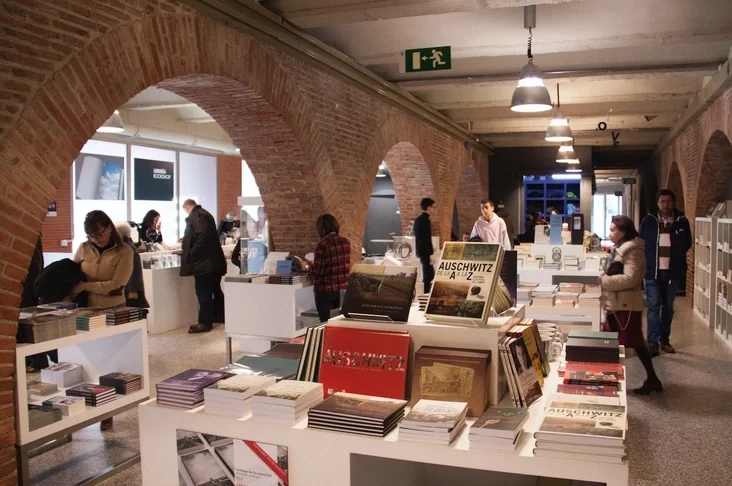
On the territory of the Auschwitz-Birkenau memorial, it is impossible, as in Khatyn, to buy children's toys and other souvenir entertainment. The local bookstore only sells historical and educational literature about the Holocaust. Photo: Auschwitz Exhibition
«Nasha Niva» — the bastion of Belarus
SUPPORT USNow reading





Head of Criminal Investigations at the Ministry of Internal Affairs saw the KGB pre-trial detention center's exercise yard from his office window, and then became a prisoner himself
Head of Criminal Investigations at the Ministry of Internal Affairs saw the KGB pre-trial detention center's exercise yard from his office window, and then became a prisoner himself
«I will still fight for Ukraine». The story of an 18-year-old relative of Tsikhanouskaya who was detained for attempting to join the Armed Forces of Ukraine











Comments
Колхозный трэш прямо!