


Millions of Black Sea Mussels Have Invaded Lake Geneva — A Disaster for the Ecosystem
Small, but extremely aggressive mussels are destroying food chains in Swiss lakes, just as they have already done in the Great Lakes of North America. These pests were recently spotted for the first time in Northern Ireland.

Quagga mussel (Dreissena bugensis). Photo: Wikimedia Commons
Just as cholesterol clogs an artery, it took quagga mussels (Dreissena bugensis) only a few years to clog a 5-kilometer network of pipes beneath the Swiss Federal Institute of Technology in Lausanne. By the time staff realized what was happening, it was too late.
The system, which pumped cold water from a depth of 75 meters in Lake Geneva to cool the campus, collapsed. The capacity of the heat exchangers decreased by a third, choked by ground-up shells.
As The Guardian writes, the consequences turned out to be serious. When the system began to lose efficiency, air conditioning started working worse: where it should be below 24°C in summer, the temperature remained at 26-27°C.
For the institute, the problem is not just about the comfort of the auditoriums. Its data centers and unique equipment, including an experimental nuclear fusion reactor, require continuous cooling.
"This is an open invasion," states Mathurin Dupagnier, head of the institute's engineering networks.
Drinking water in Geneva and Lausanne is potentially at risk because pumping and filtration systems are in the quagga's habitat zone. The airport, which uses the same water cooling system as the university, has also been affected.
"They all have this problem around the lake; there are no exceptions," says Dupagnier.
The Perfect Invader
The quagga is one of the most dangerous invasive species on the planet. These mussels, native to the Black Sea region (Ponto-Caspian basin), have spread worldwide due to shipping. Their survival rate and fecundity are impressive: a single female can produce up to a million eggs. Quaggas can reproduce year-round at water temperatures as low as 5°C and survive in the most extreme conditions.
In North America, in the Great Lakes, they were recorded as early as 1989, and now in some water bodies they account for more than 99% of the biomass of all invertebrates. The situation is catastrophic: fish populations have been decimated, and hundreds of millions of dollars are required to combat the consequences. Even long-sunken ships, which were perfectly preserved in cold water, are now covered with a thick layer of shells.
And now the alarm has sounded in Europe too. This autumn, they were first spotted in Northern Ireland.
DAERA urges greater vigilance as Quagga mussel confirmed in Lower Lough Erne – first confirmed record in Northern Ireland.
— DAERA (@daera_ni) December 15, 2025
Read more: https://t.co/NBM302jAnx pic.twitter.com/b6JXbJtbgQ
In Switzerland, this invasive species was first observed in 2014. Six years ago, quaggas were discovered in Lake Geneva. Since then, they have spread like wildfire. Today, scientists are finding these mussels at a record depth of 250 meters — in a pitch-black environment with almost no oxygen and very little life besides microbes.
In Lake Geneva, the average population density reaches 4,000 individuals per square meter, and in some places exceeds 35,000. 2024 studies showed that 100% of the biomass in bottom samples consists exclusively of quaggas.
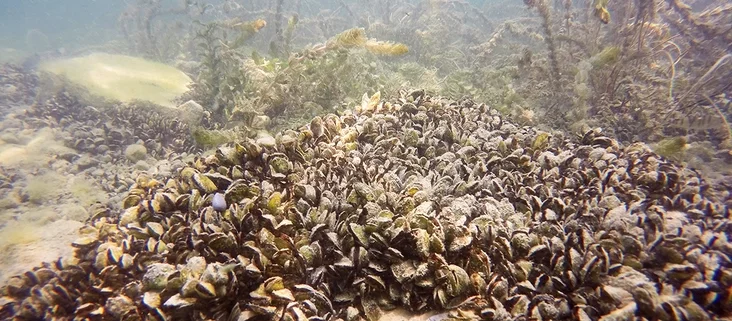
The bottom of Lake Geneva is covered with quagga mussels. Photo: Linda Haltiner / Eawag / unige.ch
For the lake's ecosystem, this is a death sentence. The bottom, which was previously sandy, now resembles an endless carpet of mussels. Native species — snails, shrimp, and local mussels — have disappeared. Crayfish are dying because they become so encrusted with mussels that they cannot move.
Each mussel filters up to two liters of water per day, absorbing phytoplankton — the foundation of the lake's food chain. This leaves microscopic creatures, such as water fleas, without food; these, in turn, are eaten by fish. When the base of the pyramid disappears, it causes a devastating domino effect throughout the entire ecosystem.
The livelihood of 120 professional fishermen on Lake Geneva is under threat. Furthermore, the water is becoming too clear, allowing sunlight to penetrate deeper, warming the lake and triggering blooms of toxic algae.
For a long time, the problem remained invisible to ordinary people, but now it's impossible to ignore. Dead mussels are washed up on beaches, sharp shells cut swimmers' feet, and boat owners are forced to constantly clean their hulls.
To save its infrastructure, the institute plans to build a new closed cooling system. Ecologists admit: over time, nature may adapt, and some fish species may learn to eat these mussels. However, it is no longer possible to return the lake to its former state.



































Comments