


Poet Uladzimir Niakliayeu also came to listen to the talented lawyer and former political prisoner.

Maksim Znak and Tatsiana Niadbai, meeting moderator. Broadcast screenshot: BellitInternational / YouTube
As today's meeting with Maksim Znak approached, the small hall of the Museum of Free Belarus in Warsaw became quite crowded. Half an hour before the speech, people slowly started to gather. Among the guests, poet Uladzimir Niakliayeu and former political prisoner, ex-chief editor of Tut.by Maryna Zolatava could be seen.
As part of the International Poetry Festival "Vershy na asfalcie" (Poems on Asphalt) in memory of Mikhas Straltsou (February 13-15), publishers, booksellers, musicians, but primarily poets and translators, gathered in the Polish capital to present the fruits of their work from the past year.
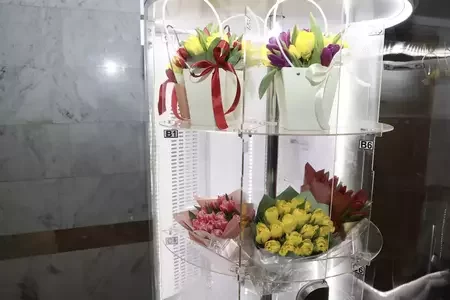
At the entrance — a table with books and a portrait of publisher Raman Tsymberau, who died on February 10 in Minsk from the consequences of a stroke. Next to it — flowers. In this detail, there is something very non-random: literature here is not only about great meanings but also about community.

When Maksim Znak approaches the microphone, after many days in a cell, he jokingly admits:
"I love a chamber atmosphere. I didn't expect so many people to be here."
This is the first creative meeting with him since his release.
In the hall, the tradition of empty chairs is recalled. An empty seat in the first row and chairs with photographs of imprisoned journalists and writers stand beside the speakers — as a sign of those who cannot be here. "A separate empty seat is not a person, it is confiscated manuscripts," says Tatsiana Niadbai, chairperson of PEN Belarus.

Maksim Znak speaks calmly, with slight irony. He jokes that the only text he managed to take out was a tube of toothpaste. Other manuscripts were confiscated. During his imprisonment, he prepared 22 book projects, 18 of which were completed.
"Just imagine: there are three years — and three years with nothing to do. Five thousand pages. And something is written in every cell of every sheet."

Maksim Znak's "Zekameron", a collection of his prison work, was published while the lawyer was still behind bars.
Texts appeared in his head — and immediately went onto paper. There was even a musical, the manuscript of which he sent, not being sure it would ever arrive, but it did.
Before starting a book, Znak drew graphs, timelines, and assembled puzzles from text fragments. But there is also another literary principle that Maksim tried to follow:
"If you can not write, do not write. I feel that I cannot not write."
Poems from such places are sublimation. They are rarely light, Znak explains.
"The more difficult the situation, the more poems emerge. When you realize that everything you had in life is still with you and no one can take it away — that is very comforting."
During his imprisonment, the lawyer managed to read 1596 books.
He also recounted other stories. About a prisoner in his fifties who cried and shouted "Mom, take me home," about music that was played at unbearably high volume.

In response to Niadbai's question about his release, he quips:
"How do I know what status I was released under? Maybe I escaped? I read online that it was a pardon. But they didn't even give me a certificate of release, or my passport."
At liberty, Znak says, time has sped up. He thought he would immediately restore manuscripts from memory, but for now, he is busy with pleasant meetings with people. Of his manuscripts, he has only managed to restore one in two months.
Until 2020, Maksim sang and wrote songs for the soul. He first began writing songs without a guitar in solitary confinement (SHIZA is an abbreviation for a punishment cell). Towards the end of his performance, he performs his own song "Andaluzka," written in prison, and then The Beatles' "Yesterday" in his own Belarusian translation.
He was released and deported about two months ago. And now he sits in the middle of a hall in Warsaw — before people who, like him, were forced to leave their country. In this space — without prison cells, without surveillance — he again reads poems and sings songs. And the audience listens as if every word is proof that what is most important in a person cannot be taken away after all.
Now reading









In the early 2000s, three history teachers fled to Ukraine from the "genocide of the Belarusian people" committed by Lukashenka's regime. What was their fate?




















Comments