


Commander of Ukraine's National Guard: We can fight for several more years
"Victory for Ukraine in military terms is, of course, to take back its territories," believes Oleksandr Pivnenko.
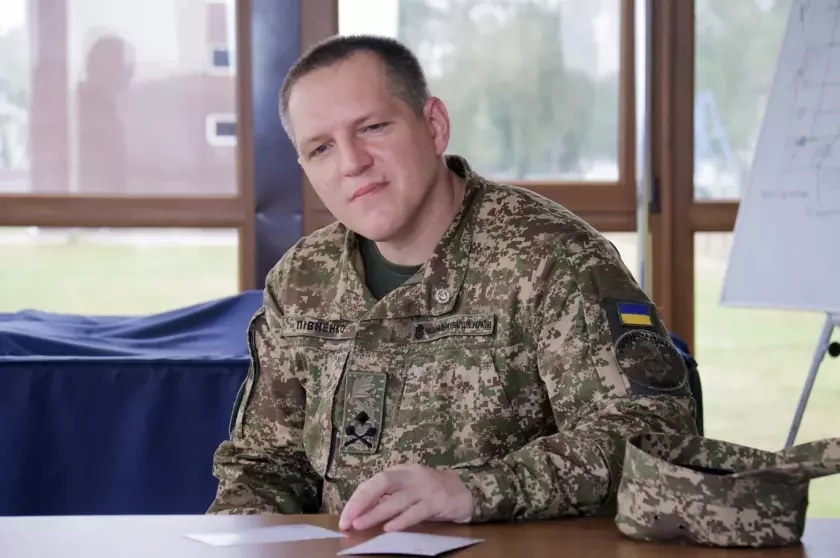
Eugen Kotenko / Ukrinform/Future Publishing via Getty Images
Commander of the National Guard of Ukraine (NGU), Brigadier General Oleksandr Pivnenko gave an interview to the BBC and spoke about what victory for Ukraine might look like, what is needed for it, and how many more years Ukraine can wage war.
"Victory for Ukraine in military terms is, of course, to take back its territories. I understand that this might not be relevant today, but potentially for the future. I understand that it might take several decades – it doesn't matter," says Pivnenko.
The return of territories is a strategic task for the Ukrainian government and population. However, currently the priority is survival and a ceasefire, says the general. Oleksandr Pivnenko has commanded the NGU since July 2023.
Before this, he headed the Eastern Territorial Directorate of the National Guard, repelled Russian military forces in the vicinity of Kharkiv, and held Bakhmut. He holds the title Hero of Ukraine.
About Territories
When asked by journalists whether Ukraine is ready to cede territories, Oleksandr Pivnenko replied that it is "impossible at present".
"A ceasefire along the line of combat engagement – that's a story we can still understand. But no one will give up territories," said the general.
At the same time, he admitted that if such an order comes from the Commander-in-Chief, Ukrainian military personnel will carry it out.
"Because we are a legal country. But how will the population of our country perceive this, and why then did we start defending ourselves?… We could have agreed then and simply handed over, for example, Luhansk and Donbas and ended the war there, figuratively speaking," Pivnenko believes.
And he adds: "We have lost a great deal of our population and territory just to stop like that and simply give up territory."
What Ukraine Lacks for Victory
Oleksandr Pivnenko is convinced that Ukrainian troops primarily need more diverse weapons.
"These could be long-range missiles, to destroy command posts, to destroy their pilots, just as they do with their aircraft, their KABs, which, unfortunately, we do not have in the quantity and volume to deliver a retaliatory strike," says the NGU commander.
He notes that Ukraine has "Deep Strike" (a category of long-range strike UAVs and kamikaze drones), which perform certain tasks, but on the battlefield, destruction at operational depth is important.
"At the tactical level, we have all the necessary types of weapons, drones, and FPV drones. We are performing quite well. But at operational depth, we would need weaponry that could act like long-range missiles, such as HIMARS systems, which we would launch from our aircraft and carry out these tasks," explains the National Guard commander.
Speaking about personnel, Pivnenko admits that Ukraine lacks soldiers for rotations: "So that we would have a second set of troops, for example, and we could calmly conduct rotations, set for set, allow people to rest, provide leave. Unfortunately, we don't have this in full measure."
About How the War Has Changed
Oleksandr Pivnenko performed tasks as an infantryman in 2014, as well as infantry assault operations in 2022. He was a brigade commander in 2023, defending Bakhmut.
"In principle, it was possible to operate calmly until drones appeared. Now an infantryman is target number one. His movement has become hundreds of times more complicated," Pivnenko recounts.
He explains that the main task of an infantryman is to reach a position unharmed, using, for example, pump-action shotguns or special cartridges to destroy drones, which are in service with the AFU: "Approach positions, take a position, and simply camouflage oneself and not reveal one's presence, so that the enemy does not understand where we are."
During Russian military assault operations, says the general, Ukrainian military personnel on the first line of defense are not given orders to open fire on them, so as not to give themselves away.
"We destroy them with drones in the rear, in the second echelon. Because we know that if this position on the first line is illuminated, the enemy will see that someone is there, and everything will fly there – from artillery to an endless number of drones," explains the NGU commander.
The general notes that the Russian military learns very quickly and now acts "very intelligently".
"They know how to use the resources they have. Yes, they lose many people, but they seize our territories. I believe that the enemy is very strong and learns quickly," Pivnenko admits.
How Many More Years Ukraine is Ready to Fight
When asked how to fight an enemy that is numerically superior, Pivnenko says that "economic pressure is needed".
"We can defend for a year, or two. Of course, with the help of our partners: European and United States. But if we keep killing more and more Russians, we will not end the war this way," the general believes.
He noted that, despite Ukraine having lost some territories, Kyiv is inflicting damage on the Russian economy.
"The post-war period will be even harder for them, because they will have to explain to their people what this war was for and why there were so many losses. We know of an entire region where, in principle, there are no more people of conscription age," Pivnenko remarks.
Ukraine's task, he says, is to preserve territories and personnel.
The NGU commander disagrees with Donald Trump's statement that if there is no ceasefire as soon as possible, Ukraine will lose the war.
"Well, not entirely. We can still fight for several years, 100%. But I believe that wars should generally end. In general, on this planet, killing people for territories and resources is a very incomprehensible story for us. It must end," Pivnenko noted.
The general is confident that people are tired of war.
"Everyone wants the war to end. But the main question for us is — at what cost? Is it a ceasefire, which I think everyone will agree to? And then a re-evaluation of further actions and agreements. Or loss of territory. Let's just say, we will not give up anything, I am sure," Pivnenko concludes.




















Comments