


"Worked at construction for 10-12 hours a day." Friends about former political prisoner Dzianis Sakalouski, who died in Berlin
Colleagues call Dzianis Sakalouski one of the best video operators in Belarus. He raised his daughter in Belarusian, loved antique dishes and pickled garlic, and was happy that he would become a grandfather. Relatives told Radio Svaboda what kind of person he was.

BySol opened a fundraiser to help with the funeral.
The body of Belarusian political refugee Dzianis Sakalouski was found in his apartment in Berlin on February 21 this year. He was 47 years old. Before that, the man had been ill for several months. Sakalouski wanted to return home and missed his homeland, his relatives and friends told Svaboda. Dzianis is planned to be buried in Belarus. For this, the deceased's family needs funds; transportation of the body to the homeland alone will cost about 2,800 euros. On February 25, the BySol foundation opened a corresponding fundraiser.
Didn't go to doctors
Dzianis lived in Germany since 2022. He chose Berlin because a friend lived there. Abroad, he could not find a permanent job in his profession. He worked at construction for 10-12 hours a day, but never complained to his relatives, his daughter Vasilina told Svaboda.
"We started working together. It's always easier that way. He was a strong man. The work was varied — we chipped concrete, built roofs, worked with wood, did painting and plastering. We took on everything where there was at least some money," says Dzianis's friend Pavel (name changed for the safety of the interviewee. — RS).
At the end of November last year, Dzianis fell ill, recalls photographer Dzmitry Brusko. He had a severe cough, shortness of breath, and felt weak. Friends believe he may have had coronavirus and then pneumonia. However, he did not seek medical attention, so the exact diagnosis was unknown. He endured the illness while working to earn money. He was waiting for his relatives to visit him in spring.
"He worked himself to exhaustion. If there was work, he worked — sick or not, because there were financial problems," says Dzianis's friend Mikita (name changed for the safety of the interviewee). Friends say that during this period, they regularly checked how Dzianis was feeling, offered help with medications and groceries. However, he usually refused.
"He became withdrawn, didn't want to meet people, it was difficult to communicate with him. I think he, like many Belarusians, had the attitude: I am independent, I don't need help, I can get through this myself, I don't want to create problems for others," suggests Dzmitry Brusko, who regularly kept in touch with Dzianis.
His daughter also notes that when her father was ill, he did not complain; information had to be almost forcibly extracted from him.
Friends insisted that Sakalouski go to a doctor. However, he didn't want to. Perhaps he was afraid that such a visit would be expensive if he was hospitalized, because he had not very good medical insurance, which might not cover all expenses, explains Mikita.
There was a situation before when Dzianis forgot to extend his insurance and paid over two thousand euros when he sought medical attention for another issue, recalls Pavel.
For the last month, Sakalouski could no longer work due to his health condition. He decided to rest. He was taking antibiotics. Shortly before Dzianis's death, Mikita, along with another friend, "forcibly visited" him at home. At that time, according to the interviewee, he looked "weak and thin, but not critically so." He said he was already feeling better.
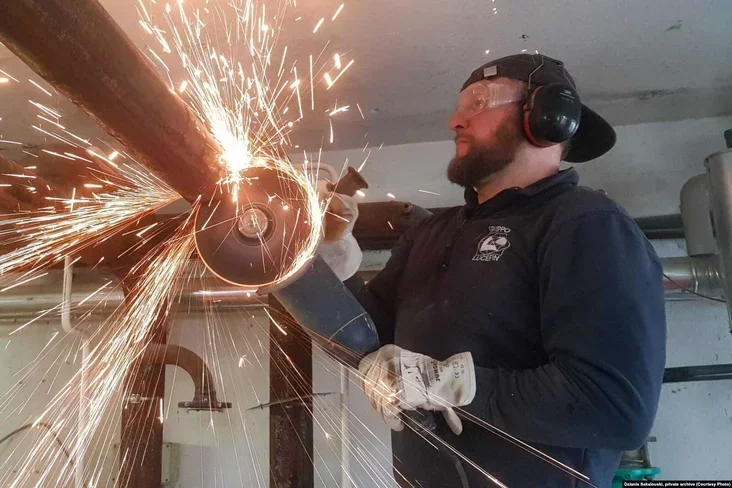
Dzianis Sakalouski during a part-time job.
Dzianis last made contact on Friday morning, December 20, recalls Dzmitry Brusko. In the evening, he no longer answered messages. Friends raised the alarm and came to Dzianis's home the next day. The landlady opened the apartment for them.
"When the apartment was opened, everything was clean, in its place," notes Brusko.
Inside, they found the body of the already deceased Dzianis. The cause of death is currently unknown.
"He took too much upon himself and, probably, couldn't cope. Perhaps the 8 months he spent in prison had an impact, maybe the frantic workloads when he worked here. I think a big problem was that he didn't trust doctors. We all tried to help him, to convince him to see doctors, but he didn't. And we came too late to try and help him," regrets his friend Mikita.
"I'm proud of you, princess!"
Dzianis Sakalouski was born in Pryłuki near Minsk.
"He loved Pryłuki very much. There were days when after work on a weekday, he would pick me up: 'Let's go get some fresh air'," his daughter Vasilina recalls.
She was born when her father was 19 years old. Due to the relatively small age difference with his daughter, Dzianis asked her friends to address him informally (using "ты", equivalent to "you" informal).
"From childhood, I knew that he loved me immensely. I was a girl who bathed in her dad's love. He always supported me. He would say: 'I love you, daughter. You're great! I'm proud of you, princess!' He would hug me. I felt his love everywhere. It was so great! I am a very happy person to have had such a dad. I know few people who had such a big open heart to the whole world," says Vasilina.
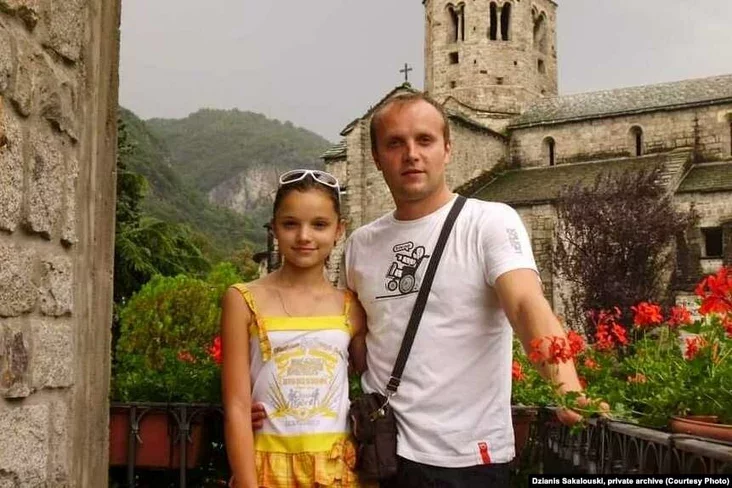
The girl was raised in the family speaking Belarusian. She attended Belarusian-language Gymnasium No. 23 in Minsk. After school, her father took her to art exhibitions, to the cinema, and introduced her to his artist friends. Together with his daughter, he sculpted with plasticine or polymer clay.
"He showed me music. Our musical taste is completely similar. It's cool retro-rock music," says the interviewee.
Vasilina says that they often called her father already in emigration. They could talk all night. Sometimes they met in his place in Berlin or in her place in Warsaw. But in recent weeks, they communicated little. They last saw each other on her birthday last August.
"He was one of the best operators in Belarus"
Dzianis Sakalouski graduated from Hlebaŭ Art College in Minsk with a specialization in "sculpture" and the Academy of Arts as a video operator.
"He was an interesting, self-confident person. There was no doubt that he dedicated himself to his work and was an undisputed authority in his circle," recalls Pavel, who studied with Sakalouski at the Academy of Arts in the early 2000s.
Colleagues call Dzianis one of the best video operators in Belarus. For more than ten years, he worked at Belteleradiocompany as a director of photography. However, he constantly combined work for Belarusian state TV channels with work for media in Germany, France, Norway, Qatar, Saudi Arabia, Australia: ARD, ZDF, DW, Arte, mdr, TV France, Al Jazeera, Al Arabia, NRK, ABC (TV Australia).
Vasilina is convinced that her father, even on state television, did not have reports he would be ashamed of; he did not compromise his principles, did not betray anyone, and condemned propaganda. From childhood, he taught his daughter to compare how different media presented the same event.
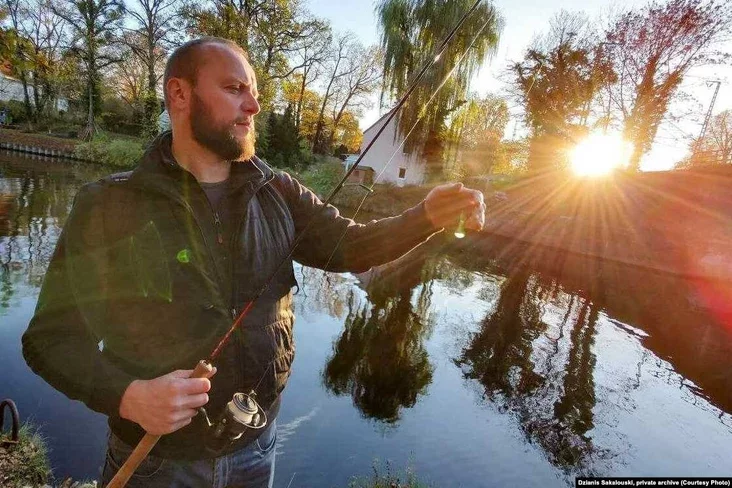
Dzianis's friend Yan* (name changed for the safety of the interviewee) told Svaboda that Sakalouski was not allowed to film political stories even before 2020 because he was considered insufficiently loyal.
"He believed that professional work could influence the system, and, as I understand it, in most cases, he distanced himself from propaganda projects," Dzianis's friend Pavel says about his work on state television.
In 2007, Sakalouski won third place in the nomination "Best TV operator in Belarus," and in 2017, he became the best operator at the "Televiaryšynia" award.
Mikita, Dzianis's friend and colleague who knew him for more than ten years, says that he was a very talented operator even in his youth. In Belarus, they filmed news together, including protests, for foreign media.
"If I had the opportunity, I chose Dzianis, because he was one of the best operators in Belarus," says the interviewee.

They also jointly shot several major documentary films, including the Belarusian part of the film Awaken, which received an award at an international festival. The entire film was shot in 35 countries, showcasing their distinctive features. The footage from Belarus lasts several minutes, but it took a month to shoot. The trailer for the film begins with Belarusian footage—girls with torches entering the water on Kupala Night, Mikita recounts.
"These were meant to be perfectly beautiful pictures. Dzianis made them simply phenomenal," says a colleague.
He notes that Sakalouski had extensive experience working in state television and always knew what needed to be filmed. He knew how to work with any equipment, was flexible, adapted to tasks, and even suggested what to film to make it beautiful. He could set up lighting, record sound, and compose shots himself, although not all operators did this. Moreover, he didn't complain and worked with pleasure.
"He operated helicopters and cranes. He saw the picture very well, had a sense of composition. He always filmed a luxurious picture. He was a reliable person you could count on. All the people on foreign channels we collaborated with were delighted with the footage and then only invited Dzianis to work," his colleague recounts.
"If I needed help with video, he would do it. He'd say: 'no questions asked,' and do it quickly and well. He helped at Belarusian events in Berlin. Connecting something, making a video – he did it for free," notes photographer Dzmitry Brusko.
Another documentary film that Dzianis shot and which received an award at an international festival is "I, Andrey Ivanovich." It tells the story of Andrey Moiseyenka, a prisoner of World War II concentration camps. This year he turns one hundred years old and lives in Belarus. The film was shot in several parts in Belarus and Germany. His other internationally awarded films are "Sister Joanna" and "Demigod."
Due to his poor command of German, it was difficult for Dzianis to find work as an operator in Germany, notes Mikita. To learn the language well, he would have needed to attend courses for six months, but he couldn't afford that and not work during that time. Sakalouski learned German using Duolingo. He wanted to find a job in his specialty.
"He was interested both in a swamp and in a palace"
For several years, while working at Belteleradiocompany, Dzianis Sakalouski filmed a documentary series "Belarusian Land."
"It was very coolly done. They traveled around Belarus, filming small towns. He loved it deeply. He was drawn to being a field journalist, not an office one," says Dzianis's daughter Vasilina.
Dzianis also corrected his colleagues' texts in Belarusian to make them correct and beautiful. He insisted that whatever was possible be done in Belarusian, his daughter recounts.
She also had the chance to work with her dad. He helped his daughter shoot a film for her diploma at EHU.
"I knew my dad was a pro. When people found out I was Sakalouski's daughter, everyone told me: 'Your dad is the best operator.' When I found myself in the role of a journalist, I felt that thrill, absolute calm and confidence that he would do everything perfectly," says the interviewee.
The girl went to study journalism following in her father's footsteps, because she saw how passionate he was about his work, that he could work "day and night."
"He was interested in working both in a swamp and in a palace," she concludes.
Vasilina notes that her father knew how to film various things.
"I think there's nothing my dad couldn't film. He told me how he was filming from a helicopter and forgot to buckle up: 'I almost fell out, but everything's good!' He filmed when he was skydiving, from a plane, did underwater shoots – he has a diver's certification," she recounts.
Eight months behind bars
In 2020, Sakalouski joined the strike at Belteleradiocompany. He was fired. Together with colleagues, he worked on creating an independent media platform — an "alternative television." On December 22, 2020, he was detained in the "Press Club" case. He spent eight months in pre-trial detention.
"We had such a strong connection, we felt each other. Once, when my father was in prison, he appeared in my dream and asked for help. Afterwards, letters came and the lawyer informed me that he had fallen ill in the pre-trial detention center at that time," his daughter Vasilina recounts.
Initially, Sakalouski was accused of "assisting in tax evasion." In August 2021, he was released on condition of not leaving the country. However, he was recognized as a suspect in "participating in a conspiracy to seize power by unconstitutional means." In 2022, Dzianis left Belarus for Germany.
"We met Dzianis already in Germany. He was a very humble former political prisoner. He always lived by the principle that other people needed support more than he did, and tried to rely on his own strength. He immediately sought opportunities to work and earn independently," describes Sakalouski Barys Harecki, an employee of the Belarusian Association of Journalists.
"Punk-rocker spirit"
Actor and presenter Aliaksei Saprykin, Dzianis Sakalouski's son-in-law, told Svaboda that they had a small age difference – 13 years, so they communicated quite closely and informally (using "ты"). Sakalouski loved to search for historical items during his travels, for example, ancient dishes.
"We found many interesting topics related to cinema, art, life, philosophy. He knew a lot and loved to tell stories," says Aliaksei.
Dzianis loved to eat well, the interviewee notes. But lately, he lived in conditions where he couldn't cook anything for himself. Vasilina and Aliaksei tried to cook something delicious for him when Dzianis came to visit them.
"And he felt at home, like in Pryłuki, his place of power, even though we all had lived abroad for a long time. He rejoiced when we saved treats from Belarus for him. He loved to treat everyone to pickled garlic from a secret recipe," says the interviewee.
Aliaksei adds that his father-in-law always tried to help, even when he himself was in a difficult situation. He recalls how once Dzianis, during a trip, had two hours in Warsaw between transfers. And during that time, he helped them move furniture to their new place of residence.
"Vasilina tells me: 'You know, he loved you very much.' I loved him very much too. I remember our first meeting. He was so nervous that he even wore a shirt, but usually he dressed in jeans and a T-shirt," says Aliaksei.
Once, when Aliaksei and Vasilina were visiting Dzianis in Berlin, he made a surprise for them and reserved them an overnight stay in a camper van on Alexanderplatz – the central square of the city.
"He had a punk-rocker spirit, rock-and-roll. Maybe it wasn't very comfortable, but it was very warm and sincere, adventurous. In Berlin, that's how it should be, not hotels with soft mattresses and white sheets, but a camp on Alexanderplatz, when, at three in the morning, people walk around, make noise, and prevent you from sleeping. Such is real life, unedited," says the interviewee.
"A very sociable person. Open, cheerful, always anecdotes, jokes, stories. Very educated. In Berlin, he often went to museums, especially loved the exhibition of ancient Greek art. He loved Berlin very much, walking around Alexanderplatz, taking photos with his phone," Mikita says about his friend.
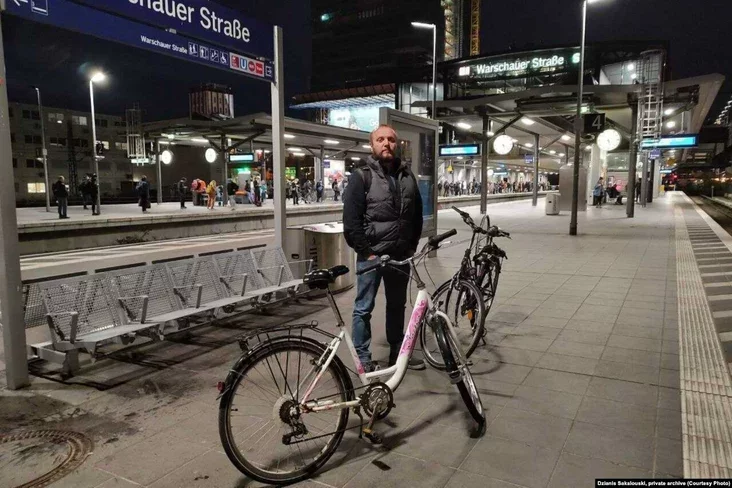
Vasilina notes that her father loved people, could make friends with someone even without knowing their language. He rode a bicycle, loved adventures and travels.
"He loved to wander through the forest. I got this love from him - to break out into the field, to go somewhere, somewhere through the swamp. He loved nature, saw cinematic shots everywhere," says his daughter.
Vasilina thinks that her dad wouldn't want her to fall into grief after his death.
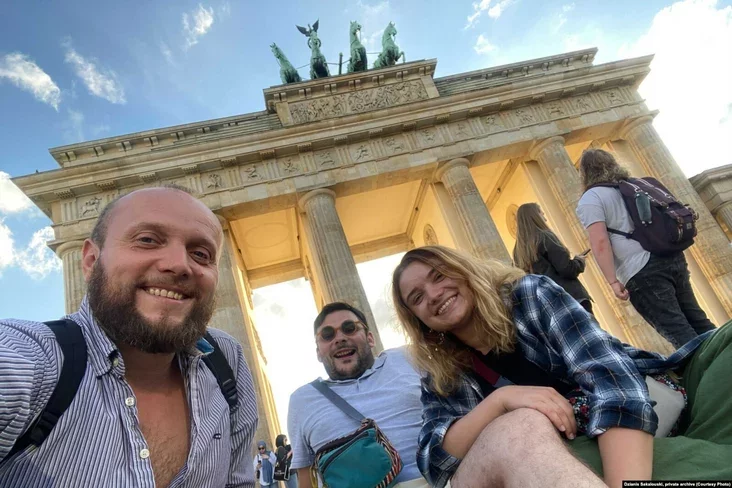
With daughter and son-in-law
"My dad would never admit in his life that he was feeling bad. He always had a smile. Everything's fine! He had an insane amount of positivity. When I worried, complained, he always said: 'Hey, girl, everything will be great!' He would probably tell me now: 'Hey, girl, what's wrong with you!'," says Vasilina.
Vasilina admits that she and her husband are now expecting a child.
"He was so incredibly happy for me and Lyosha, so happy that he would become a grandfather. We even joked that we would have Grandpa Dziona. He would have been a great grandfather. I'm so sorry he won't see his granddaughter. I hope he'll see her somewhere out there. I'd like to tell him: 'I love you so much, Daddy!' I think he would want us to be doing great here," says Vasilina.
BySol opened a fundraiser to help with the funeral.






















Comments