


Bialiatski: In the colony, I was in complete isolation; in 2025, I received only one letter from my wife
Ales Bialiatski, Nobel Peace Prize laureate, head of the Belarusian human rights center "Viasna," released and deported from Belarus last December, gave an interview to the Dozhd TV channel.

In it, he spoke about the inhumane conditions of detention in Belarusian prisons and the support of other prisoners, whether it is worth negotiating with Lukashenka's regime, the Belarusian dictator's dependence on Putin, his attitude towards Sviatlana Tsikhanouskaya, and what the Belarusian authorities are still afraid of. Dozhd provides the main theses.
On pressure in detention
I was there [behind bars] for quite a long period – 4 years and 5 months. And, of course, these were different periods of detention. A pre-trial detention center is one situation, a colony is another situation. It was certainly harder in the colony than in the pre-trial detention center, because there they already applied complex methods against political prisoners, including psychological pressure, punitive isolation cells (SHIZO), and cell-type premises (PKT). I also had to go through all of that.
Unfortunately, it was a very difficult time. And now it's a little over a month since I was released, but a significant part of me is still there, in prison. And it's like, prison lets go gradually. This process is happening now, and psychological and physical recovery is ongoing.
There was constant issuance of violations, constant psychological pressure, the search for prisoners who cooperate with the operational department to put pressure on political prisoners. Well, I also had to go through all of this along with other political prisoners. This is my second term, and I have something to compare it with. Much is similar to how it was 10-12 years ago. But new methods of pressure and massiveness have appeared.
If previously, [during imprisonment] in 2012-2014 in the Babruisk colony, I was the only political prisoner, now in the Horki colony, there were up to 50 political prisoners per thousand inmates. And, of course, in some ways it was easier, because even conspiratorially, we communicated with each other, exchanging information. But in some ways it was harder, because now these methods of pressure have become more sophisticated, more subtle, and more massive.
On conditions in the SHIZO (punitive isolation cell)
I spent 38 days in the SHIZO during my time in detention. It might not seem like much, but it was enough to experience terrible cold, when you sit without heating in just a shirt and thin trousers and are forced to sleep on bunks tied with iron strips, literally half sleeping on iron, half on these boards.
If, of course, you have the strength to sleep, because you constantly wake up from the cold, forced to somehow stretch, do physical exercises, because you are really shaking from the cold. And this goes on for days. The first day, the second, the fifth. And you just wait for this warmth, like some blessing. These are the inhumane conditions present in Belarusian SHIZO.
On conditions in the PKT (cell-type premises)
I spent six months in the PKT, practically a prison within a prison, when you effectively sit in a toilet for days and months, because it's a small room and bunks are strapped up for the day, everything is removed, and you are in this room with another person in humidity.
The humidity is such that when you wipe the walls with a towel, you then wring it out. And you just have to hope that your body will endure it. And the administration watches how you go through it all. And they are not in a hurry to help if you have any problems. That's why several political prisoners have died in prison in recent years for one reason or another, but mostly because they did not receive timely medical care; they simply died from the lack of this medical care.
On the goals set in Belarusian prisons
To isolate, to pressure a person, to maximally break your human dignity and to show others, "Look, this will happen to you too." Practically all those anti-human methods that existed in Soviet prisons towards dissidents, towards political prisoners, have neatly transferred to Belarusian prisons, even though times have changed.
On what supported him in prison
What always delighted and supported me was the rather strong support from ordinary prisoners who had nothing to do with politics, who ended up there under other articles, but nevertheless, especially the youth, they understand the situation, they understand why you are imprisoned, they at least don't do any meanness or nastiness to you, and often help with everyday issues.
It's not for nothing that they say prison is a reflection of the state itself. And indeed, the Belarusian prison conveys what is now happening in the Belarusian state itself. And although we sat there in practically complete isolation, I absolutely did not feel isolated from the Belarusian people, and the sentiments that Belarusians have now are, in principle, very positive, anti-militarist, quite democratic.
On adapting to freedom after 4.5 years of imprisonment
You just jump out of a stuffy room into the fresh air like crazy, and your lungs just cut, and your eyes, and you don't quite understand where you are. I experienced all this recently and to some extent continue to experience it. You learn again to use the phone, social networks, email, some of the simplest things you usually don't pay attention to. You go into a supermarket, and you want to buy everything, everything you didn't have the opportunity to taste there. I now look at the world as if with new, freshly washed eyes, and everything that I didn't notice before delights me.
And, of course, it is very important that now I am with my wife, I can talk to my relatives, with friends, because in 2025 I received only one letter from my wife, there was complete isolation in this regard. This, again, is a lever of psychological pressure on political prisoners, and the fact that I now have the opportunity to speak, to communicate, is very important to me.
I generally didn't know what was happening in the political, civil life of Belarus; again, for me, this is such a new world. And now there is such a process of rapid world recognition, as if you are starting to walk again, starting to grow up quickly.
When did you find out you were being released?
Information reached us about this, because the official Belarusian mass media, they rarely talk about anything, but about this they spoke in detail, they considered the chances of breaking through the political, economic isolation that had existed for the past years. Of course, we listened to this information, analyzed it, and, in principle, expected that a release would happen.
I was woken up at 4 in the morning, then a full search, some of my belongings were thrown away, everything written was taken – letters, my notes. I practically wrote a book of memoirs, all of it remained, it's unclear what's with it now: whether these papers were thrown away or they are lying somewhere.
An hour later I was already in a car with my eyes blindfolded and handcuffed, heading to Minsk, then from Minsk towards Lithuania. And I already understood that I was getting closer to freedom. But no one said anything, we were kept in complete ignorance. Only when American diplomats met us at the border, and then we crossed this border with them, it finally became clear that I was free, and that what we had been expecting for the past months had happened.
Maria Kalesnikava says that one should negotiate with Aliaksandr Lukashenka, with the regime.
I would approach this with great caution and distrust, because I have been observing this character [Lukashenka] since the early 90s, when he was just a collective farm chairman and a deputy of the Supreme Soviet.
These campaigns for the release of political prisoners, for the desire to establish economic relations – primarily with the EU and the USA – this was not the first time. We've been in this water before, in 2005, in 2014, when I was also conditionally early released, and after that, in 2015, relations with the West improved. Now it's clear that the gold reserves of his elder comrade [Putin] are running out, and Lukashenka himself is forced to look for opportunities to keep both the Belarusian economy and the social contract he made with the Belarusian people afloat: he needs to pay pensions, salaries, and other social benefits. And therefore, of course, they are very interested in lifting these political and economic sanctions now.
But what in return? Political prisoners are released on the one hand, but new ones continue to be taken in, constantly, every day we have news about new arrests, new detentions, the number of political prisoners practically does not decrease, there are still more than 1100 political prisoners in Belarus, and these are only those known to human rights defenders.
Therefore, of course, it is very important that other political prisoners are released, that this process continues, but again, it is very important that new recruitment of political prisoners stops, and that some more or less clear democratic reforms finally begin in Belarus, otherwise after some time we will again run into the same repressions.
What kind of pressure should be put on the regime?
It seems to me that the policy of economic sanctions, political sanctions, and non-recognition of elections was quite effective.
If there had been no these political and economic sanctions, we would have remained imprisoned. Therefore, it is clear that the margin of safety of the economy and this political isolation of the regime worries even the so-called Belarusian elites. And, naturally, some actions have now begun to unblock this situation, but we must look at it in perspective, so that it doesn't turn out like before again.
Let me remind you that in 2015, sanctions were lifted, a sharp rapprochement of the European Union with Belarus began on many programs – economic, political. Lukashenka was given the green light.
In 2020, what did it end with? Thousands of people were arrested, massive crackdowns, thank God it didn't reach what happened in Iran. I felt that atmosphere of fear among the authorities then, they were ready to do anything.
Given this, it seems to me that pressure on the Belarusian regime should continue, and serious changes should be sought.
How great is Lukashenka's dependence on Putin now?
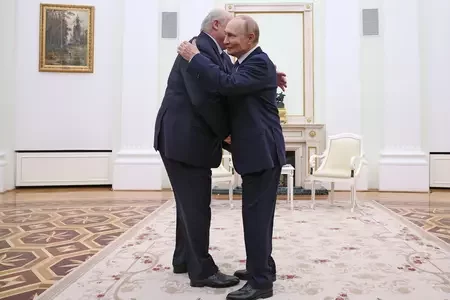
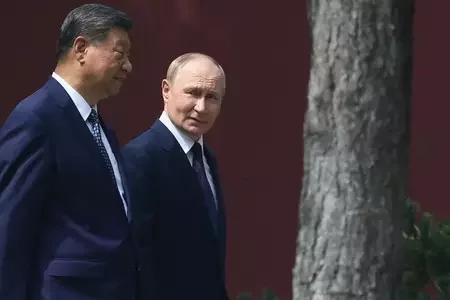
Quite strong. I would say that [Putin] controls [Lukashenka] enough to be calm that there will be no changes in Belarus's policy towards Russia as long as this vassal is in power.
Incidentally, this strongly reminds me of the situation when, back in the 13th century, Russian princes used to travel to the Golden Horde to pay tribute. And having received this tribute, they then somehow ruled their principalities.
Lukashenka also constantly travels to Putin to confirm such a tribute every year, perhaps even more often. They found each other. Bad sticks to bad, good to good – that's a law of nature.
On the war
I watched Russian television in prison; it wasn't forbidden for us. Naturally, already a couple of months before the start of the war, there was an atmosphere of preparing Russian society for the war to begin, that "there are fascists, there are those who don't like us, and we went through all this in World War II, we need to restore order."
The psychological preparation of society was in full swing, so even before the New Year 2022, it was personally clear to me that the war would begin sooner or later.
It was difficult to perceive such news. Incidentally, I am experiencing the same scenario a second time. Because in 2014, when military actions began in Donbas, when Crimea was captured, I was also in a colony, also powerless, it was even impossible to discuss it with anyone. Now this has practically repeated itself and, again, it's difficult because you yourself can't do anything, you can't even say anything.
Well, it was clear that because Belarus got involved in this war, we find ourselves in the position of hostages and even prisoners. Incidentally, I very often compared our situation with the situation of prisoners in a colony. Because there are no rights, and there is also this semi-military situation in Belarus, although it has not been declared, but the situation itself, when everything is forbidden, any freedom is forbidden, all this very much resembled wartime.
On Sviatlana Tsikhanouskaya
I don't know much, but I remember well how she started. She was a person with great potential, but with minimal experience. However, she grew very quickly, and now she is a real, serious politician, especially since millions actually voted for her. And I saw very different people in the colony, even old people from villages, who said they voted for her.
Therefore, her real popular support does not just disappear. When people vote, it remains in memory and gives her the legitimacy to truly represent the democratic part of Belarusian society. And I believe that it is very important for the Belarusian opposition, for the entire Belarusian society, to have its own democratic, solid, clean voice.
How can the opposition help Belarus and Belarusians from abroad?
Now, the influence we can exert on Belarus is our number one issue. But I always remember here the experience, for example, of the Polish opposition, when after [World War II] hundreds of thousands of Poles and the Polish government in exile were abroad. But they exerted a very great influence on the situation in Poland, in the postwar, 50s, 80s, practically until the moment when this communist regime fell.
It seems to me that the influence of the Belarusian opposition can be compared to this. It is, of course, significantly greater than the influence of individual dissidents or small groups, as it was in the Soviet Union.
Is Lukashenka afraid of Tsikhanouskaya and other opposition figures outside Belarus?
Naturally, because memories constantly resurface. He [Lukashenka] distances himself from this, tries to criticize, find some compromising material or create this compromising material.
We see how the special services work with some activists. All this shows that they perceive both Tsikhanouskaya and the Belarusian activists who found themselves abroad quite seriously and as a threat to their power.





In the early 2000s, three history teachers fled to Ukraine from the "genocide of the Belarusian people" committed by Lukashenka's regime. What was their fate?









Comments