


The world is holding its breath. Donald Trump has given Tehran time to accept Washington's terms. American aircraft carriers are taking positions, oil markets are shaking — the region is on the brink of the largest escalation in decades. BILD writes about the situation in the Middle East.

Photo provided by the US Navy, showing a Boeing F/A-18E Super Hornet landing on the aircraft carrier USS Abraham Lincoln in the Indian Ocean, January 2026. Photo: Daniel Kimmelman / US Navy via AP
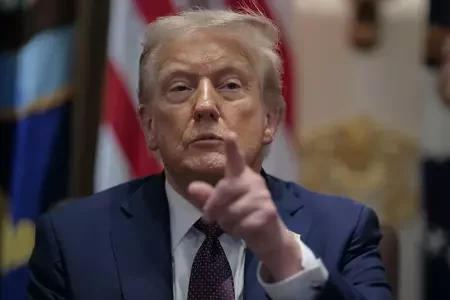
The US has issued an ultimatum to Iran. By early March, Tehran must agree to a nuclear deal — "otherwise, bad things will happen," warned US President Donald Trump.
At the same time, the States have sharply increased their military presence in the region. Aircraft carriers, fighters, and air defense systems are being redeployed to the Middle East — observers speak of forces that significantly exceed the scope of a symbolic threat.
Financial markets are already reacting. Stock exchanges in the Persian Gulf countries are falling, oil prices are fluctuating wildly, and investors fear an escalation with global consequences.
Tehran officially demonstrates a combative mood, but speaks of defense. In a letter to the UN, the Iranian leadership stated that it does not want war, but will defend itself "with determination," and that military facilities of "any hostile forces" in the region will be considered legitimate targets in the event of an attack.
Israel also spoke out, viewing the situation as a strategic turning point. Prime Minister Benjamin Netanyahu speaks of the Middle East "at a crossroads." Israel is ready to "respond to any challenge" — and is closely cooperating with Washington.
Israeli security expert Ori Rabinovich says that Israel would prefer to be rid of the Iranian regime once and for all.
What Netanyahu's government does not want? "A step that is essentially just a 'slap on the wrist.' This risks emboldening the [mullah] regime" — a symbolic strike without strategic effect could even strengthen Tehran. If Washington has a plan "that will truly lead to a significant outcome," then it is likely that Israel will support it.
Jerusalem also fears that Trump may ultimately agree to a "limited" deal — that is, an agreement that only concerns the nuclear program, but not Iran's missile arsenal or support for allied armed groups in the region.
At the same time, according to sources in Israeli security structures, Israel and the US are working on joint defense against possible Iranian retaliatory strikes.
Missile and drone defense systems are being deployed in several countries in the region. This includes American fighter jets being prepared in Jordan.
In many Arab capitals, sentiment is moderate. Saudi Arabia, Qatar, and Egypt warn that a US strike could lead to a large-scale conflict. Middle East expert Galip Dalay of Chatham House formulates it this way: many governments want to avoid a war that "could bring even more turmoil to the region."
They fear that in response, Iran could attack not only Israel but also American bases in the Persian Gulf, that oil facilities in the region would be attacked, and strategically important shipping lanes would be blocked.
Officially, negotiations on a possible nuclear agreement are still ongoing. But the closer Trump's deadline, the stronger the pressure. Security experts warn of an escalation spiral: a limited strike could trigger large-scale retaliatory actions.
The upcoming events could disrupt the entire balance of power in the Middle East. The central question is: will the ultimatum lead to a deal? Or has the countdown to a military strike already begun?





































Comments