


“Lukashenka imagines that Poland could abandon support for the Belarusian opposition in exchange for Poczobut. This will not happen”
Journalist and activist of the Polish minority in Belarus, Andrzej Poczobut, received the Sakharov Prize for Freedom of Thought. One of those who represented the political prisoner at events in the European Parliament was former Sejm deputy Robert Tyszkiewicz. In a conversation with Belarusian journalists, he reflected on why Lukashenka is not releasing the political prisoner and what Poland and the European Union should do in conditions where Washington is striking deals with Minsk.
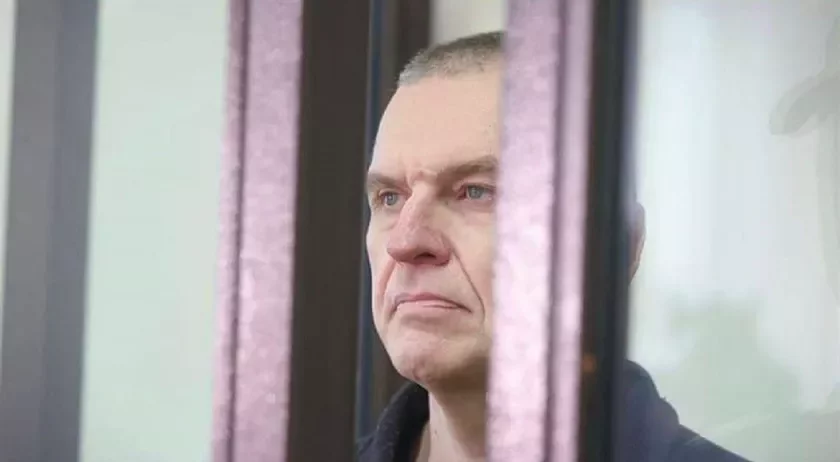
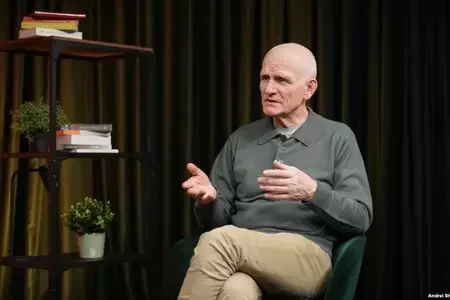
Andrzej Poczobut. Photo: sb.by
Robert Tyszkiewicz was a deputy of the Polish Sejm for almost 20 years. Among other things, he headed the parliamentary group on Belarusian affairs, supported the Belarusian opposition, and defended the rights of the Polish minority in Belarus.
Two years ago, he left the Sejm. Now Tyszkiewicz works in the Chancellery of the Senate, where he is responsible for relations with the Polish diaspora. Recently in Strasbourg, the former deputy was one of Andrzej Poczobut's representatives at the Sakharov Prize award ceremony.
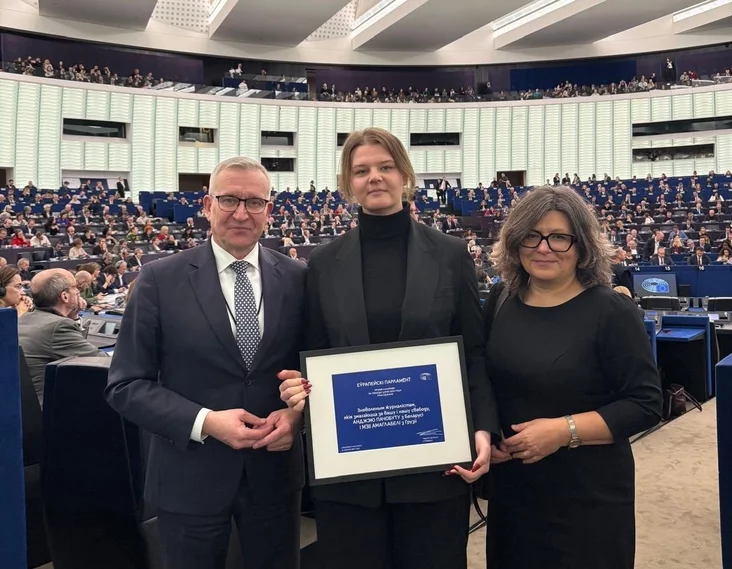
Robert Tyszkiewicz at the Sakharov Prize award ceremony for Andrzej Poczobut. Photo: his Facebook
Incidentally, Tyszkiewicz himself was imprisoned for journalism in his youth. In the 1980s in his native Białystok, he edited an underground youth magazine, and was jailed twice. But the politician says it is impossible to compare Poland during martial law and modern Belarus.
— We Poles understand that there will be no victory for democracy without free speech. First, there must be an opportunity for communication between people outside the regime's control. There must be independent information, journalism, debates. And organizing this under the conditions of totalitarian oppression that we now have in Belarus is possible only in clandestine or émigré settings.
We actively used the support of our emigration, operating in the underground of "Solidarity." Thanks to this, "Solidarity" was able to survive for these 8 years in very difficult conditions and under severe repression, although it must be emphasized — they were absolutely not as difficult as today in Belarus.
It's incomparable. What is happening today in Belarus is Stalinist repression. During martial law in Poland, sentences of 3–4 years were passed; 6 years was an absolute exception, and they were then quickly reduced by amnesty.
The draconian punishments handed down in Belarus — these are the times of Stalinism. So yes, we in Poland know, we have it in our blood, how important free speech is and that everything starts with it.
— Why is it so fundamentally important for Lukashenka not to release Andrzej Poczobut?
— It's hard to get inside the dictator's head, but it's clear that Andrzej Poczobut has become not only political prisoner #1 for Lukashenka, but also hostage #1. Because Lukashenka treats political prisoners as hostages. Why did Andrzej remain in prison and was not released along with a group of 123 political prisoners? It seems to me there are two reasons.
The first is that he is not only a journalist but also a leader of the Polish minority. This is a signal from Lukashenka to this almost half-million-strong community: "Do not interfere in the struggle against the system, sit quietly, be submissive, otherwise the same fate awaits you." Apparently, he believes that it is not yet time to send a signal to this community that the severe repressions are over.
But there is also a second reason: Poland's active participation in supporting Belarusian society, refugees, the opposition, and the struggle against the regime. He wants Andrzej to be a hostage specifically in relations with Poland. He is keeping this card for negotiations with Warsaw and probably imagines that Poland could abandon support for the Belarusian opposition in exchange for Andrzej's release. We, of course, will not do this — also because Andrzej himself would not want it.
For almost five years now, he has been sending us a signal from prison that values are important. If he wanted to, he would have written a pardon request, and he would have been demonstratively and fanfare-ly released. But he shows us that we must stick to principles, otherwise everything will fall apart.
In Poland, there are over 150,000 Belarusian refugees, over 12,000 students, and many political and civil organizations. This will not change. Poland will provide the strongest support to the structures of free Belarus among all European countries.
— Perhaps Lukashenka is expecting something specific from Poland?
— We would like Poland and Belarus to be normal neighbors. Even with all differences, elementary principles must be observed, and they are not subject to discussion. First of all, people must be released from prisons. As they say about peace negotiations: first a ceasefire, then we can talk. The situation here is the same: first release the people, and then we can start a dialogue.
I do not believe in deals (Tyszkiewicz uses the word 'deals' here. — NN) with a dictator. He releases 123 people, and in recent months over 150 have been imprisoned. The numbers balance out. He is ready to sell people again in exchange for lifting sanctions on gas or petrol, and then he will imprison another hundred or two. Such a deal changes nothing in the system. The repressiveness does not change, the laws do not change. You can still be jailed for a social media post or a photo from a demonstration. Prisons are working.
The challenge is how to launch the liberalization process and return the situation at least to the level of 2020. For me, before 2020, Belarus had an authoritarian regime, and after 2020 — a totalitarian one. There are no rules there. Today they release, tomorrow they imprison — it's madness. We are happy for every freed person and grateful to the Americans for the negotiations, but we realize that the system has not changed.
— What should Poland and the European Union do in these conditions, when Washington is striking deals with Minsk?
— Look: we opened border crossings not as part of some agreement, but only because through consistent policy and the construction of a security fence on the eastern border, we achieved a reduction in illegal migration pressure. Within this hybrid war, it became unprofitable for Belarusian services and and firms linked to the regime to deliver these migrants, as they couldn't manage to push them to the other side.
And now, one can say, they themselves came to the conclusion that Poland will not allow a migration route to be created there, but Poland will also not negotiate whether such a route will arise or not. This means we must protect ourselves, and look at the result. The result is that border crossings were opened, making it easier for people — it's always important for ordinary people to be able to travel more easily to work, school, university. At the same time, migration pressure is now significantly, significantly lower than it was — it's incomparably lower compared to what it was just half a year ago.
Therefore, I believe that, first and foremost, consistency in dealing with the regime is needed, meaning a demonstration of firmness. Consistency means continuous pressure and sending signals of readiness: if you behave properly, if people are released, we will be able to sit down and talk about normalizing the situation with Poland, with the West, with the European Union. But this is a necessary condition.
Patience and time are also needed, because time also plays a role here. Today, Lukashenka is very worried that he is not at the negotiating table for a peace agreement between Russia and Ukraine. He is very afraid of this and discusses it with the Americans. He is afraid of whether he will still be needed by Putin. He supported Putin in the aggression, and now all negotiations are happening behind his back. He doesn't know what they will agree on, what deal they, in turn, will make, and where Lukashenka's place will be in this deal. He is completely unsure about what will happen to him next.
Therefore, in my opinion, we must be consistent, we must exert pressure, we must adhere to principles, and demand the fulfillment of absolutely minimal requirements — the release of prisoners. At the same time, it is necessary to support independent organizations, media, and all institutions of Belarusian civil society that operate outside Belarus today, because within the country itself there are no conditions for their work.
We know from our own history how important it is to maintain this activity. Independent media, those 12,000 young Belarusians studying in Poland — this could be the elite of a future free state. That is why we admit them to study: although the Belarusian side unilaterally terminated the agreement with Poland on the recognition of diplomas and certificates, Poland has maintained it. Therefore, every Belarusian applicant can submit documents based on a Belarusian certificate, and it will be recognized.
So this is also a conscious choice on our part, and the other side sees it. We believe that all of Europe must stand firm on this. The end of the war in Ukraine can change a great deal. This could become a "window of history" for changes that are difficult for us to definitively foresee today, but we must be ready for these changes.
Now reading






Ihar Losik recounted how he was held in the KGB pre-trial detention center with a former delegate of the All-Belarusian People's Assembly — a police colonel who, while drunk, almost killed his wife







Comments
а сьцяну і ровы за 4 млрд будуеце ,