


At the meeting of the Human Rights Commission, he urged the United States to wisely use its existing leverage against Lukashenka.
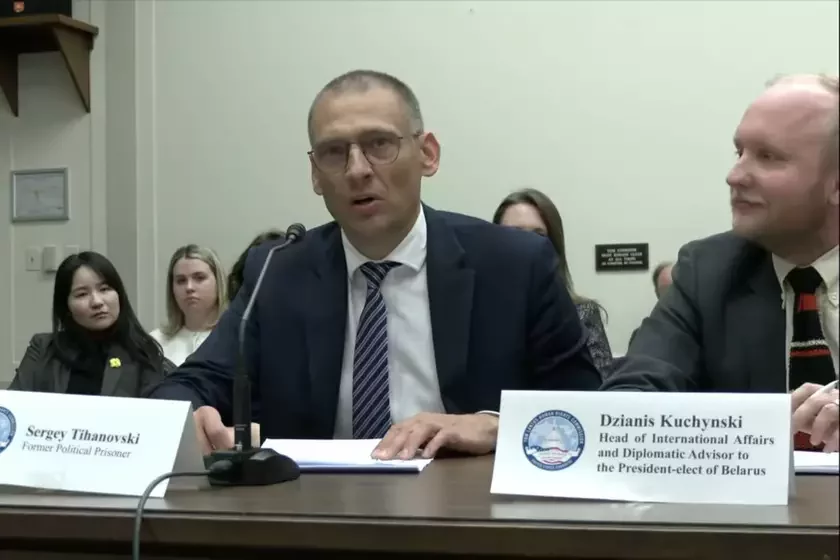
Now there are "only three real ways" to free political prisoners held hostage by Alyaksandr Lukashenka: "foreign military intervention, their removal abroad in exchange for something, or coercive diplomacy conducted by U.S. President Donald Trump."
Sergei Tsikhanouski expressed this opinion on February 3 at a hearing on the human rights situation in Belarus before the Tom Lantos Human Rights Commission in the U.S. Congress. The former Belarusian political prisoner testified as one of the witnesses, writes "Pozirk".
He also stated that he supports the third option.
According to Tsikhanouski, Trump needs Lukashenka much more than Lukashenka needs Trump, which gives the American administration "immense leverage" over the Belarusian dictator, leverage which the ex-political prisoner urged to use wisely.
As Tsikhanouski stated, Lukashenka not only bargains with Washington over hostages, but also actively tries to attract American business to Belarusian national airlines, the potash industry, and nuclear energy. He also drew attention to Lukashenka's active attempts to play the role of a mediator in relations between the U.S. and Russia.
Considering all the mentioned factors, according to the speaker, with Washington's political will, it is possible not only to achieve the release of all regime hostages from Lukashenka but also to insist on an end to political repression.
He also noted that he has "additional recommendations" that he would like to discuss "privately, not publicly."
"I ask you for one thing: please do not stop. You have already saved doctors, politicians, bloggers, and even Nobel Peace Prize laureate Ales Bialiatski, but more than 1,100 people remain in detention," Tsikhanouski appealed to U.S. representatives.
The witness also spoke about the conditions of his detention in places of deprivation of liberty, specifically thanking the American side for his release.
Tsikhanouski noted that there are people in detention in Belarus whom, as he put it, Lukashenka hides from the American side and "will not agree to release under any circumstances." He included former judges, investigators, security service officers, lawyers, and officials whom Lukashenka considers traitors. According to the ex-political prisoner, such people are held in the most severe conditions and "subjected to the most brutal torture."
Tsikhanouski also named one of them — former special services officer Uladzimir Kniga, who should be "rescued as soon as possible, if he is still alive."
The chairman of the hearing, U.S. House of Representatives member from the Republican Party, Christopher Smith, opening the event, stated, among other things, that the U.S. authorities (unlike their president Donald Trump) do not recognize Lukashenka as the legitimate president of Belarus (unlike Donald Trump).
As the initiator and main author of four editions of the Belarus Democracy Act, Smith expressed confidence that Congress would adopt the fifth edition of the document developed by him, which was first adopted in 2004 and updated in 2006, 2011, and 2020.
The Tom Lantos Human Rights Commission is a bipartisan human rights commission of the U.S. House of Representatives.
It monitors the human rights situation in various countries, conducts relevant hearings and briefings, and provides recommendations to American legislators and government agencies.
In addition to Sergei Tsikhanouski, the witnesses at the February 3 hearing included Sviatlana Tsikhanouskaya's diplomatic advisor Dzianis Kuchynski, the head of the Lithuanian office of the human rights organization Freedom House Vytis Jurkonis, and international human rights lawyer from the U.S. Jasmin D. Cameron.






In the early 2000s, three history teachers fled to Ukraine from the "genocide of the Belarusian people" committed by Lukashenka's regime. What was their fate?

















Comments