


«I earn from 200 to 1,200 BYN a day». An industrial climber told about his work
Raman has been in the profession for 17 years. He has performed work on high and significant city structures: buildings of the National Olympic Committee, the National Library, Lukashenka's residence, and others. The man even descended as Father Frost to children's windows. But behind the romance of height lies hard work, seasonal earnings, injuries, and a constant struggle with dishonest clients. A journalist from Myfin found out how much industrial climbers actually earn in Belarus, why it's crucial to work with a contract, and what risks they face.

Here and further, photos from Raman's archive
How it all began
Raman is currently 42 years old. By education, he is a chemical engineer-technologist. He was born in Salihorsk, worked for two years at "Belaruskali" after university, then served in the army. Love changed his usual life: he met a girl from Minsk, and it became clear that living in different cities was not an option. He decided to move to the capital. He came into industrial alpinism not "from the street" but from extreme sports.
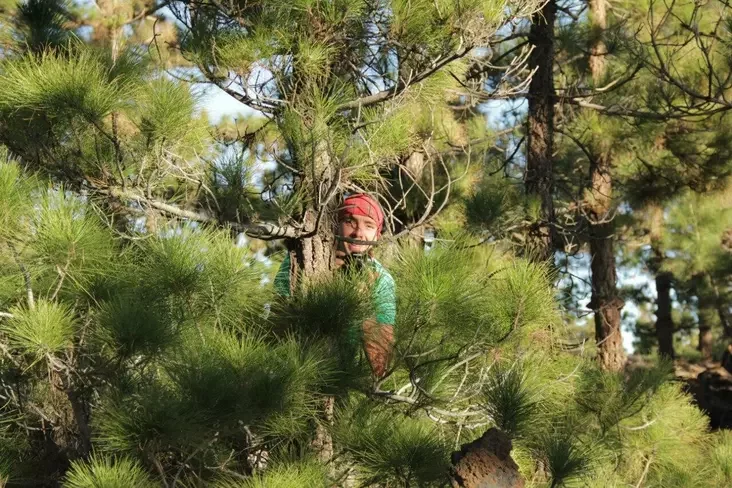
— In 2008, when I was 25, we were actively involved in rope jumping. We had our own team, we knew everything about knots, carabiners, and belaying. One day, acquaintances received an order to paint cell phone towers, and they were short on people — so they invited me. I had to quickly get trained [retraining for workers for 2 weeks. — Myfin note] at the Ministry of Emergency Situations institute near Barysaw, get a "certificate" and start working. That's how a hobby became a profession.

This is where the text's hero received his industrial alpinist "certificate"
Entry into the profession — from 4,500 BYN
Many think: just complete a month-long course, buy a rope, and start earning millions. Raman debunks this myth. The entry threshold is currently high:
Training. Industrial climbing courses cost about 400 BYN. But alpinists are paid not for their ability to hang on ropes, but for skills in finishing, plastering, welding, etc. Therefore, you will have to constantly take professional courses to grow.
Equipment. If you roughly divide all equipment into "economy," "standard," and "luxury," equipping yourself at a "standard" level costs about 3,500 BYN.
Consumables. Approximately 100 meters of rope are needed, costing from $1.5 per meter. And it can be "killed" in one job if working on facade painting or cut by a sharp ledge. There are other small consumables: gloves, clothing, etc.
— If you want to do arboriculture, be prepared for expenses on chainsaws, aerial platforms, stump grinders.

An industrial climber can engage in arboriculture — working with trees and shrubs
— Working with your own equipment is already the level of a small business. If you want to save money and have zero experience, you can get a job with a firm that provides everything necessary. But, as a rule, the salary there is significantly lower.
Earnings: from $100 per shift to terrible dumping by half
Raman says that at the start of his career in 2008, industrial climbers were considered an elite. There were few professionals, and they were paid well. They didn't even look at jobs where the rate was less than $100 per shift (6 hours). They could come, earn a factory worker's monthly salary in a couple of days, and then go to the mountains.

Raman — furthest to the right
— Now the situation has changed. The market is oversaturated. When the profession gained popularity, people "from the street" came into it. They quickly got their "certificate" and started moonlighting on weekends, after their main job. For me, alpinism is my only bread, it feeds me. But for them, it's "side work." They get a salary at their main job, so they are willing to climb a wall for 100 rubles a day.
— How much can you earn now?
— A reasonable rate for a shift for an experienced specialist is from 350 BYN. I can earn from 200 to 1,200 BYN a day. At the same time, your monthly salary directly depends on the number of hours worked, with no upper limit. You need to understand that this is not "net" money. Some part always goes to consumables, and it's hard to calculate the exact amount.

Raman gives an interesting example of dumping in the profession. Once, his team received an order to demolish a large brick tower for $23,000. They were already preparing to sign a contract, and suddenly the client refused — saying they found contractors cheaper. As it turned out later, those same "people from the street" offered to perform similar work for 10,000.
On the importance of working officially
According to Raman, industrial alpinism is a field where people are often "scammed," especially if working without documents. Raman is an "individual entrepreneur," always signing a contract, but even that doesn't always save him 100%.
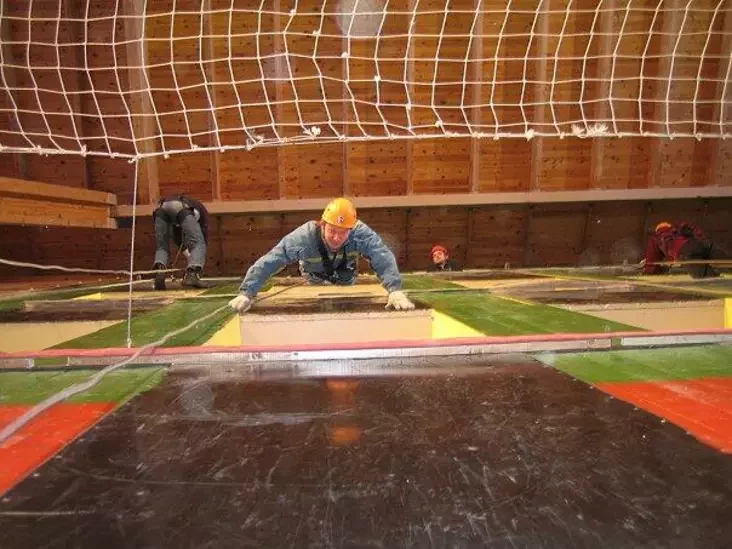
At the Ministry of Emergency Situations base during training
— We had a story with a well-known company. In winter, they urgently asked us to clear snow from roofs. The sum was decent, about $10,000 for the brigade. And then it started: "No money, wait." In such cases, the only option is to go to court. I naturally won it, but even with that, it took two years for us to get the debt back. I paid my guys from my personal pocket immediately, but I was in the red myself.
More energy goes into recovering your own money than into the work itself. This year, the situation repeated with a large grain complex.
— We completed the work in June. They asked us to wait a month. Then another. In October, I got tired of "tomorrow" and sent a pre-trial claim. They immediately called me and said they would send the money today.
The main working period — from early spring to late autumn
Raman works not for a career, but for a lifestyle. His wife also loves tourism and hiking, so even the birth of their son didn't stop their urge to travel. On the contrary, they started taking the little one with them into the harshest conditions.
— By the age of three, our son had already visited 22 countries. In Iceland, we lived in tents at minus 9 degrees, and he was only 2.5 years old. We carried baby food and diapers with us. In Armenia, I completed a 1st category mountain route with him on my back. I have a special Osprey carrier where the child sits like in a backpack.
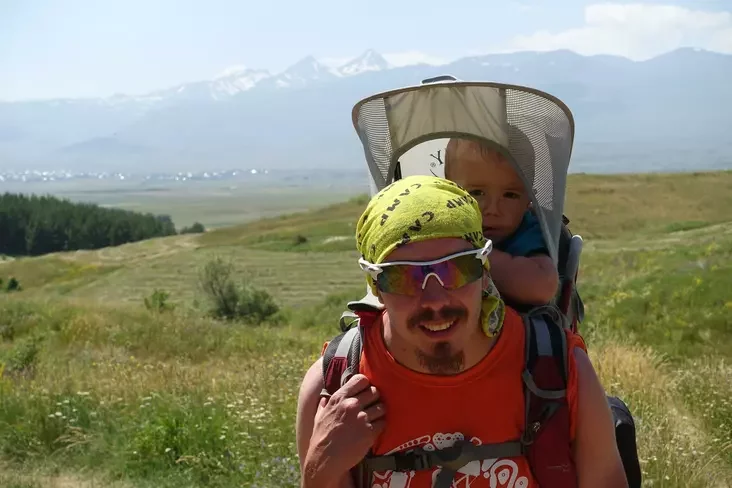
Raman in Armenia with his family
— We didn't climb higher than 2,500 meters with the child to avoid hypoxia, and the hardening turned out great.
Such a life schedule is possible due to the seasonality of an alpinist's work: from early spring to late autumn you work, in winter — you take care of yourself. Of course, work is also found in sub-zero temperatures: internal building finishing, snow removal from roofs. But seasonal earnings allow for a long break, and many do so.
There was a case when the man participated in a charity campaign in winter.

Father Frosts — professional alpinists
A deadly dangerous profession
Raman assures that the risk of injuring oneself tends to zero. With one big caveat: if safety techniques are impeccably followed.

During work
There are situations that cannot be predicted.
— This autumn in Belarus, our colleague, a 43-year-old man, died at work, leaving behind two underage daughters and a wife. We have a close community, we sent out a call in chats, collected money. One guy even raised the topic on a Russian forum, organized a fundraiser, and together we collected something around 120 thousand Russian [rubles]…
In any case, Raman does not regret choosing his profession. Once, he came here for the freedom that seasonality and high earnings provided. Now the market has dropped, taxes have risen, but the "spirit" of freedom remains. And he continues to work to live, not live to work.














"We invested a million dollars in Belarus." 94-year-old Nadzeya Zaprudnik — about her love for the country, life during World War II, and the trials of Belarusians



















Comments