


"Too Early" - "Too Late" - "Wait" - "No Appointment". Belarusians are furious over the orthodontist shortage
"Now bite problems are much more common than before: soft food, prolonged pacifier use, short frenulums. This is a complex generational problem." Meanwhile, queues for this type of dentist stretch for years, and there's no choice for either adults or children.

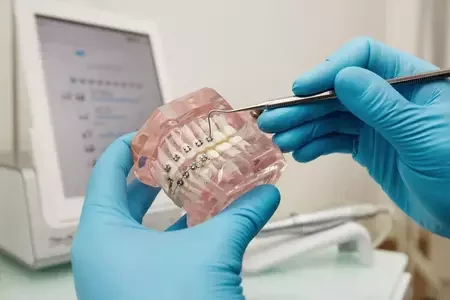
Illustrative photo: belstom.by
Orthodontics in Belarus today is not about the aesthetics of a smile. It's about patience, nerves, and the ability to wait a long time. Especially when it comes to children, for whom "waiting a few years" can mean losing the time when the problem could still have been solved more simply.
Getting to an orthodontist is like winning the lottery
Maryna (name changed) from Grodno long postponed braces; her crowded teeth didn't bother her much in life. But during a routine dental check-up, the dentist said something that resonated: an incorrect bite can lead to joint problems after 40 (including the temporomandibular joint - the joint connecting the lower jaw to the temporal bones of the skull, responsible for chewing, swallowing, and speech). As a result, Maryna decided: okay, I'll do it.
From that moment, her ordeal began.
In state institutions, she was referred to private clinics, and in private ones, appointments were "for later," and "later" meant six months or more. And even if you do finally get to an orthodontist, that's not a victory yet: first, diagnostics, X-rays, sanitation, consultations with related specialists (orthopedist, surgeon). Moreover, there is no choice of specialist; you're just glad to get in at all. As a result, more than a year can pass between the decision to get braces and their actual installation — simply because all stages have to be caught in the schedules.
This story is not just about Grodno. Reviews and discussions on social media reveal the same logic across Belarus: an orthodontist is a narrow specialist, appointments are scarce, queues are long, and treatment is lengthy.
"Waiting list for March 2026... In reality - for summer"
We looked at reviews for dental clinics. It's noticeable that when people write negative comments, they are most often related to the work of orthodontists. The most painful point is not the cost, but accessibility: phones are busy, administrators don't answer, appointments are booked months in advance.
In a review on 103.by for Grodno's "AxisDent," a person writes that they were offered to "be put on a waiting list for March 2026... in reality, it could be June-August." And even an accelerated examination in a complex situation couldn't be obtained.
The institutions themselves openly speak about problems with specialists. In a response from Grodno's "Ortadent" on 103.by, the administration directly explains: "We lack specialists to meet the needs of the population of Grodno and the Grodno region" — and because of this, appointments are stretched out.
On the page of Grodno's "Dentarium" on 103.by, a rather cynical response from a doctor to a request for help is quoted: "People walk around with crooked legs their whole lives, and it's fine."
Minsk and other cities: appointments 2 months in advance and everything through a waiting list
In Minsk, the situation looks better, but even here, you have to wait. On 103.by, in a review for Minsk's "Family Dentistry Center" (regarding pediatric orthodontic treatment), a person writes: "all appointments are booked two months in advance." And even those already undergoing treatment find it difficult to get an adjustment.
For highly publicized metropolitan orthodontists, the waiting list is generally 9-12 months.
Similar complaints exist in Brest, Mogilev, Gomel. Somewhere it manifests as a limit on appointment slots, somewhere as "appointments once a month." While Minsk still offers some choice, in regional centers it often boils down to the formula "wait or go to the capital."
For regions, in open reviews over the last year, a similar motif is often found not only about orthodontists but also about related dental specialists: waiting, postponements, "appointment cancelled."
For example, in Vitebsk on 103.by, a person writes that they waited five weeks for an orthopedist's appointment, and two days before, they were called and rescheduled — this happened several times. For a patient with braces, this is important, as orthodontists often require conclusions from an orthopedist and other specialists — and the chain falls apart at each link.

Illustrative photo: belstom.by
Not a child's problem
When an adult decides to get braces, they usually think about money and patience. When it comes to children, something else comes to the forefront — time. In fact, parents don't just need to find an orthodontist, but to understand who will take their child based on age and case — and still fit into the queue.
In January 2026, a post appeared on Threads that garnered dozens of comments. The author from Grodno writes:
"I've been calling different places (the same ones) for a year and a half, because they don't even book for a consultation. The situation is better in Minsk, but going there wasn't in my plans. Why are there so few orthodontists in Grodno?"
In response, people began sharing their own experiences. And this experience turned out to be surprisingly similar — regardless of the patient's age.
So, one mother writes:
"My daughter and I tried to book an appointment with an orthodontist at Horkaha Children's Hospital — that was quite a quest. About a year. We booked every month, and the rules changed every month."
First — "call only on the 25th," then — "call on the first of the month," then — "we'll book you for the next month." When they finally managed to get in:
"Three days later they call: the orthodontist quit. Then — our orthodontist went on maternity leave, another one quit."
As a result — an appointment that lasted three minutes:
"In 30 minutes, at least 4-5 people could have been seen. But no."
It becomes clear: there are few specialists, they work part-time, and schedules fall apart with every resignation.
Another characteristic phrase that parents often hear:
"We don't take children until all their permanent teeth have erupted."
At the same time, orthodontists themselves say that many problems need to be caught at 5-7 years old. In the comments, this looks like a vicious circle: "Too Early" - "Too Late" - "Wait" - "No Appointment."
Why is there a shortage of orthodontists?
In the same thread, a comment appears explaining the situation from the inside:
"To become an orthodontist now, you need to study for three more years. Then you absolutely have to work in a polyclinic. Many simply don't go into this specialization."
And yet — demand is enormous. Parents are willing to pay, travel, wait.
Another comment adds medical context:
"Now bite problems are much more common than before: soft food, prolonged pacifier use, short frenulums. This is a complex generational problem."
Adult patients describe a different, but no less exhausting, path.
In the comments, one solution constantly recurs — going to Minsk.
"I stopped bothering myself and booked an appointment in Minsk."
"I myself went to Minsk for three years."
"We didn't wait for the queue in Grodno — we went to 'Smartmedical' in Minsk."
But this is not always a solution: not everyone has the time, money, and opportunity to regularly travel to another city — especially when it comes to a child.
How much does it cost?
Even if you're lucky with an appointment, the next question is the cost.
According to clinics and 103.by data for 2025-2026:
- Orthodontist consultation — about 60-70 rubles;
- Children's mouthguard — about 500-530 rubles;
- Plates — from 180-450 rubles;
- Adult braces — from 1400 to 3400 rubles (not including adjustments and other procedures).
And all this against the backdrop of treatment stretching for years and requiring constant visits.
Why doesn't the queue disappear?
The orthodontist queue doesn't disappear because people suddenly decided en masse to fix their smiles. It's about the specific nature of this profession. An orthodontist is one of the "longest-term" specialists in dentistry: one patient stays with them not for one appointment, but for years. Braces, mouthguards, plates require regular adjustments, control, and observation. Therefore, even if no new people join the queue, the doctor's schedule is already filled with those who started treatment earlier and must come back again and again.
To this is added another factor: orthodontic treatment almost never starts immediately. It's always a chain of several stages — oral hygiene, X-rays, consultations with an orthopedist, sometimes a surgeon or an ENT specialist. Until the patient has seen all these specialists, the orthodontist cannot start. And getting to each of them quickly is a separate challenge, especially in regions where there is a shortage of staff.
And finally, another important point — there are truly few people in Belarus who have chosen orthodontics as a specialization. After 2020, Belarus experienced a wave of medical professionals leaving the country. Simultaneously, within the country, there were dismissals and pressure on medical professionals based on so-called unreliability. These processes could not but affect the system: the staffing base decreased, and new specialists are not keeping up with compensating for the losses.
As a result, the shortage of orthodontists is not a local problem of individual clinics. Overload, lack of specialists, and inability to take on new patients are openly stated by medical institutions themselves in their responses to patients. Experienced doctors leave, new ones don't come, and the queue, as a result, doesn't move — it simply stretches out in time.
«Nasha Niva» — the bastion of Belarus
SUPPORT US






















Comments
Спроси об этом у Луя. Ему специалисты были не нужны. Теперь вот шарики запускает туда, куда они все уехали. Там наверно листовки, вернитесь обратно, я все прощу.
мне кажется, это часто надуманная проблема красоты. У моей племянницы в германии небольшая щель (наследственная от отца), многие годы носила брекеты. Алла Пугачева со щелью годами пела, никто тогда брекеты не ставилпо такой проблеме.