


"If you refuse, you'll go to pre-trial detention." How "charity" donations are collected from political detainees in Belarus
Since summer 2025, the practice of so-called "charitable contributions" to state organizations has spread among political prisoners and their relatives in Belarus. These contributions are proposed to be made before trial or at the detention stage — with the hope of mitigating the sentence or stopping criminal prosecution. Facts of such transfers are indeed attached to case materials as mitigating circumstances, however, it is unknown whether they have a real impact on the sentencing, writes "Viasna".

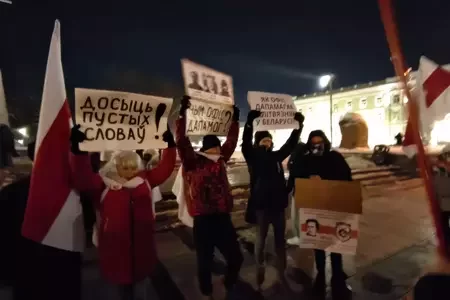
Illustrative photo. Photo: Lookby.media
"I don't know if it influenced my case. Probably not."
Since summer 2025, relatives of political prisoners have actively started making "charitable contributions" to state organizations. For this, before trial, one must choose an organization and transfer money to its account on behalf of the prisoner. In court, the fact of the transfer, and in many cases along with a heartfelt confession, is counted as "mitigating circumstances."
Initially, requests from political prisoners to engage in charity began to arrive in letters, then through lawyers. Now, this has become widespread, as it gives people hope for a reduced sentence. Previously, this was mainly done by relatives of those involved in the "Hayun case," but later, relatives of those detained under other criminal articles also became interested.
However, as a defendant in the "Hayun case," whose family also made a "charitable contribution," noted, a sentence with such "mitigating circumstances" is a lottery. He himself was sentenced to "home confinement," but he knows of cases where deprivation of liberty was imposed under similar circumstances:
"None of the authorities offered me to make a transfer. Simply at some point, information started circulating among the arrested, as I understand it, through lawyers, that it is better to pay before court and attach the payment in court. It was as if investigators unofficially confirmed this to someone. They didn't openly ask for it. But this information circulated among the detainees.
While I was in detention, my family made two payments: the first to a medical institution, and the second to a social one. The choice was based on information circulating as rumors. But it was a voluntary contribution to charitable organizations.
I don't know if it influenced my case. Probably not. Because I know stories of people who also made similar contributions, but they were sentenced to real prison terms. So, it's unlikely that it was a key aspect."
In addition, the former political prisoner knows of a recent case where, after a person was allegedly detained for financing the Armed Forces of Ukraine, he was offered to make a charitable transfer to the account of the Zhyrovichy Monastery. After the money transfer, the person was released without a criminal case being initiated.
"They gave me a paper with an account number and a few days to pay."
Human rights defenders from "Viasna" know of a case where a detainee in the "Hayun case" was forced to make a "charitable contribution" so that he could be released without a criminal case. For one message to the "Hayun" bot, he was offered to transfer several thousand dollars to the "Republican Center for Medical Response Organization."
"They told him: 'If you don't come yourself tomorrow, we will come for you.' There they said briefly: 'If you refuse, you'll go [to pre-trial detention] immediately.' Then they gave him a paper with an account number and a few days to pay, and if he didn't bring it, there would be all the consequences. He paid. No papers were given as a result, only a verbal agreement: if he pays, they will forget about him," a source familiar with the detainee's situation told "Viasna."
After the money transfer, the man is at large.
"Looking at what is known about the Hayun cases, 'charity' has no influence on the sentence."
Another source told human rights defenders about forced "charitable transfers"; this source's acquaintance was convicted in 2025 for comments. According to the source, the person was forced to transfer money twice:
"Upon detention, GUBOPiK (Main Directorate for Combating Organized Crime and Corruption) forced [him] to deposit a significant portion of his cash into the account of the state institution "Republican Center for Medical Response Organization." The rest of the money disappeared. There was no detention protocol. An official letter denying the initiation of a criminal case was received.
After detention, during the consideration of the criminal case, the Investigative Committee proposed through a lawyer to make another contribution. The person was in pre-trial detention; nobody is released home, which is a very rare occurrence.
Now, the "authorities" are informing the relatives of all political detainees to make these contributions. The court may recognize these as mitigating circumstances, but it has no obligation to do so.
We were lucky; they recognized it. The confession of guilt was also recognized as mitigating. But the sentence was still 5/6 of the maximum.
Looking at what is known about the Hayun cases, "charity" has no influence on the sentence. Money was proposed to be sent to the account of a state organization of one's choice, by the relatives of the suspect on his behalf, and then the transfer receipt was to be brought to the investigator or lawyer at the trial."
"Such payments serve as additional pressure."
"Viasna" lawyer Viktoryia Rudzenkova analyzed the situation with "charitable contributions" that detainees are forced to make by law enforcement agencies in some cases, and provided a legal assessment of it.
"So-called 'charitable' contributions are currently one of the most widespread economic forms of political repression in Belarus. Initially, this mechanism was developed for cases related to donations, but today, as we see, it is also used for other actions undesirable to the authorities that constitute a form of expressing opinion: both for 'offensive' comments and for sending information about military equipment on the territory of Belarus.
Such payments serve as a function of additional pressure (also on the person's entire family) and actual enrichment of the state at the expense of repression victims.
This practice violates a very wide range of human rights (freedom of property, freedom of expression, right to a fair trial, etc.), and at the same time has no legal basis in Belarusian legislation, despite the fact that law enforcement agencies cynically try to hide behind legal rhetoric.
First of all, from a legal point of view, so-called "charitable" contributions are not always charity in essence, because: a) in some cases, they are not made voluntarily, but for "refusal to initiate a criminal case," and b) in other cases, with the hope that thereby a political sentence might be less harsh, which is incompatible with the principles of legal certainty and predictability of criminal legislation.
Precisely because "charitable contributions" are not charity in their essence, they must be declared invalid by the court, with the subsequent return of funds to the person.
Here's how it looks under the law:
A donation is made within the framework of a civil law agreement (Part 1, Article 553 of the Civil Code recognizes a donation as the giving of an item or right for public benefit purposes), the essence of which is that a person voluntarily and gratuitously transfers property (including money) for socially useful purposes (Part 1, Article 543 of the Civil Code). Such a transfer cannot be accompanied by conditions, exchanges, or depend on receiving any benefit, especially personal freedom, mitigation of a sentence, or refusal of criminal prosecution (here we are dealing with Article 426 of the Criminal Code "Abuse of power or official authority").
In practice, however, we have "charitable" contributions made under duress, threats, or in situations of extreme vulnerability. From the perspective of civil law, such payments are agreements made without free will, and therefore invalid (Part 1, Article 108 of the Civil Code). Accordingly, under the Civil Code, they can and should be declared invalid by the court, with the subsequent return of funds to the person from whom they were illegally collected."
What kind of organization is it to whose account security forces suggest making contributions?
According to "Viasna," security forces in some cases suggest transferring money to the "Republican Center for Medical Response Organization." Since 2021, Dzmitry Alkhavik has been the head of the state institution. Before that, he worked as the head of the military medical department of the Ministry of Defense of the Republic of Belarus.
According to information on the center's website, the institution accepts gratuitous aid to its account, including from European countries and private individuals from abroad (as of 2025).
Now reading




















He bequeathed Karina Shuliak 50 million, and her father flew with him on a helicopter a month before his arrest. What else became known from the Epstein files













Comments